Friday, September 27, 2013

WNTV Blog For AM Saturday, September 28th: Weather Maps Waking Up

Fall Color Update
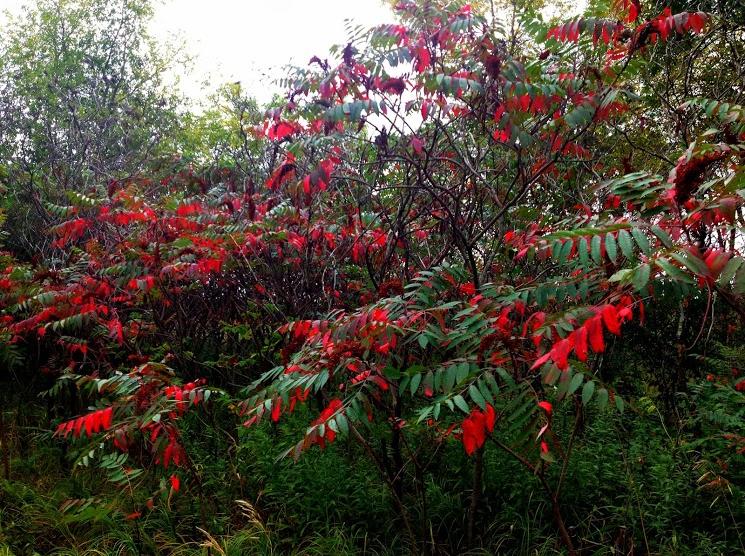
Those fall colors are starting to pop! One of my favorite things to see early in the season is the sumac. I love the bright red along the road. I had to stop and take a picture...


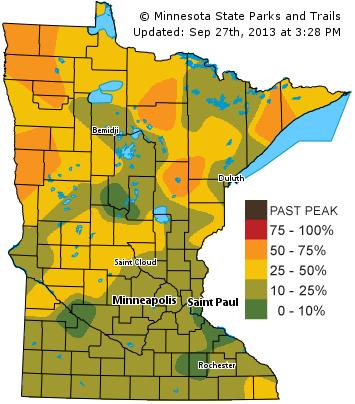
If you haven't seen the Minnesota DNR Fall Color Update page, check it out! It's filled with up to date information and pictures from state parks all over the state. According to the MN DNR, some across northern Minnesota are at 50% to 75% of peak color.

See the MN DNR website HERE:


Winter Camping in Autumn?
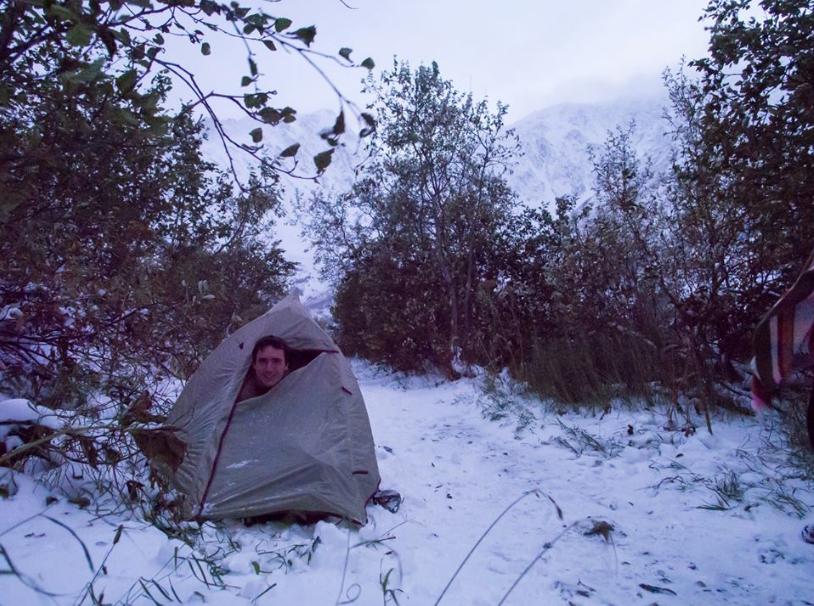
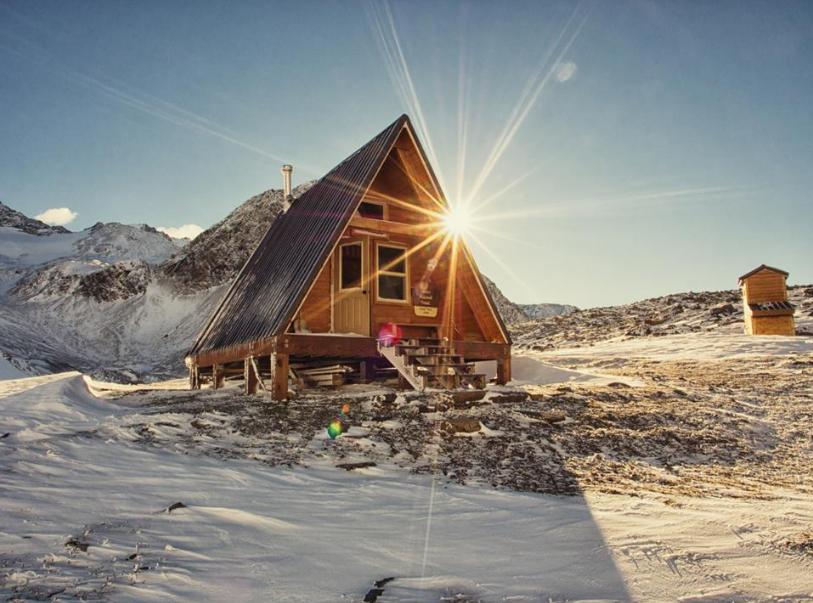
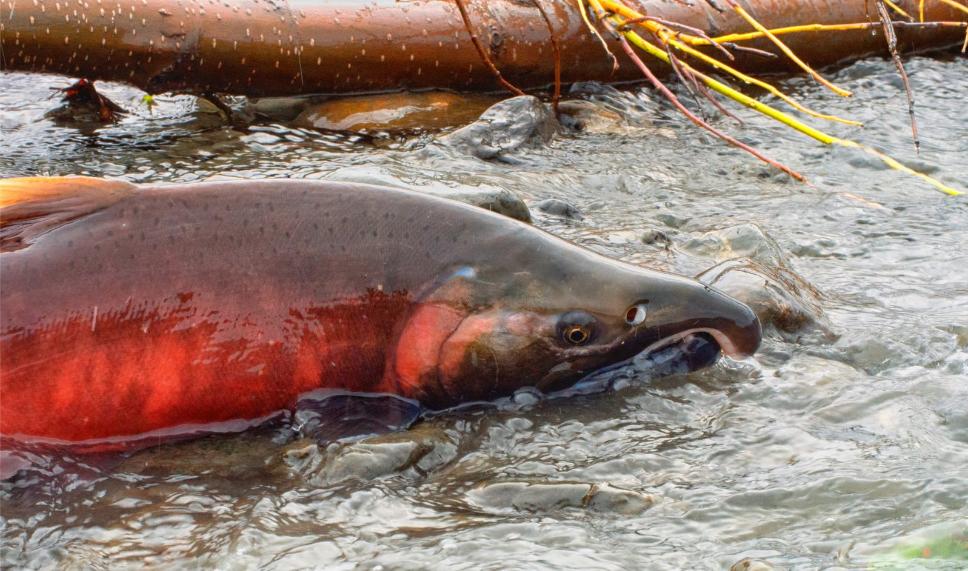
Thanks to my good friend, John Thain, for the pictures below who is truely an adventurer! Originally from Minnesota, he took a photography job at a news station in Alaska a few years ago and struck gold. For someone that loves being outside and experiencing what nature has to offer, Alaska is quite a place. John says he went 'winter camping' in autumn... here are some of his amazing pictures!


Dusting Off The Snow Maps...
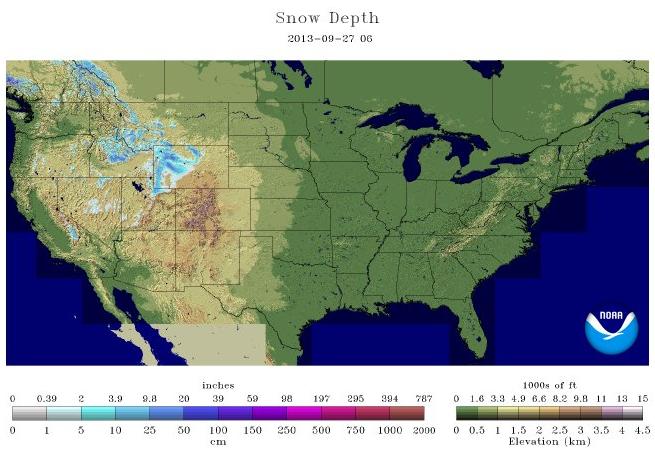
This is a map that we haven't seen much of lately... It's the national snow analysis map, which shows how much of the nation is reporting snow on the ground. According to NOAA, 3.7% of the nation was reporting snow on the ground, this mainly in the Rocky Mountains.


Soggy Saturday Ahead...
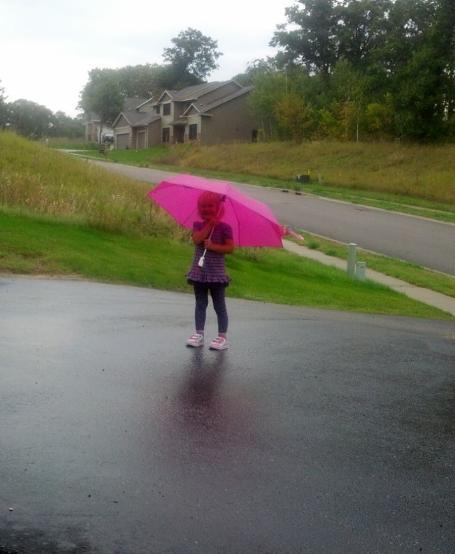
Thanks to my good friend Julie Ganfield for the picture below of one of her beautiful girls, who decided to make the most of Friday's soggy weather. The good news is that we need the rain. The bad news is that it'll continue into our Saturday, when most folks would want to get outside.


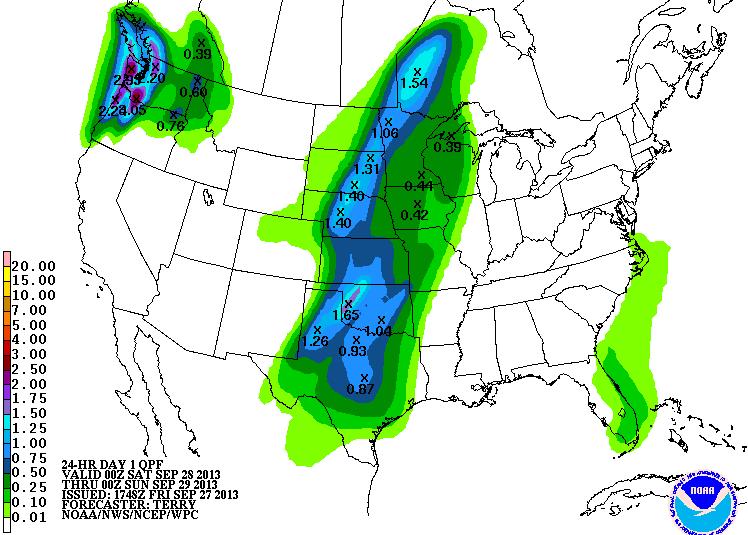
Saturday Precip. Potential
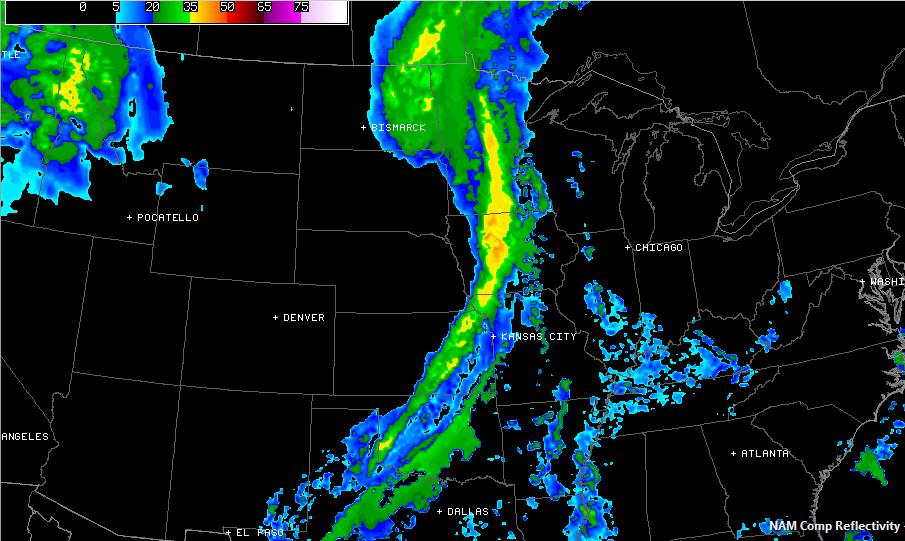
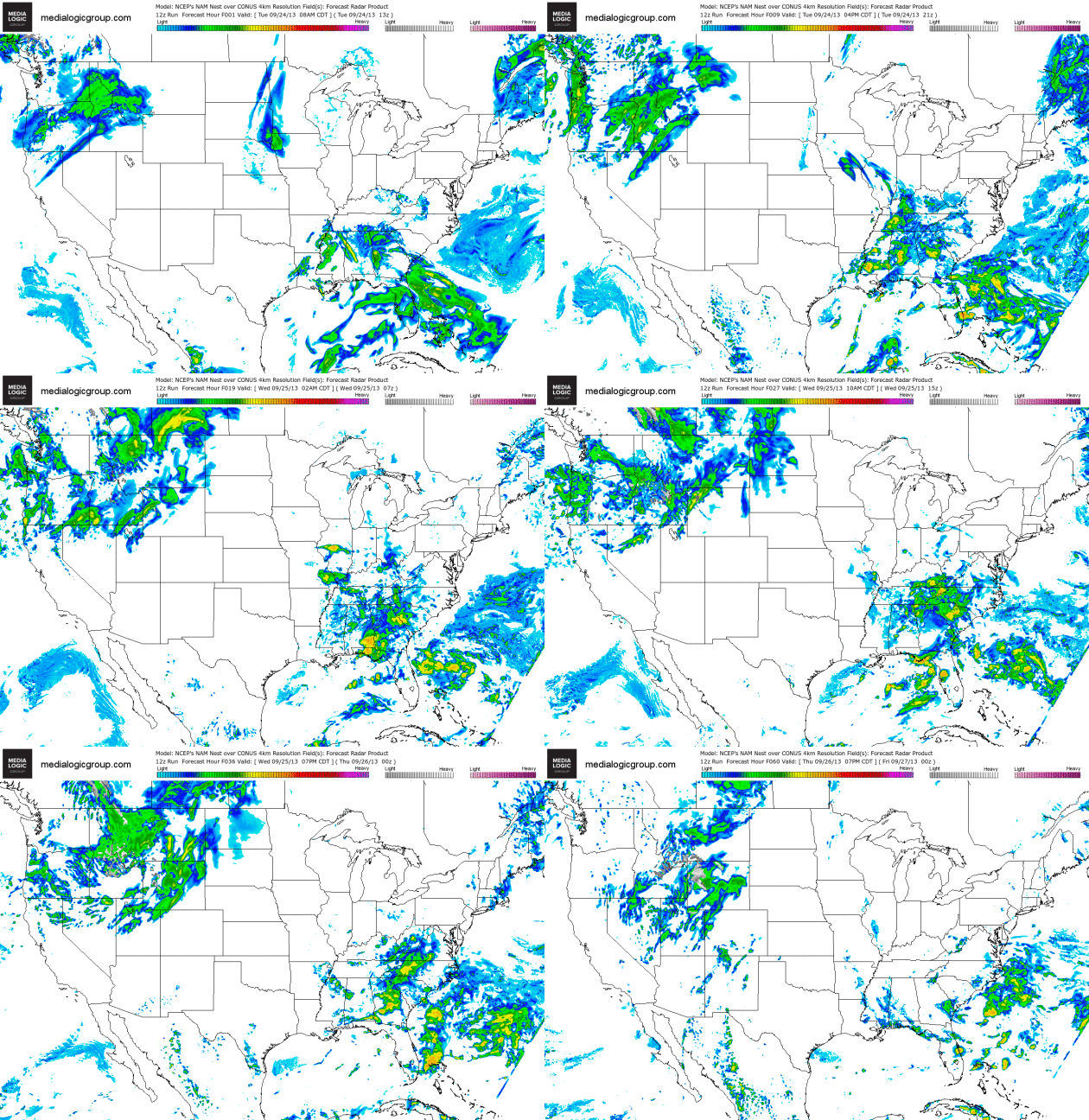
The storm system responsible for snow in the Rocky Mountains earlier this week will continue to slowly move through the Midwest on Saturday. Weather models project a fairly soggy start to the day across the Upper Mississippi River Valley. By PM Saturday, the front will move into the Great Lakes region with continued soggy weather their through the first half of Sunday. Below is the simulated radar by mid/late morning Saturday.


Accumulated (Saturday) Precipitation
According to NOAA's HPC rainfall forecast from 7pm Friday thru 7pm Saturday, some spots could tally nearly 1" to 2" across parts of the Midwest.


Anatomy of a Storm
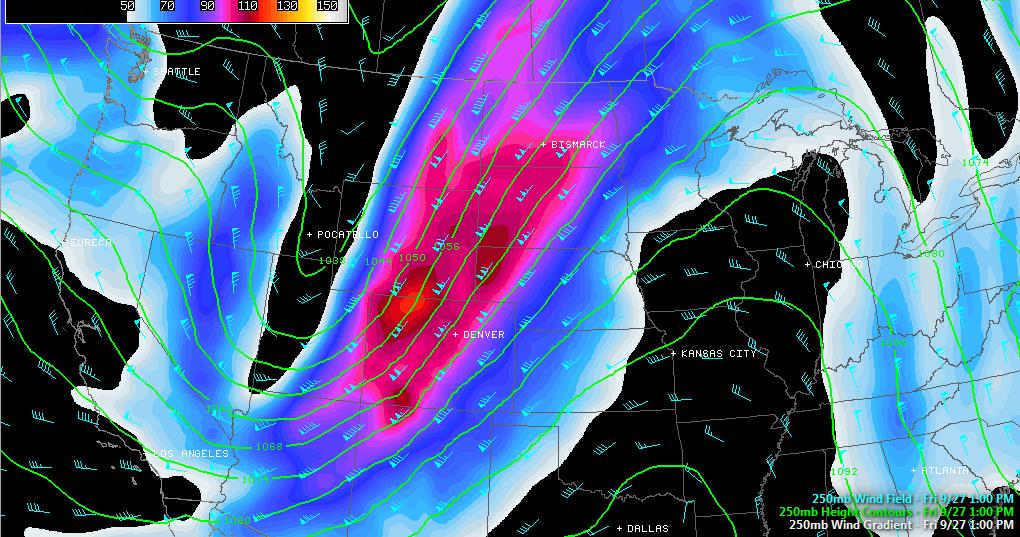
it's hard to imagine the atmosphere as a 3 dimensional fluid when we look at 2D maps all the time, but it's important to look at different slices of the atmosphere for different specific weather features. Our current storm system moving through the middle part of the country has a pretty interesting wind field and I thought I'd break it down for you to show you how winds change with height...

250mb Winds
This is the 'Jet Stream' level, which is a typical cruising altitude for jetliners. Note the big dip in the wind field in the western part of the country. This is called a trough of low pressure, which indicates 'stormy' weather. This is a favorable wind for a quick flight from back from Las Vegas to Minneapolis!


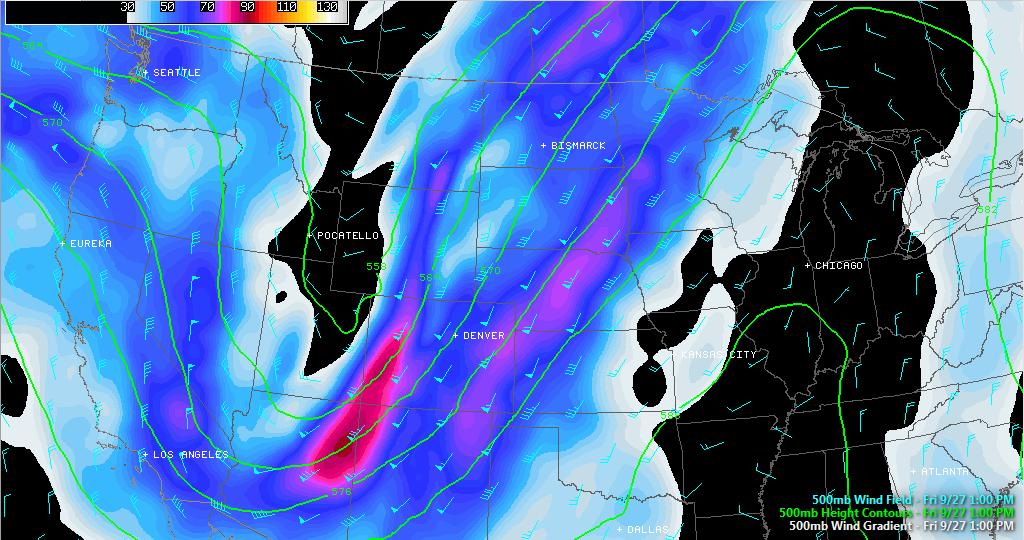
500mb Winds
At this level, wind speeds are quite as strong, but an area of low pressure may start to become a little more pronounced, which can be see closer to the UT/WY/CO border.


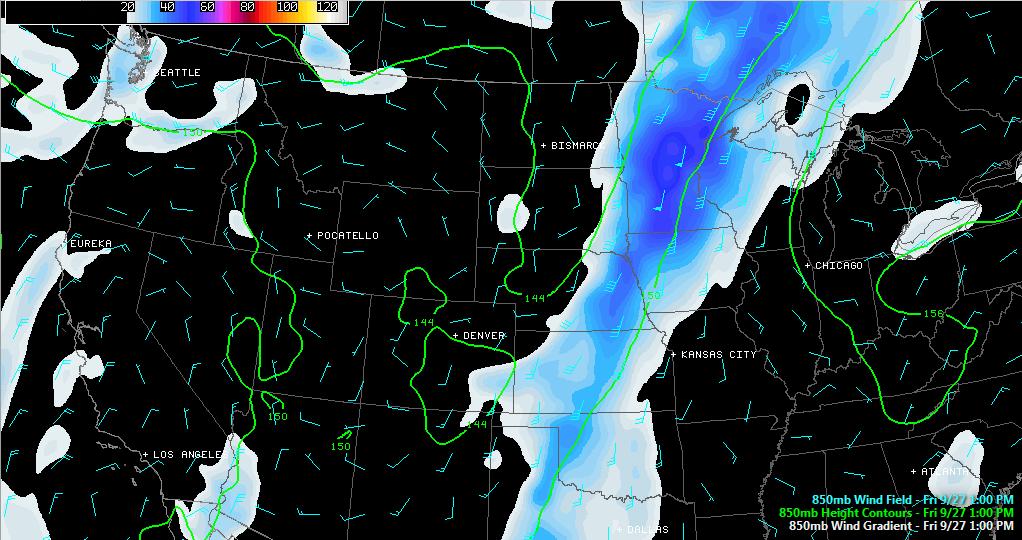
850mb Winds
In the lower part of the atmosphere, the winds taper quite a bit more yet, but notice how those 'stronger' winds are lined up a little more from south to north, rather than southwest to northeast. These are examples of wind shear, both speed and direction. In a convective or severe weather situation, this would help support longer lived, rotating, thunderstorms.


Surface Winds
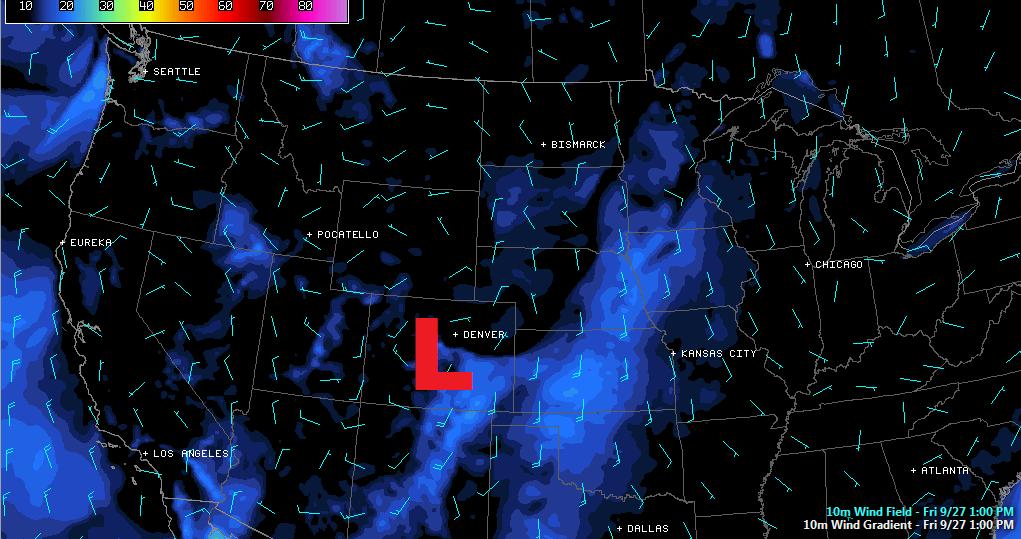
The wind shear becomes even more pronounced as you get to the surface. Not only do the winds lessen even more, but the wind direction becomes even more southerly, even southeasterly across parts of the Mississippi River Valley, this is due to friction or air resistance near the ground.


Surface Winds
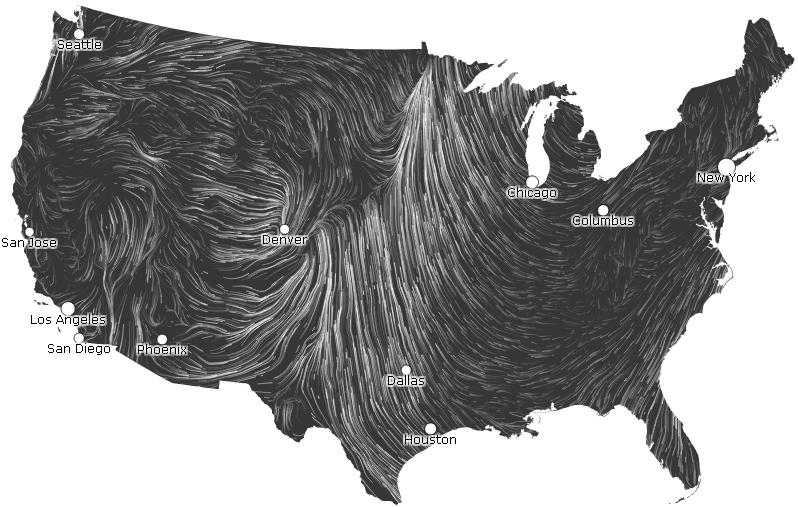
Here's a different visualization of the surface winds from hint.fm/wind/ - you can actually see the center of low pressure (counterclockwise winds) near Denver and the strong southerly flow out ahead of the storm.


East Coast Storm?
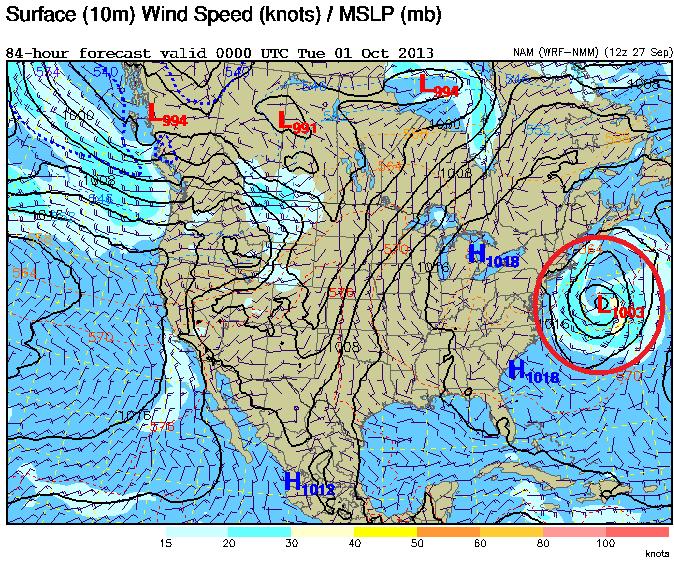
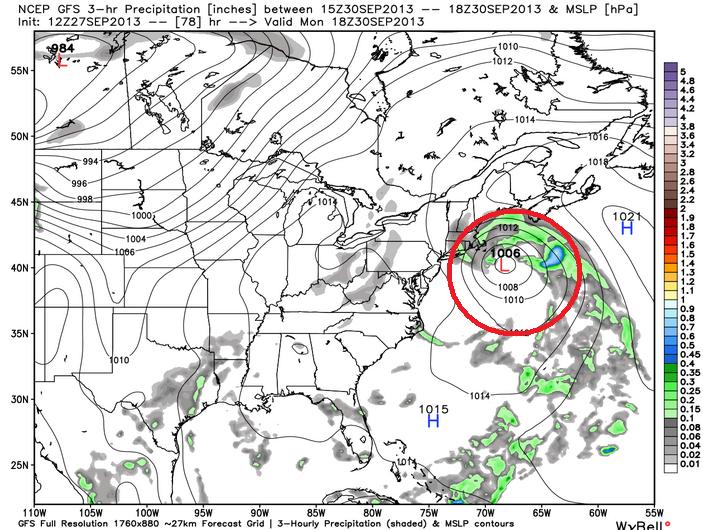
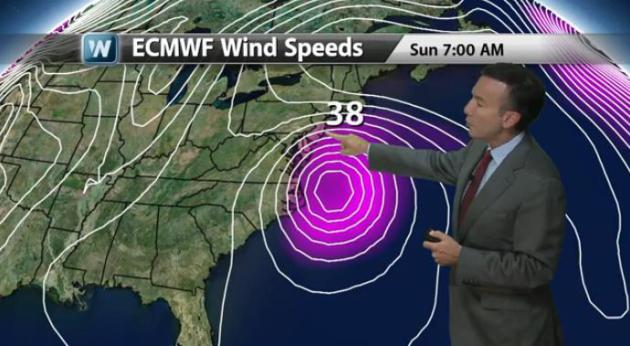
Weather models are still hinting at the potential of a developing coastal storm early next week from the Mid-Atlantic Region to the New England States. Here's a look at two different models, which show the center of the storm offshore, but close enough to bring gusty winds and precipitation into the region as we approach the start of October.

Here's the NAM for PM Monday (Sept. 30th), which shows a pretty decent area of low pressure offshore. The wind field would be large enough to bring gusty winds into the Northeast.


Here's the GFS solution by midday Monday, which also shows the stronger area of low pressure offshore, but close enough to bring gusty winds and precipitation into the area. This will be a storm to watch and much dependent on how close it gets to the East Coast.

(image courtesy: WeatherBell)


A More Substantial Cold Front...
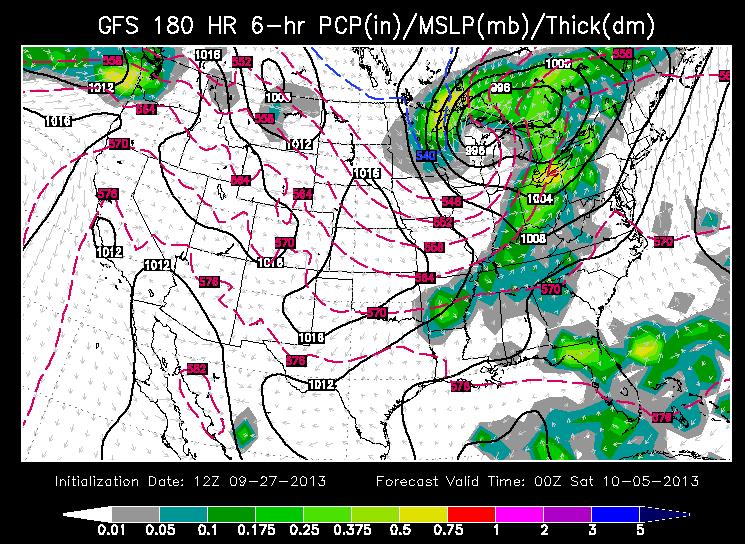
Take a look at this, the GFS for late next week suggests another storm system over the midwest with cold enough air for the potential of flurries near the border?? It's definitely a ways into the future, but it'll be interesting to see how the models handle this particulra storm if it in deed develops. The image below suggests that infamous "540" line or freezing line dipping into the Lower 48 into Minnesota and Wisconsin by next Friday. It wouldn't be a for sure thing, but there certainly could be a few snow flurries and mix in with the light rain across the northeastern part of Minnesota if current trends hold.


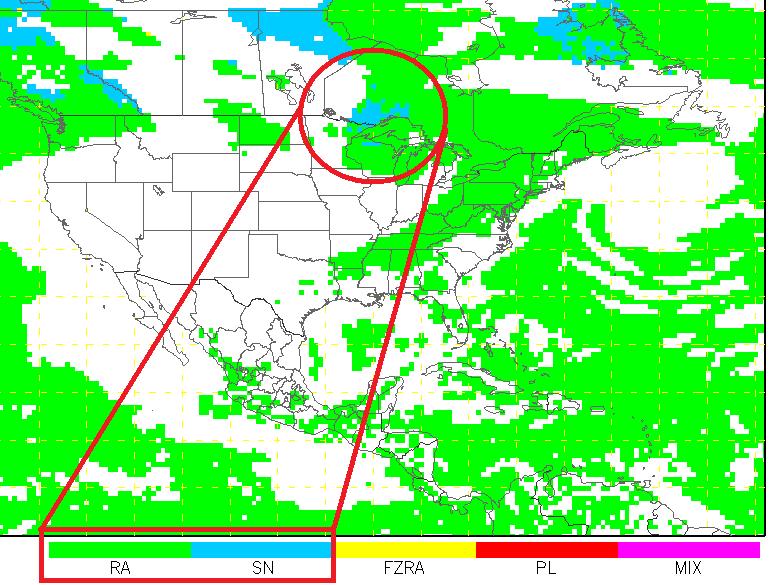
The image below shows the GFS' solution for precipitation type next Friday night. Note how it shows green and blue near the northeastern part of Minnesota, which correlates with the "540 Line" - Stay tuned for further updates.


Thanks for checking in, have a great rest of your weekend.
Don't forget to follow me on Twitter @TNelsonWNTV

Wednesday, September 25, 2013

Soaking Rains Push Into Pacific Northwest (coming soon: E1- E4 wildfire rating scale?)

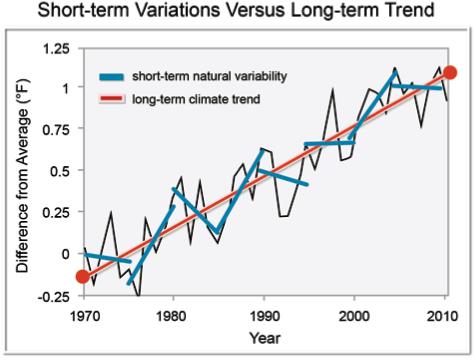
What "Pause?" Short-Term Variations Versus Long-Term Trends. Nature (and science for that matter) rarely move in a perfectly straight line. Here's an explanation from NASA: "Short-term trends in global temperature (here, the blue lines that show temperature trends at five-year intervals from 1970 to 2010) can range from decreases to sharp increases. The evidence of climate change is based on long-term trends of 20-30 years or more (red line)." Measurement data from NASA-GISS.


The Present

Every day is a gift - that's why they call it the present. "Look for the good in everything and everyone" my late mom said, with a grin and a sigh. Some good advice. Drought aside, we're blessed with some of the best weather in America floating above our heads.
San Diego, without the smog and soul-crushing traffic.

A late-season summer swoon spills over into next Tuesday with 70s every day, a good 5-15 F. above average the next 7 days.

Reality check: nearly 2 inches of snow fell on September 26, 1942. On this date in 1965 the low temperature was a crisp 27F. No, I don't take a bug-free 78-degree blue-sky day in late September for granted.

For the record, much of the MSP metro sees the first frost by October 7; the first hard freeze (colder than 28F - cold enough to end the growing season) by October 20.

Long-range models hint at frosty suburbs by October 6; a better chance of frost the second week of October.

But you can expect low 80s today & again Friday. Classmates and co-workers may go missing, a rash of inexplicable "sick days".

Right.

Models print out a little rain Saturday (enough to keep the dust down) but no big storms are brewing. By mid-October it should be cold enough for flurries up north.

Are you ready? Me neither.


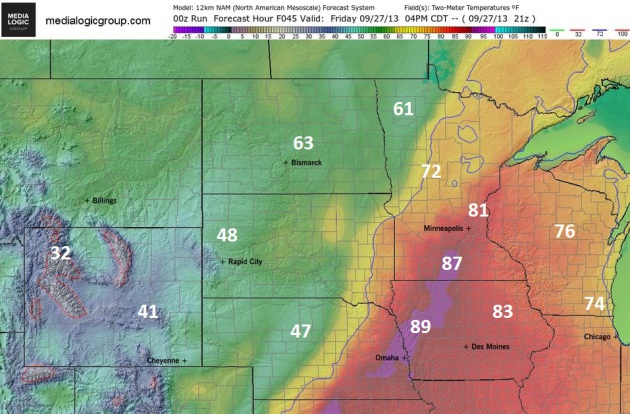
Summer Won't Let Go. The mercury may to 80F this afternoon, low 80s tomorrow if the sun is out for a few hours midday and afternoon; the last 80-degree day in sight for the Twin Cities. Friday highs hold in the 60s over the Red River Valley, 30s and 40s showing up as close as Wyoming and Colorado. 4 PM NAM predicted temperatures on Friday courtesy of Ham Weather.

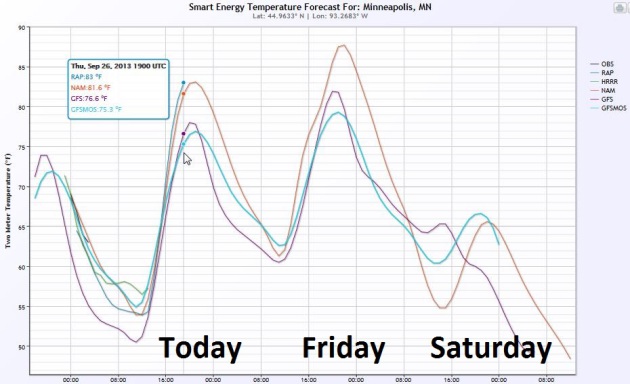
Warm Spikes. Model plots from Smart Energy show highs close to 80F today, maybe a couple degrees warmer on Friday before we cool down into the 60s on Saturday.

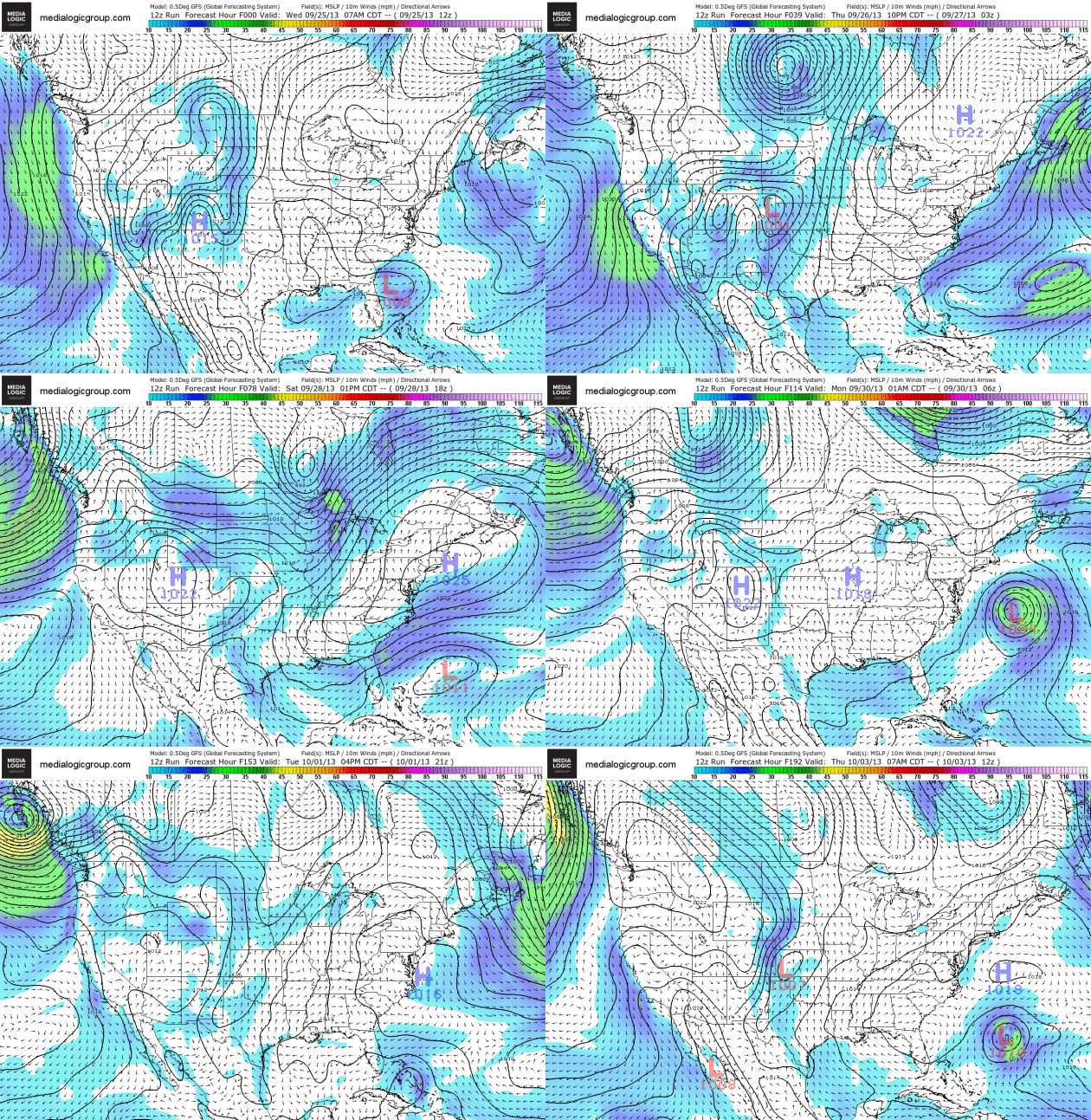
7-Day Trend. GFS data shows the storm that soaked Florida spinning up over the Atlantic - staying well offshore, whipping up 40 mph winds for Bermuda, maybe some major swells for Long Island and Cape Cod by Monday. The Pacific Northwest sees very heavy rain with some potential for flooding, while the northern USA cools down closer to average. Animation: Ham Weather.

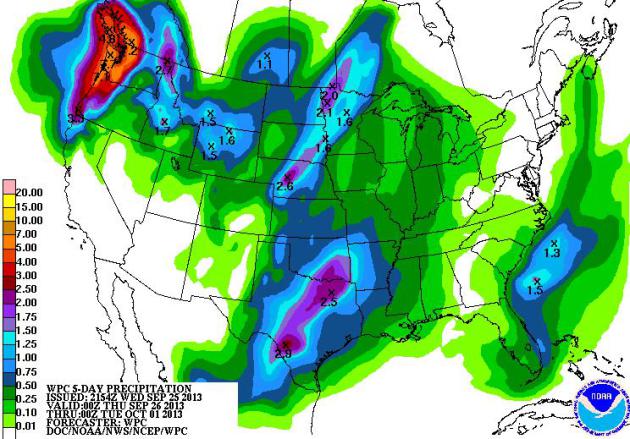
5-Day Rainfall Potential. The Pacific Northwest picks up 3-6" of rain by Tuesday - I could see some street and urban flooding from Portland to Seattle. Heavy rains soak much of Texas, while the Southwest stays dry. Map: NOAA.

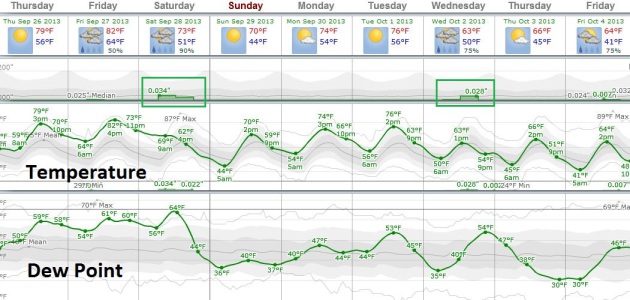
Lukewarm Into Early October. The Twin Cities cool off a bit on Saturday with a chance of showers, before warming back up into the 70s early next week. ECMWF data shows the best chance of showers Saturday, again Wednesday of next week - but not the soaking we need right now. Graph: Weatherspark.

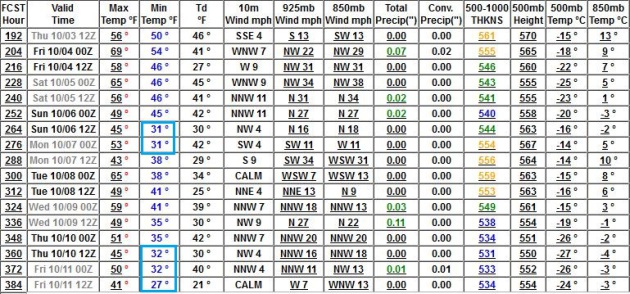
Frosty Possibilities. I don't see much of a chance for frost in the MSP metro area until October 6-7; an even better chance the second week of October, based on the latest GFS numbers.

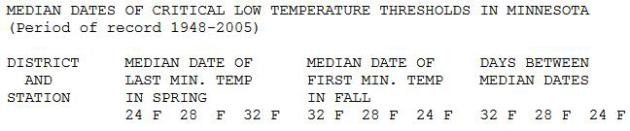
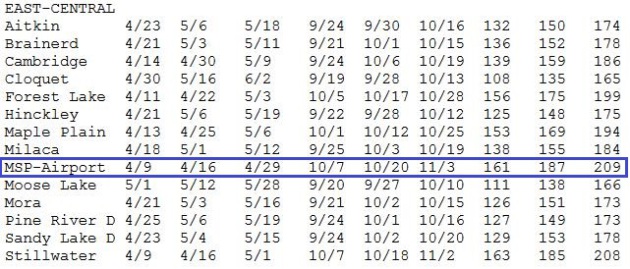
Average First Frost. Here is a portion of a table provided by the Minnesota Climatology Working Group, showing the average (median) date of the first 32F and 28F temperature at various locations around the Twin Cities. You can see what a difference the urban heat island makes with frost. Cambridge normally sees the first 32F low by September 24, but MSP International doesn't see frost-worthy conditions until October 7, on average.

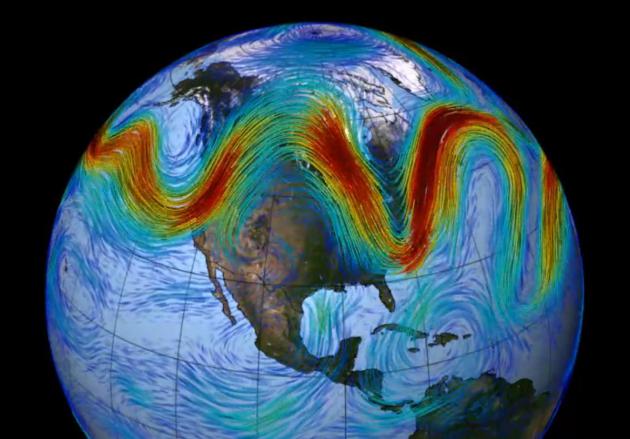
Wild Weather Tied To Unusual Jet Stream Activity. I've been talking about this, ad nauseum, for nearly a year now. We're witnessing more "polar amplification", more extreme north/south swings and dips in the jet stream than average, with (apparently) a greater potential for systems to become "cut off", temporarily stalled, amplifying floods (and drought). Here's a clip from a good explainer at NPR: "...But this year, the jet stream has been making surprisingly dramatic swings to the north and south. And it also has split into two separate streams, says , a research professor at Texas A&M University and the Texas state climatologist. Back in May and June the presence of this dual jet stream contributed to flooding in the northern Alps and in Alberta, Canada, Nielsen-Gammon says. "The flood conditions took place in between the two jet streams, where weather patterns tended to move relatively slowly because they weren't being carried along by the upper-level winds," he says. During the summer, the double jet stream produced a very strange temperature pattern along the Pacific coast, Nielsen-Gammon says. Down in Southern California it was unusually hot — in Death Valley the temperature reached 129 degrees. Meanwhile, up in British Columbia, it remained unseasonably cold..."

Image credit above: NASA Goddard Space Flight Center.

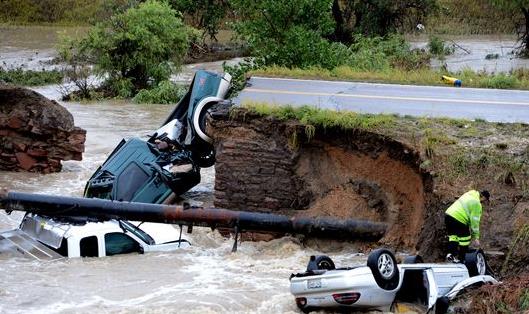
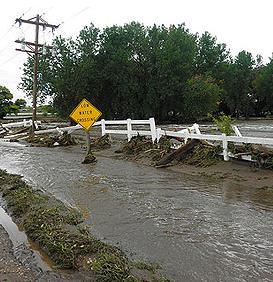
Report: Colorado Flooding Was "Unprecedented". Details from USA Today; here's an excerpt: "The flood that ravaged Colorado earlier this month was "unprecedented," according to a preliminary assessment issued by government and university scientists Wednesday. The report, which also stated that the flooding was "probably unmatched in at least 35 years," was prepared by the Cooperative Institute for Research in Environmental Sciences (CIRES) in Boulder, Colo. The institute includes scientists from the National Oceanic and Atmospheric Administration, the University of Colorado and Colorado State University. "In the context of the entire Front Range this was a rare precipitation event, especially for September, and in some respects unprecedented," the assessment states..."

Photo credit above: "A bridge collapsed after flash flooding at the Broomfield/Lafayette border in Colorado on Sept. 12. The flooding in Colorado earlier this month was "unprecedented," according to a report." (Photo: Cliff Grassmick, AP)

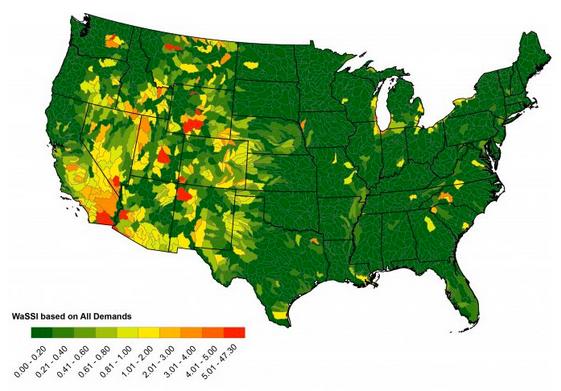
Nearly 1 In 10 U.S. Watersheds Is "Stressed"; Demand For Water Outpacing Supply: CIRES Study. Water, not oil, will quickly become the most precious natural resource in the 21st century. Here's a clip from a Huffington Post story: "Nearly one in 10 watersheds in the United States is "stressed," with demand for water exceeding natural supply -- a trend that appears likely to become the new normal, according to a recent study. "By midcentury, we expect to see less reliable surface water supplies in several regions of the United States," said Kristen Averyt, associate director for science at the Cooperative Institute for Research in Environmental Sciences at the University of Colorado-Boulder and one of the authors of the study. “This is likely to create growing challenges for agriculture, electrical suppliers and municipalities, as there may be more demand for water and less to go around...”

Graphic credit above: "CIRES produced a map illustrating all of the stressed watersheds in the continental United States, with colors from light green to red indicating increasing levels of stress."

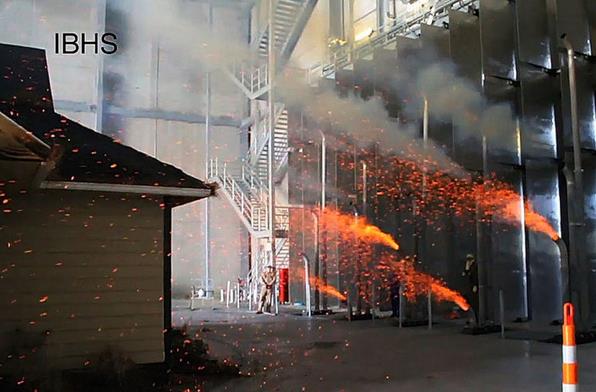
Scientists Developing "Richter" Scale For Wildfires. We have a scale from 1-5 for hurricanes, 0 to 5 for tornadoes, some NWS offices are experimenting with winter snow/ice scales from 1-5; why not a similar scale for rating wildfires? Here's a clip from The Santa Fe New Mexican: "...The National Institute of Standards and Technology hopes its Wildland Urban Interface Hazard Scale will tell residents the likely intensity of a wildfire burning into their neighborhood. The scale would allow city planners to assign better building codes for the millions of people who live in fire-prone areas in the West and would also measure how those homes could contribute to the spread of a fire. The proposed scale would range from E1 to E4 — with E4 being a location’s highest exposure to fire, be it from grasslands to a forest in a remote mountain canyon. Building codes and buffer zones between homes and forest could then be set accordingly..."

Photo credit above: "This frame grab from a 2011 video shows embers being shot at a structure during a test at the Insurance Institute for Business and Home Safety test facility in Richburg, S.C. The National Institute of Standards and Technology is developing the Wildland Urban Interface Hazard Scale to get a measurement of the intensity of a wildfire similar to the way officials use scales to measure hurricanes, tornadoes and earthquakes." Courtesy IBHS.

Atomic Goal: 800 Years Of Power From Waste. You have to give Bill Gates some credit for thinking outside the box (although MSFT could sure use him back in the saddle as CEO right about now). It's a technological breakthrough like this that may provide some truly viable (non-carbon) energy sources in the years ahead. High risk - high reward. Here's a clip from a New York Times story: "In a drab one-story building here, set between an indoor tennis club and a home appliance showroom, dozens of engineers, physicists and nuclear experts are chasing a radical dream of Bill Gates. The quest is for a new kind of nuclear reactor that would be fueled by today’s nuclear waste, supply all the electricity in the United States for the next 800 years and, possibly, cut the risk of nuclear weapons proliferation around the world. The people developing the reactor work for a start-up, TerraPower, led by Mr. Gates and a fellow Microsoft billionaire, Nathan Myhrvold..."

Outsourced...By Robots? The idea isn't as ludicrous as it sounds, in fact it's already happening. Which jobs are most at risk? Here's a clip from an article at Quartz: "...So, if a computer can drive as well as you, serve customers as well as you and track down information as well as you, just who is safe in their job these days? Careers at low risk of computerization are generally those that require knowledge of human heuristics and specialist occupations involving the development of novel ideas and artifacts. Most management, business, and finance occupations, which are intensive in generalist tasks requiring social intelligence, are still largely confined to the low-risk category. The same is true of most occupations in education and health care, as well as arts and media jobs..."

Photo credit above: "The new nine-to-fiver." Reuters/Gleb Garanich.

Tesla's Rise Forces Other Auto Makers To Up Their Electric Car Game. Will GM (or BMW for that matter) be able to catch up? Here is a clip from a story at The Daily Beast: "Cars can’t fly. But Tesla Motors, the electric sports car manufacturer, continues to defy gravity. Its stock has risen six-fold in the past year, giving it a market capitalization of $22 billion. That’s stunning, especially given that Tesla sells only about 2,000 cars per month and last quarter reported a $70 million profit. By contrast, GM, which sold more than 275,000 cars in August and earned $1.2 billion in the most recent quarter, has a market capitalization $51.8 billion—about 2.5 times that of Tesla. And Ford, which sold 221,270 cars in August, more than 100 times Tesla’s total, and notched a $2.6 billion profit in the most recent quarter and is valued at $68 billion, about three times what Tesla is worth. Put another way, these companies have more in profits each quarter than Tesla has in revenues..."
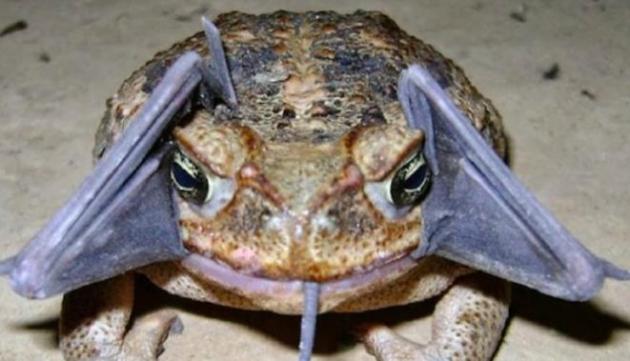
A bizarre image has emerged which originally lead people to believe that an alien toad had flown down to earth from the outer regions of space, but instead was simply a picture of a cane toad eating a bat.

Phil Torres, a naturalist who is based in Peru, brought the bizarre image to the attention of his followers thanks his blog post.

Read more at http://www.inquisitr.com/964037/alien-or-toad-frog-attempting-to-eat-bat-creates-bizarre-image/#Bl7YD3aY1f8Rj5wv.99Tesla's Rise Forces Other Auto Makers To Up Their Electric Car Game. Will GM (or BMW for that matter) be able to catch up? Here is a clip from a story at The Daily Beast: "Cars can’t fly. But Tesla Motors, the electric sports car manufacturer, continues to defy gravity. Its stock has risen six-fold in the past year, giving it a market capitalization of $22 billion. That’s stunning, especially given that Tesla sells only about 2,000 cars per month and last quarter reported a $70 million profit. By contrast, GM, which sold more than 275,000 cars in August and earned $1.2 billion in the most recent quarter, has a market capitalization $51.8 billion—about 2.5 times that of Tesla. And Ford, which sold 221,270 cars in August, more than 100 times Tesla’s total, and notched a $2.6 billion profit in the most recent quarter and is valued at $68 billion, about three times what Tesla is worth. Put another way, these companies have more in profits each quarter than Tesla has in revenues..."

Alien Bat-Toad? No, we're not being invaded by some new and horrific form of flying toad (to my knowledge). A perfectly reasonable explanation at inquisitr.com.


Climate Stories...


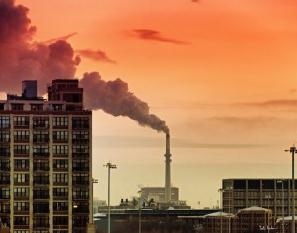
How Sure Is Sure? Scientists Like Certainty Of Global Warming To Deadliness Of Smoking. The Washington Post has the article - here's an excerpt: "Top scientists from a variety of fields say they are about as certain that global warming is a real, man-made threat as they are that cigarettes kill. They are as sure about climate change as they are about the age of the universe. They say they are more certain about climate change than they are that vitamins make you healthy or that dioxin in Superfund sites is dangerous...Some climate-change deniers have looked at 95 percent and scoffed. After all, most people wouldn’t get on a plane that had only a 95 percent certainty of landing safely, risk experts say. But in science, 95 percent certainty is often considered the gold standard for certainty..."

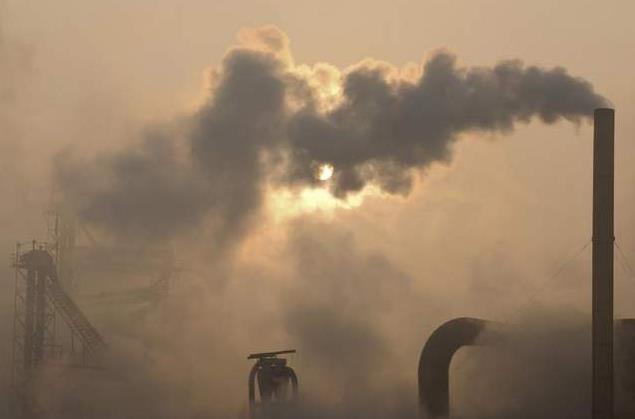
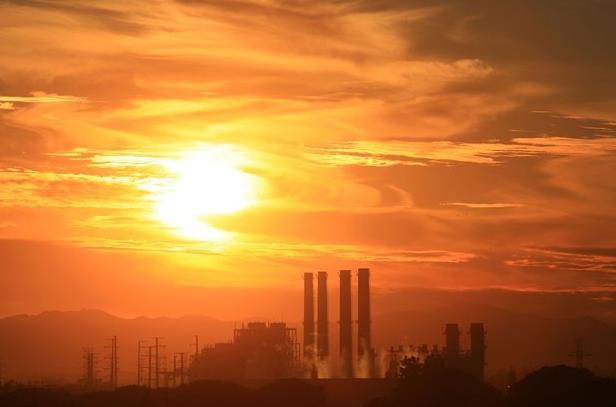
Photo credit above: Associated Press - FILE - "Smoke pours from a chimney at a cement plant in Binzhou city, in eastern China’s Shandong province, Thursday, Jan. 17, 2013. Scientists from around the world have gathered in Stockholm in September 2013 for a meeting of a U.N. panel on climate change and will probably issue a report saying it is “extremely likely” - which they define in footnotes as 95 percent certain."

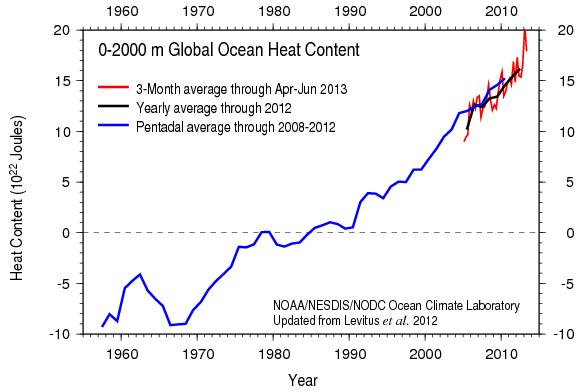
What Ocean Heating Reveals About Global Warming. More than 90% of warming is going into the world's oceans, and with the denial-sphere abuzz about the recent "pause" in the warming, here's a clip from a story at RealClimate: "The heat content of the oceans is growing and growing.  That means that the greenhouse effect has not taken a pause and the cold sun is not noticeably slowing global warming. NOAA posts regularly updated measurements of the amount of heat stored in the bulk of the oceans.  For the upper 2000 m (deeper than that not much happens) it looks like this (above). The amount of heat stored in the oceans is one of the most important diagnostics for global warming, because about 90% of the additional heat is stored there (you can read more about this in the last IPCC report from 2007).  The atmosphere stores only about 2% because of its small heat capacity.  The surface (including the continental ice masses) can only absorb heat slowly because it is a poor heat conductor.  Thus, heat absorbed by the oceans accounts for almost all of the planet’s radiative imbalance..."

Graphic credit above: "Change in the heat content in the upper 2000 m of the world’s oceans." Source: NOAA.

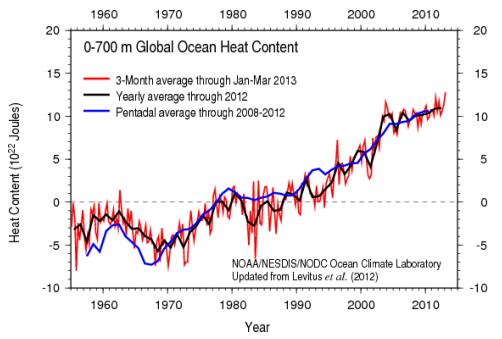
Does This Look Like A "Pause" To You? An estimated 2% of the sun's energy goes into warming the atmosphere, where temperatures have leveled off in the last 15 years, not warming as fast as during the 80s and 90s. But more than 90% of the energy goes into the world's oceans, where warming continues to accelerate. How this will manifest itself (other than helping to accelerate sea level rise) is still unclear, but no, the warming has not stopped. Image credit: "Change in the heat content of the upper 700 m of the oceans." Source: NOAA. More details below from RealClimate.

The Cost Of Climate Change. Models are fairly reliable, but there is no such thing as a perfect model. The truth: we don't know what we don't know. The rate of greenhouse gas release into the atmosphere is historically unprecedented (previous build-ups of CO2 and methane took thousands, even millions of years to unfold). We're in uncharted waters, scientifically, and we simply don't know if a continued build-up of heat-trapping gases will reach a tipping point, with unpleasant consequences. The New York Times has more: "...For instance, standard models used by scientists suggest that if the concentration of CO2 in the atmosphere were to rise to 700 parts per million, temperatures would rise some 3.5 degrees Celsius above that of the preindustrial era in subsequent decades. But there is enormous uncertainty about this. At that level, Professor Weitzman estimates there is an 11 percent chance that the temperature increase would reach or top 6 degrees Celsius. “That would melt west Antarctica and Greenland,” Professor Weitzman said. “It’s pretty scary.” There is no real precedent for this kind of climate change. The closest occurred in the Eocene era, more than 30 million years ago, when the earth was some 10 degrees hotter than it is today. Then alligators roamed near the North Pole..." (image: PBS).

Is Natural Gas "Clean"? Cleaner than coal, absolutely, but methane leakage from improperly sealed wells may be a factor in answering that question definitively. Here's a clip from The New York Times: "...To see natural gas as even semi-clean, then, you have to burn all you take out of the ground. Because at least one study found that if as little as 3 percent of the methane produced escapes, you might as well be burning coal, from a climate perspective. All that talk of a bridge to a renewable future … forget it. That’s why Anthony R. Ingraffea, professor of civil and environmental engineering at Cornell University, refers to natural gas as a “gangplank...”

Climate Uncertainty Is A Sign Of Good Science. Is science ever 100% certain about anything - or 100% settled? Science (and nature) rarely move in a straight line, and living with uncertainty is a part of life, and science it turns out. Here's an excerpt of an Op-Ed at Bloomberg: "...I recalled my friend’s odd logic amid the reaction to the most recent report from the Intergovernmental Panel on Climate Change. The report -- its contents were leaked in June, and it will be officially released this week -- concludes that it’s now 95 percent certain that human activity lies behind at least half the warming seen in the past half-century. Skeptics savaged the report for revising slightly downward earlier estimates of the warming likely to be seen in the next two decades -- as if trying to be accurate was an offense. The scientists behind the IPCC report actually deserve credit for acknowledging their uncertainty. We all have some lessons to learn about how poor a guide intuition can be in understanding the workings of the climate system..."

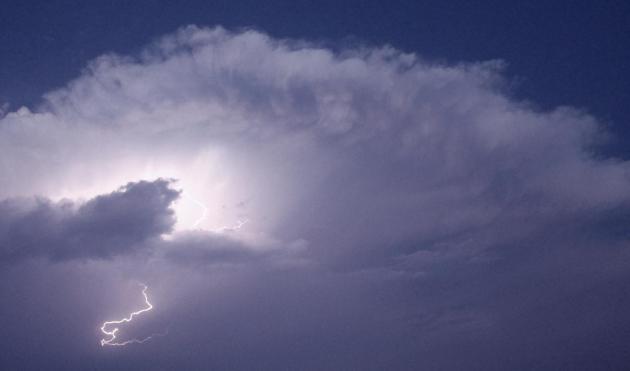
The Number Of Killer Thunderstorms Could Jump 40% By 2070. Quartz has the story; here's the intro: "That spate of destructive thunderstorms that struck the US last year, killing scores of people and racking up billions of dollars in damages? Get ready for more. A lot more. In a first-of-its-kind study published yesterday, scientists at Stanford University have linked climate change to the increasing frequency of such super storms. By 2070, the number of severe thunderstorms, which often spawn deadly tornadoes, could increase by 40% in the eastern US, according to the computer model developed by the Stanford scientists. Such storms typically are strongest in the spring, but as the planet warms, those storms will also increasingly strike in the autumn and the winter between 2070 and 2099, states the report published in the Proceedings of the National Academy of Sciences..."

Photo credit above: "Don't lose that last umbrella." Scott Eisen/AP.

Tuesday, September 24, 2013

Tracking a Potentially Significant (Hybrid) Nor'Easter For Early Next Week


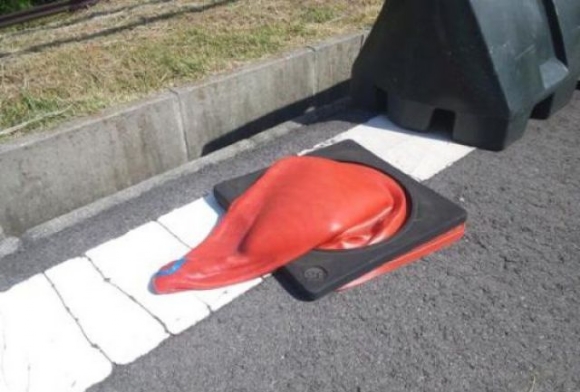
Orange Cone Alert

All this road construction almost makes me look forward to winter.

Almost.

I know - our highways don't repair themselves. MnDOT crews have a job to do, and they do it very well. Yesterday a quick 15 minute drive turned into an epic, 2-hour scavenger hunt. At least the sun was out.

When it comes to all things atmospheric I take NOTHING for granted. On September 24, 1985 half an inch of snow cheered up Twin Cities residents. Nearly 2 inches fell on September 26, 1942. No, I don't take 70s and low 80s in late September for granted.

NOAA's Climate Prediction Center is forecasting a milder than average October for Minnesota and much of the USA. Spring was chilly, snowy and wet - maybe autumn will balance things out.
I don't see any frost risk for the Twin Cities metro looking out thru October 10.

Temperatures warm into Friday (low 80s!) before an eastbound cool front sparks showers and T-storms on Saturday. Have a Plan B. Skies clear Sunday with highs in the upper 60s, closer to average.

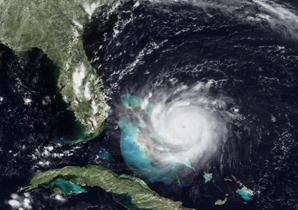
The same tropical swirl responsible for flooding rains over Florida may spin up into a formidable Nor'easter, soaking New England early next week.

While we enjoy the best week of autumn.

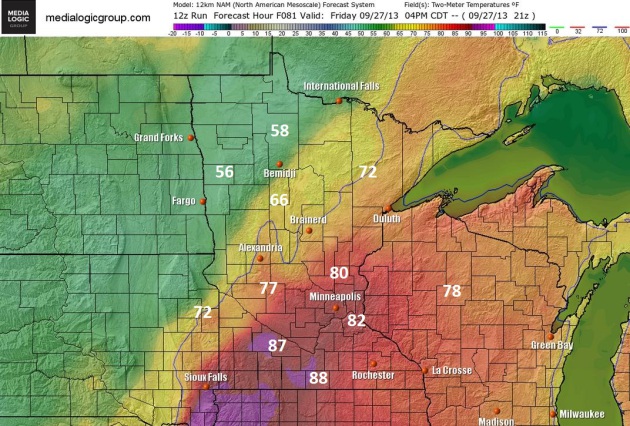
Shades Of Summer. NAM predicted highs nudge 80F in the Twin Cities, maybe some mid to upper 80s over southern Minnesota, while temperatures hold in the 50s and 60s north and west of Alexandria and Brainerd. Not bad for late September. Map above: Ham Weather.

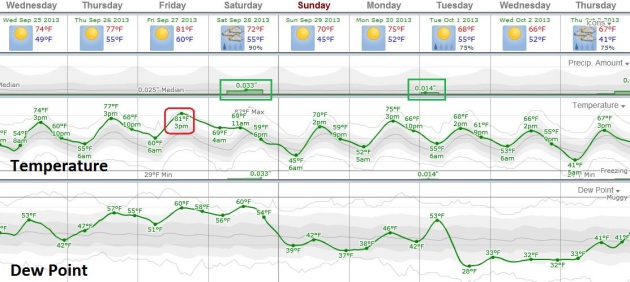
Mild Bias Continues. 80F or beyond Friday, a few more 70s the first half of next week? Not too shabby considering the sun is as high in the sky as it was in mid-March. ECMWF guidance shows only a small chance of (light) showers Saturday, again early Tuesday.

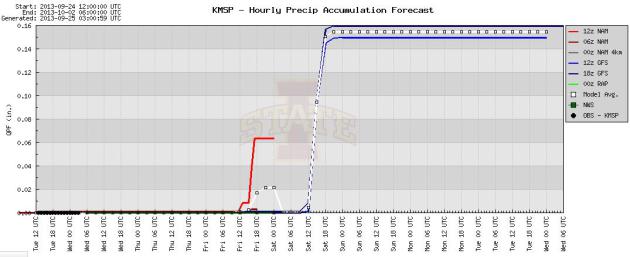
When In A Drought - Don't Predict Rain. Latest models show only light showers, possibly less than .10 or .20" rain late Friday into Saturday as a (slightly) cooler front approaches. Graphic: Iowa State.

NAM Solution. The 84-hour NAM shows a potentially significant storm brewing over the Southeast, while showers and T-storms push across the northern Rockies - most of the USA dry into Friday. Animation: Ham Weather.

Another "Hybrid" Nor'Easter? It's still early, but the same model that gave us an 8 day jump on "Sandy" last October is suggesting a robust East Coast storm early next week, possibly a mash-up of extra-tropical low pressure system and tropical storm, spiked with extra levels of moisture. Florida has seen soaking rains, and this tropical-depression-like system may mutate into something more as it hooks toward New England late Sunday and Monday. More details in today's edition of Climate Matters: "WeatherNationTV Chief Meteorologist Paul Douglas shows what some of the models are hinting at for the northeast. Nothing as bad as Sandy, but it is looking like a "hybrid storm" that we are beginning to see."

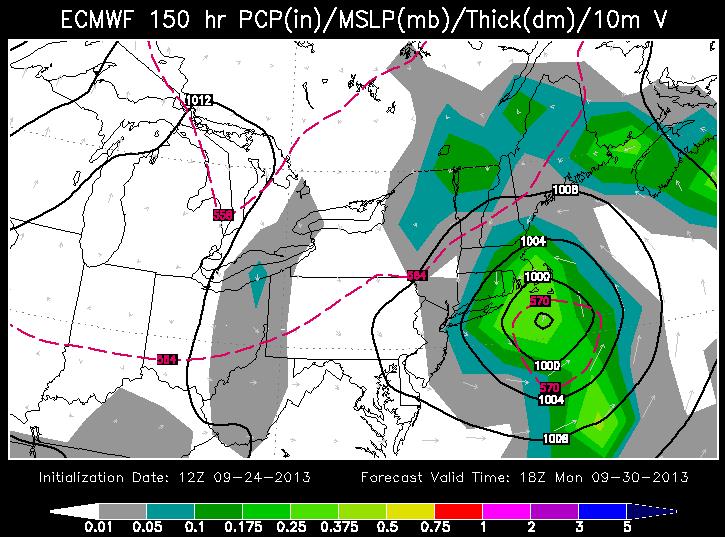
Significant Coastal Storm? Here is the ECMWF solution, valid midday Monday, showing a deep area of low pressure capable of some level of coastal flooding and potential beach erosion - heaviest rains from Long Island into coastal New England. We'll see. Graphic: WSI.

Nebraska Is Diverting Flood Water From Colorado. Details from KWGN-TV; here's the intro: "The Nebraska Department of Natural Resources, local natural resources districts, and irrigation districts in the Platte River Basin have taken steps to divert floodwaters out of the river as they moved into Nebraska from Colorado. These efforts consisted of developing agreements and coordinating the timing of the diversions of this flow in an attempt to attenuate the peak flood flows. The diversion of these floodwaters will have the added benefit of recharging the aquifer as these waters seep into the ground beneath the canals and lakes along the South Platte, North Platte, and Platte Rivers..."

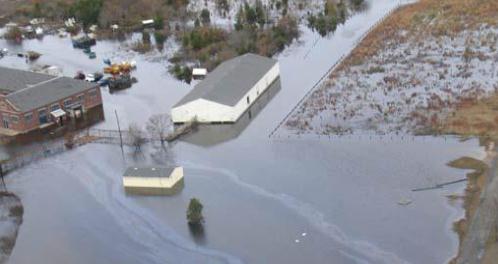
Flood Insurance: Costs Rising, Claims "Confusing". Many Americans are discovering, for the first time, that they now live in a flood zone. An apparent uptick in historic, 1 in 500 and 1 in 1,000 year floods is causing many to reexamine their coverage. CNBC has the story - here's a clip: "More homes and businesses In the U.S. are feeling the devastating impact of flooding, as was dramatically demonstrated in Colorado. But most households remain without flood insurance—and obtaining it may become more difficult. Only 18 percent of Americans have any kind of flood insurance coverage. For those who might want it, the price is about to go up. That's because subsidies to policyholders for the federal government's flood insurance program—the National Flood Insurance Program, which is nearly the sole provider of flood insurance—are to end Oct. 1..." (Image above: NOAA).

* Record June flooding in Alberta, Canada damage toll reaches $6 billion (Canadian). Details from Bloomberg.

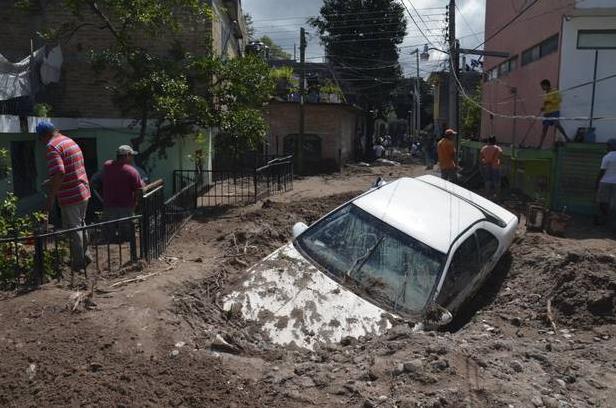
Survivors Recount Horror Of Twin Storms In Mexico; Death Toll Rises To 97. Here's an update on the two tropical systems that moved slowly enough to drop excessive rainfall amounts, capable of producing historic flooding. AP and The Dallas Morning News have the story - here's a clip: "With a low, rumbling roar, an arc of dirt, rock and mud tumbled down the hillside in the remote mountain village of La Pintada, sweeping houses in its path, burying half the hamlet and leaving 68 people missing in its mad race to the river bed below. It was the biggest known tragedy caused by twin weekend storms that struck Mexico, creating floods and landslides across the nation and killing at least 97 people as of Thursday — not counting those missing in La Pintada..."

Photo credit above: Alejandrino Gonzalez/The Associated Press. "A car lays buried in mud after flooding triggered by Tropical Storm Manuel as residents try to clean up their neighborhood in Chilpancingo, Mexico, on Thursday. Manuel, the same storm that devastated Acapulco, gained hurricane force and rolled into the northern state of Sinaloa on Thursday before starting to weaken."
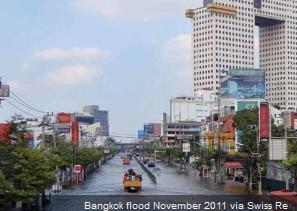
Which Cities Are Most At Risk For A Natural Disaster? This is one Top 10 List you don't want to be on, as explained at earthsky.org; here's a clip: "Swiss Re – the world’s second-largest reinsurance company, with headquarters in Zurich – has released results of a new study that looks at the human and economic risks from natural disasters faced by over 600 cities around the globe. The report is called Mind the risk: A global ranking of cities under threat from natural disasters, and it’s based on Swiss Re’s risk models and detailed available hazard data. Los Angeles is the only city in the U.S. that makes the top 10 list for “most people potentially affected” (aggregate risk of five perils including earthquakes, tsunamis, storms, storm surge and river flooding). After all, it has a large and densely packed population, located along the earthquake-prone Ring of Fire, on a coast. When you look at “working days lost,” however, San Francisco, New York, Paris and Amsterdam-Rotterdam also make the top 10 list..." (Image above: Swiss Re).

* the full 36 page PDF from Swiss Re is here.

Typhoon, Hurricane Or Cyclone: What's The Difference? Here's an excerpt of a good explainer from National Geographic: "...If you've never lived in Asia, you might be wondering what it feels like to experience a typhoon. But if you've ever survived a hurricane or cyclone, you already know the answer. That's because hurricanes, cyclones, and typhoons are all the same weather phenomenon. Scientists just call these storms different things depending on where they occur. In the Atlantic and northern Pacific, the storms are called "hurricanes," after the Caribbean god of evil, named Hurrican. In the northwestern Pacific, the same powerful storms are called "typhoons." In the southeastern Indian Ocean and southwestern Pacific, they are called "severe tropical cyclones..."
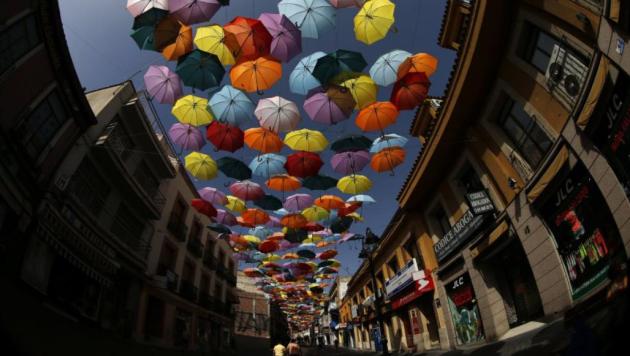
New Financial Umbrellas Keep Companies Dry When It Rains On Their Earnings. When in doubt blame the weather, right? But now companies can hedge their bets against inclement, potentially disrupting weather. Here is an excerpt from an interesting story at Quartz: "It has become more widely accepted that volatile weather is having an increased impact on corporate performance in a variety of global industries from retail and entertainment to agriculture and energy.  For example, recent retail and beverage earnings reports from Zara, Target,  and Coca-Cola highlight cold and rainy weather as two key factors that contributed to decreased customer demand for springtime goods. More broadly, a study from the National Center of Atmospheric Research estimates that in the US alone, economic activity can swing plus or minus $240 billion annually due to routine (as opposed to catastrophic) weather variability, depending upon whether or not the observed weather was favorable for business operations.  However, despite the clear relationship between weather and profits, the majority of weather-exposed businesses continue to retain weather risk rather than mitigate it...."

Photo credit above: "Sunny skies on the horizon." Reuters/Juan Medina.

Nasty Weather Plaguing NFL. Suddenly those domed stadiums are looking like a pretty good return on investment, as reported by NPR; here's an excerpt: "...Already, three games, including two in prime time, have been disrupted by weather issues, mostly lightning. Kickoff for the Ravens-Broncos opener to the season on Sept. 5 in Denver was delayed for 33 minutes. On Sunday, New Orleans' visit to Tampa Bay was interrupted for 69 minutes. And the showcase matchup of San Francisco at Seattle went through a one-hour delay in the first quarter Sunday night. Hardly ideal — for the teams, the fans, or the folks watching on TV. But necessary..."

How The NFL Fleeces Taxpayers. Hey, I'm just as excited about a new Vikings stadium providing an economic jolt of excitement in the heart of Minneapolis as the next guy, but this article at The Atlantic and BeyondChron made me do a double-take, with one hand on my wallet. Wait, the NFL is a tax-exempt "non-profit?" Yes, and I'm an aspiring Russian ballerina. Here's an excerpt: "...In Minnesota, the Vikings wanted a new stadium, and were vaguely threatening to decamp to another state if they didn’t get it. The Minnesota legislature, facing a $1.1 billion budget deficit, extracted $506 million from taxpayers as a gift to the team, covering roughly half the cost of the new facility. Some legislators argued that the Vikings should reveal their finances: privately held, the team is not required to disclose operating data, despite the public subsidies it receives. In the end, the Minnesota legislature folded, giving away public money without the Vikings’ disclosing information in return..."

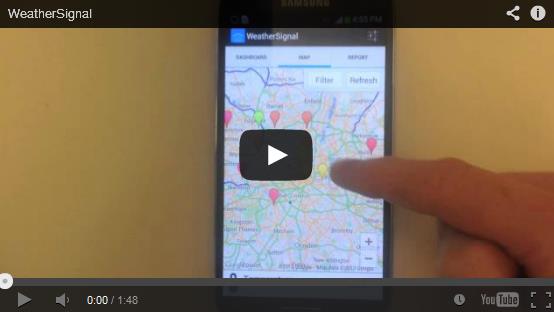
Your Phone's Battery Can Tell You Site-Specific Weather. Great, about to be replaced by a smartphone battery. That's the good news. Media Bistro has the details (and video clip): "We first brought you OpenSignal’s crowdsourced weather data from Weather Signal in May, but since then, the team have discovered that there was a correlation between your phone’s battery and the weather outside. It’s not black magic after all!..."

All I Want For Christmas Is A Shiny, New....Jetpack? Move over Buck Rogers - science fiction becomes reality (if the price is right and you have an extra 100K in your pockets). Details from Time Magazine: "...It doesn’t look much like a jetpack, does it? More like some far flung future mini-jet plane, the rounded nose pointed skyward, twin turbine-like 200hp engines strapped to either side, and you secured below, hanging out like the payload. It’s relatively small (and thus easy to deploy if you need to get in and out of small spaces), has an auto-hover feature, and includes both flotation capabilities and a ballistic recovery parachute that auto-deploys if the engines go kaput. It’ll probably cruise at 35 m.p.h. (with a top speed around 45 m.p.h.) and be able to travel a little under 20 miles (or 30 minutes) a shot..."

Photo credit above: Martin Aircraft.

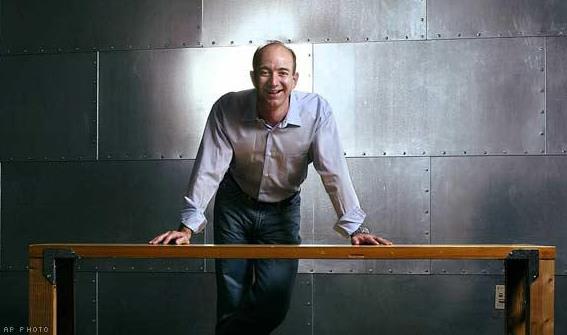
The 20 Smartest Things Jeff Bezos Has Ever Said. The founder of Amazon has way with business....and words. Here's an excerpt from The Motley Fool: "...Thank Amazon's quirky CEO, Jeff Bezos, for this success. He created a culture that's not only different from, but often totally at odds with, how most business leaders think. He's also quite quotable. Here are 20 smart things Bezos has said over the years. 1. "All businesses need to be young forever. If your customer base ages with you, you're Woolworth's."
2. "There are two kinds of companies: Those that work to try to charge more and those that work to charge less. We will be the second."
3. "Your margin is my opportunity..."

Photo credit above: AP.

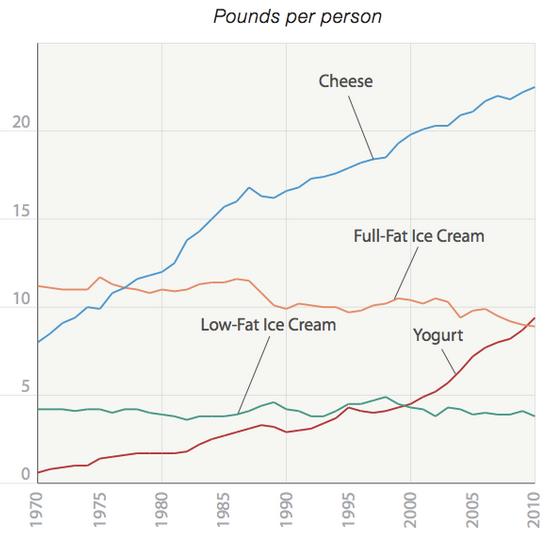
The Average American Eats Almost 3 Times As Much Cheese Today As In 1970. Let them eat...cheese? 23 pounds of cheese in 2013? That sounds about right. Here's an excerpt of an eye-opening article at The Atlantic: "Yesterday the Center for Science in the Public Interest released a "report card" on U.S. eating habits, entitled "The Changing American Diet." In The New York Times, Jane Brody called our performance therein a disappointment. That depends how you feel about D-pluses, I suppose, and cheese..."

Graphic credit above: Center for Science in the Public Interest.

Average Person Forgets 4 Things A Day: Study. Now this is in the UK, I'm sure our memories are much better over here in the states. Uh huh. Where am I again? The Indian Express has the details: "An average person forgets four key facts, chores or events every day, while trying to keep up with the demands of a hectic lifestyle, a new UK study has found. On average, people forget things on 1,460 occasions every year, according to the research. Researchers charted 50 of the most commonly forgotten things after polling 2,000 adults in the UK..."

Photo credit above: "On average, people forget things on 1,460 occasions every year, according to research." (Reuters).

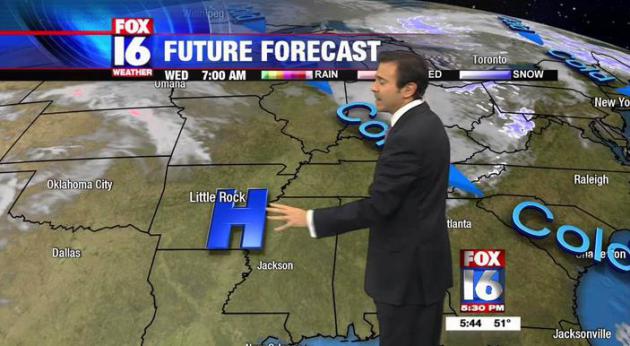
Local Weathermen Arrested After Fight Breaks Out Over Rain Chances For This Weekend. O.K. This is a parody, a local version of The Onion, but I thought Rock City Times did a masterful job. Let's hope it never comes to this: " Local Weathermen Jeff Baskin of Fox 16 and Keith Monahan of KARK were arrested along with several members of their news stations late last night after a fight broke out between the two outside of their studio on Capitol Ave. Witnesses say the disagreement began during show prep for Baskin’s weather segment on the 9 o’clock newscast for Fox16. Monahan entered the weather center the two stations share while Baskin was reviewing his forecast and having mascara applied. Monahan reportedly asked Baskin what he was going to show for the rain chances on Saturday. Baskin replied that he thought the rain would hold off and move in on Sunday. The two exchanged a few further remarks and walked away..."

Climate Stories....

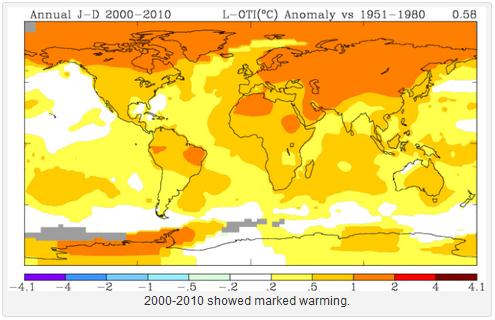
What 95% Certainty Of Warming Means To Scientists. Here's a clip from an AP story at ABC News: "Top scientists from a variety of fields say they are about as certain that global warming is a real, man-made threat as they are that cigarettes kill. They are as sure about climate change as they are about the age of the universe. They say they are more certain about climate change than they are that vitamins make you healthy or that dioxin in Superfund sites is dangerous. They'll even put a number on how certain they are about climate change. But that number isn't 100 percent. It's 95 percent. And for some non-scientists, that's just not good enough..."

Graphic credit: 2000-2010 global temperature anomalies (compared to 1951-1980 averages) courtesy of WMO, The World Meteorological Organization.

Settled Science. Here's the intro to a story from Jeff Nesbit at U.S. News: "The debate is over. On Friday, an international panel of hundreds of scientists will issue its fifth (and perhaps final) comprehensive scientific assessment of what we now know about climate change. Its central conclusion will be certain and unequivocal – human beings are altering the climate, with impacts starting to occur now. Yes, there are still a handful of scientists who like to take slightly contrarian positions, which allows them to be quoted in media stories. And, yes, scientists are still trying to determine how much things like La Nina, excess water vapor and ocean sinks (the ability of the oceans to store carbon dioxide and warming) mask the extent of how rapidly the planet is warming from greenhouse gases..."

Photo credit: "A new Intergovernmental Panel on Climate Change report, its first in six years, will be released Friday with the unequivocal conclusion that human beings are altering the climate."

Study Sees A Higher Risk Of Storms On The Horizon. The New York Times has a good overview; here's the introduction: "The eastern and central United States likely will see a greater risk of severe weather by the middle of this century as rising temperatures trigger atmospheric changes that favor storms, a new study by climate scientists from Stanford and Purdue universities concludes. By the century’s final 30 years, the study forecasts, the eastern United States could experience severe thunderstorms an average of nearly 7.5 spring days, an increase of almost 42 percent. A 15 percent increase is forecast during June, July and August..."

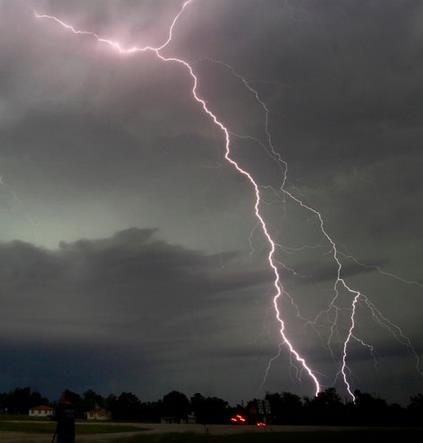
Photo credit above: Gene Blevins/Reuters. "Thunderstorms are forecast to increase in the eastern and central United States."

What Is The Climate Change Context Behind The Colorado Floods? Scientific American has the article - here's a clip: "...The science of linking extreme events to climate change is relatively young. Practitioners in this field, called attribution science, work to understand whether any part of an event like a flood, drought or heat wave can be attributed to climate change. Martin Hoerling, a research meteorologist at the National Oceanic and Atmospheric Administration's Earth System Research Laboratory in Boulder, has been one of the leaders in the field of attribution research. Asked how the Boulder flood could be put into a climate change context, Hoerling first listed some statistics highlighting the extreme nature of the event..."

Photo credit above: "Is Climate Change to Blame? Although it is still relatively young, practitioners in the field of attribution science are looking at the relationship between climate change and extreme weather events such as the recent Colorado flooding." Image: Nurpu/Flickr.

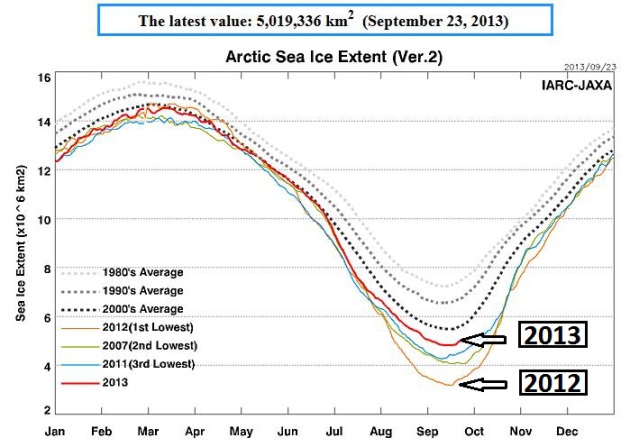
Arctic Sea Ice Minimum In 2013 Is Sixth Lowest On Record. More details from Tucson News Now; here's an excerpt: "After an unusually cold summer in the northernmost latitudes, Arctic sea ice appears to have reached its annual minimum summer extent for 2013 on Sept. 13, the NASA-supported National Snow and Ice Data Center (NSIDC) at the University of Colorado in Boulder has reported. Analysis of satellite data by NSIDC and NASA showed that the sea ice extent shrunk to 1.97 million square miles (5.10 million square kilometers). This year's sea ice extent is substantially higher than last year's record low minimum. On Sept.16, 2012, Arctic sea ice reached its smallest extent ever recorded by satellites at 1.32 million square miles (3.41 million square kilometers). That is about half the size of the average minimum extent from 1981 to 2010..."

Graph above: Arctic Sea-Ice Monitor.

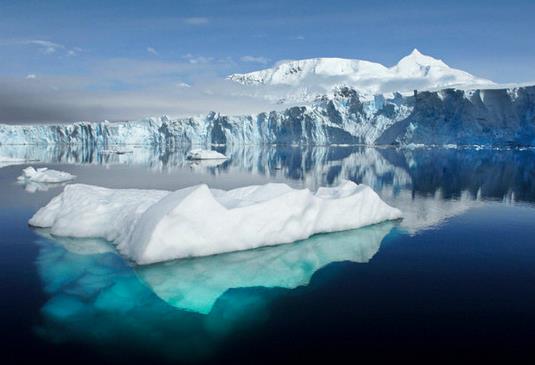
Rising Oceans Set Off Alarms. Additional sea level rise is already in the pipeline - the question is: how much, and how quickly? Here's a snippet of a story at The Daily Astorian: "...With a constant level of greenhouse gases, the upper ocean will warm 0.6 degree C by 2100 to balance between heat in and heat out, Thompson said. Sea levels will continue to rise for centuries because the entire ocean needs to warm up for the energy budget to balance. Ben Strauss, vice president for Climate Impacts and director of the Program on Sea Level Rise at Climate Central, has described the phenomenon as a “long-term commitment,” that rising sea levels have been locked in, whatever changes are made in emissions. “It appears that the amount of carbon pollution to date has already locked in more than 4 feet of sea level rise past today’s levels. That is enough, at high tide, to submerge more than half of today’s population in 316 coastal cities and towns, home to 3.6 million, in the lower 48 states...” (Image above: NASA).

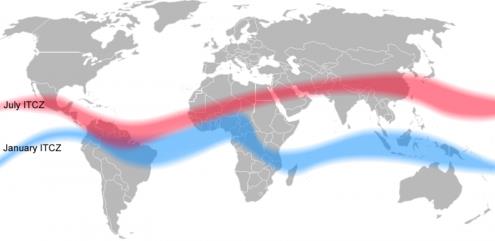
Wind And Rain Belts To Shift North As Planet Warms, Research Says. Phy.org has the article - here's an excerpt: "As humans continue to heat the planet, a northward shift of Earth's wind and rain belts could make a broad swath of regions drier, including the Middle East, American West and Amazonia, while making Monsoon Asia and equatorial Africa wetter, says a new study in Proceedings of the National Academy of Sciences. The story authors base their predictions on the warming that brought Earth out of the last ice age, some 15,000 years ago..."

Image credit above: "During boreal summer, Earth's tropicla rain belt migrates north. A similar but prolonged shift could happen if the north continues to heat faster than the south, disrupting global rainfall patterns." Credit: Mats Halldin.

Register Guard: Acidification Complicates Fishing. Much of the warming is going into the world's oceans, which are becoming more acidic (higher PH levels) over time - which isn't great news for fish or other aquatic life, as reported at OPB.org: "...Scientists — including many at Oregon State University — are beginning to define the cause of these events. They call it ocean acidification and hypoxia. Wind, currents and ocean chemistry conspire to create pools of corrosive waters that can be lethal to key commercial species in Northwest waters — and favorable to some nuisance species, such as jellyfish. The die-off of coral reefs has been publicized everywhere from Australia to the Indian Ocean to the Caribbean. But less well known are the problems surfacing on the West Coast of North America — where people may have more cause to worry. “Scientists are learning that ocean acidification is hitting waters off the West Coast earlier and harder than elsewhere on the planet,” Oregon Gov. John Kitzhaber said recently..." (Image: NASA).

Methane Reserves: Does Size Really Matter? Will a slowly thawing permafrost and Arctic release vast quantities of methane, compounding future warming? The jury is still out, but the concern is valid. The Carbon Brief takes a look - here's a clip: "Size isn't everything when it comes to the stores of methane locked up in the earth. A recent paper warns a sudden release of these resources could exact a terrible economic and humanitarian cost. But while vast stores of the potent greenhouse gas exist, scientists do not have sufficient evidence to believe they will be suddenly released into the atmosphere, methane expert Dr Vincent Gauci explains."

A Quick 'N Dirty Guide To Falsifying AGW. Here's an excerpt from a post at Our Changing Climate: "Have you ever heard of Newton’s theory of gravity? Well, it’s all made-up nonsense. You’ve been fooled. The reasoning goes as follows:
  1. According to the theory of gravity, objects should fall to the Earth’ surface.
  2. That bird in the sky remains there, without falling.
  3. Theory of gravity is wrong.
This reasoning bears a lot of resemblance to the following, equally strong reasoning that falsifies the theory of anthropogenic global warming (AGW):
  1. According to AGW, CO2 controls the climate.
  2. For the past 10 years, global temperature remained more or less steady whereas CO2 levels went up.
  3. AGW theory is wrong..."

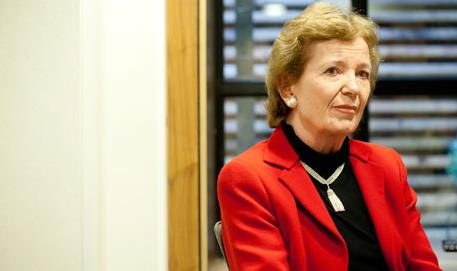
Major Fossil Fuel Reserves Must Be Left In The Ground, Senior Diplomat Warns. I'm pretty sure ExxonMobile will be OK with this. Here's a clip from a story at The Guardian: "World governments must get used to the idea of leaving fossil fuel reserves in the ground unexploited and unburned, one of the world's most senior diplomats has said, ahead of a landmark report on climate science to be unveiled this Friday by the Intergovernmental Panel on Climate Change (IPCC). The former Irish president and UN high commissioner for human rights, Mary Robinson, is to spearhead a new international push aimed at breaking the climate talks deadlock and silencing sceptics, with a group of senior diplomats and politicians from around the world. Climate sceptics are "not based in reality" and parts of the business community are "trying to cloud and distort the science", she said, adding that strong political leadership was needed to counter them..."

Photo credit above: "The former Irish president and UN high commissioner, Mary Robinson, is to spearhead a new international push aimed at breaking the climate talks deadlock and silencing sceptics." Photograph: Martin Argles for the Guardian.

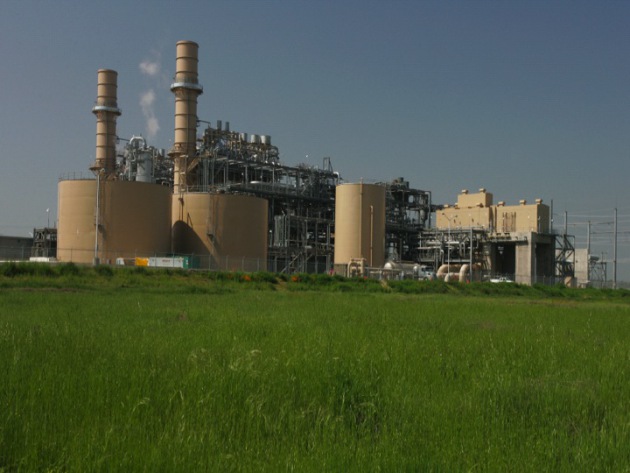
One Failed Project, Another Over Budget, Hint At Carbon-Capture Challenges Under EPA Rules. Grist has the story - here's a snippet: "...Despite an abundance of underground storage space where CO2 could conceivably be stashed, only a dozen or so carbon-capture projects are operating or under construction worldwide. And in a bad sign for any coal barons who might still be optimistic about the future of coal burning in the U.S., one of the world’s most ambitious carbon-capture efforts has just been abandoned in Norway. That development coincides with news of nearly billion-dollar cost overruns at another CCS project in Mississippi..."