Monday, March 3, 2014

Time Warp: Maps Looks More Like Early February Than Early March (slow thaw likely later next week, nationwide)


Still Standing

Have we reached an epic new low for winters in Minnesota? Maybe. 50 subzero lows IS impressive, but Kent Smith in Eden Prairie and Pete Boulay at the Minnesota Climate Office both confirm no record lows this winter at MSP, which I found a bit odd. A spree of subzero lows but nothing record-breaking. 9th coldest meteorological winter on record at KMSP, and based on heating degree days we've spent 12.3 percent more than average heating our homes this winter. Whatever average is.

Two meteorological trends I've noticed in recent years: a tendency for weather to stall, to get "stuck". And more volatility, more extremes, more weather whiplash.

Think about it. Two years ago we saw 60F the first week of March; 80F by mid-March. Flowers were in bloom & sail boats were in the water by late March, on our way to a 7 month boating season! This winter we feel blessed just to see freezing.

"Every winter seems like a new low" my oldest son complained. Here's a guy that lived for snow days and shrugged at cold fronts growing up. Now he's thoroughly disgusted. I sense he's not alone. Last winter it snowed in early May, creating a chorus of groans. The groans have turned into gasps.

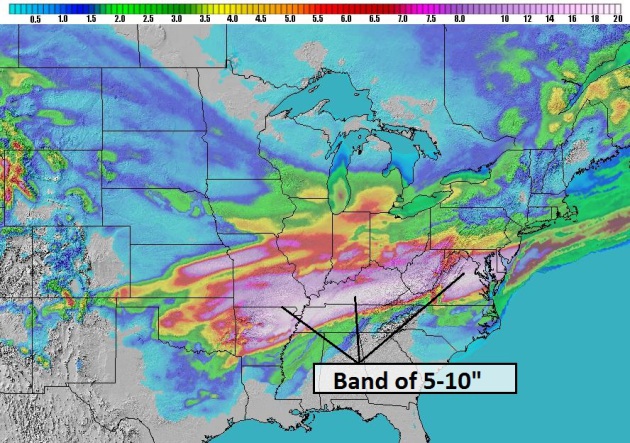
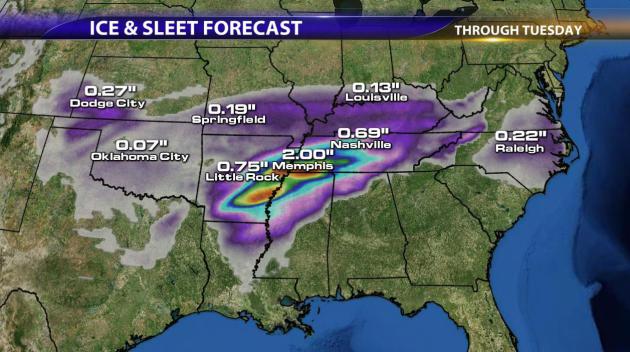
No epic, March Tournament storms are brewing anytime soon; an inch or two from a fast-moving clipper tonight - a better chance of a few inches of slush next Tuesday as a more significant storm spins up over the Midwest - the brunt of snow, ice and rain may stay south and east of Minnesota, but it could be a close call.

Remarkably no more subzero lows are in sight. We brush 32F Thursday; 40F is possible next week. I'm nervous saying this out loud, but I sense we're finally turning the corner... on a winter to remember.

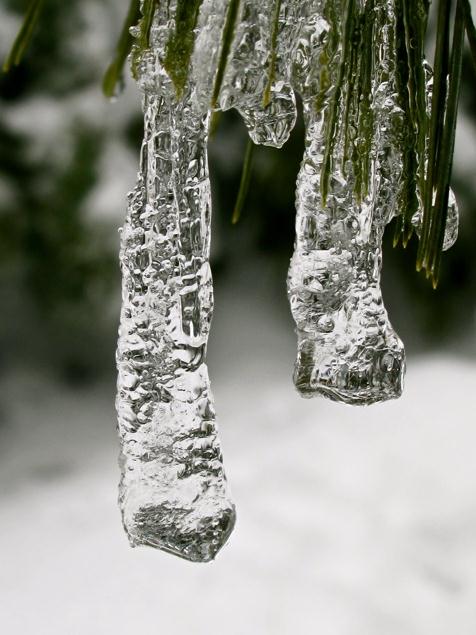
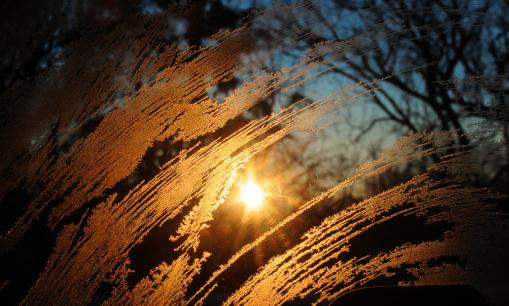
* photo above courtesy of duckduckgrayduck.com.
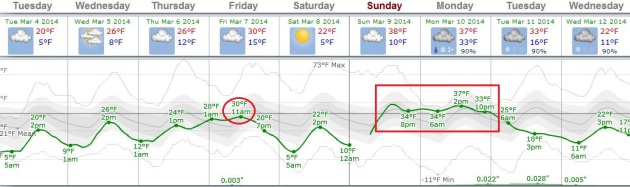
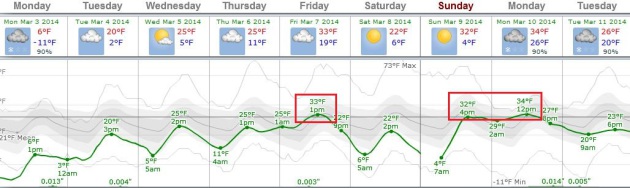
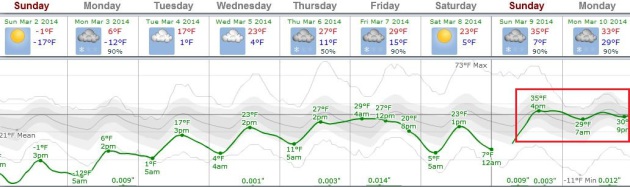
Another Cruel Meteorological Mirage? I know, we've been burned too many times by long-range models that dangle the possibility of 30s, only to get closer to the blessed event and have them vanish into thin, Canadian air. The temperature trend is upward, a hint of low 30s by Friday, then cooling off Saturday before a more significant whiff of Pacific air arrives early next week. A thaw seems likely Sunday and Monday before cooling down. Look carefully at the ECMWF (European) guidance above. Notice anything unusual? No subzero lows predicted. That's progress, in a ghastly, pathetic sort of way. Graph: Weatherspark.

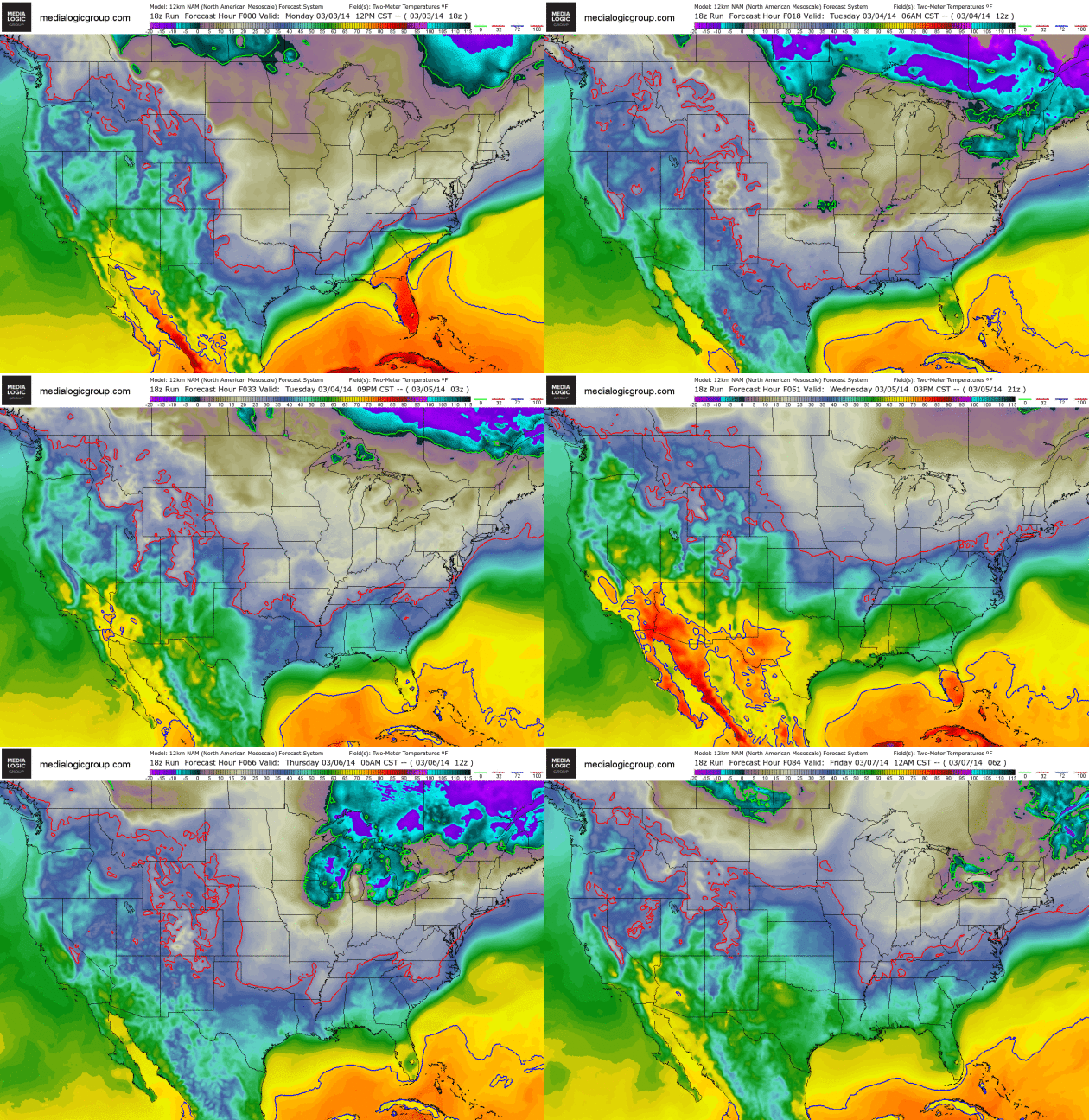
A Sluggish Thaw. With all the snow on the ground I guess we should be hoping for a slow-motion thaw, and that's exactly what we'll get later this week. The solid red line marks the 32F isotherm, pushing north Wednesday and Thursday. All that snow and ice in your yard will melt. Give it a month or two. 2 meter NAM temperature forecast courtesy of NAM and Ham Weather.

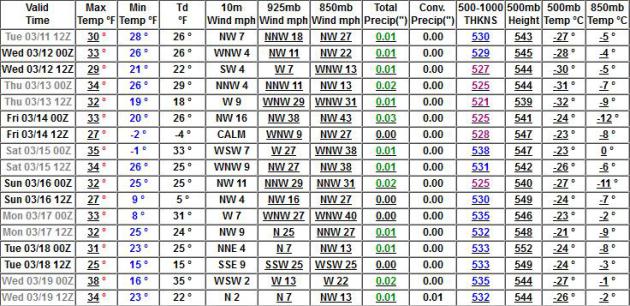
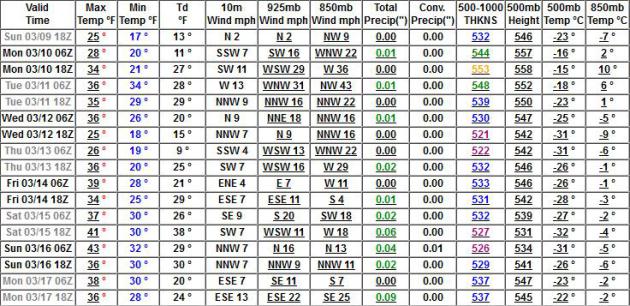
Extended GFS Numbers. Yes, I'm skeptical of (all) long range models now, after the persistent polar rut we've been in since December. But the GFS is fairly consistent, run to run, showing mostly 30s the third week of March. We'll see, but it's probably still too early to celebrate.

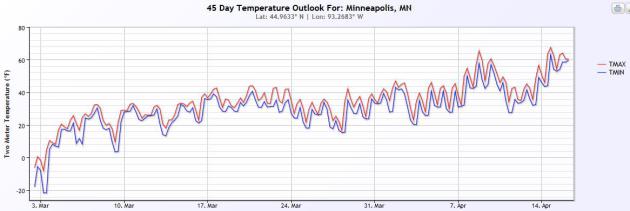
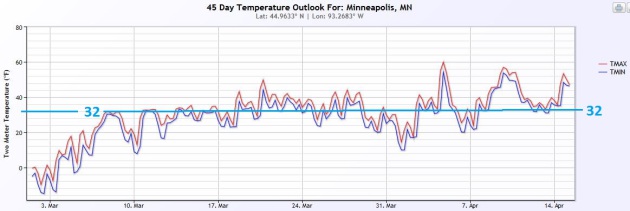
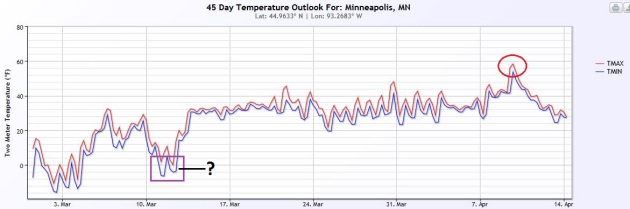
Upward And Onward. At least if you believe NOAA's 45-day trends, the CFS (Climate Forecast System) model, which I lovingly describe as the "Wish-Cast". It shows highs topping 40F by the third week of March, some 50s to near 60F the second week of April. One prediction with rare 100% accuracy: none of us will EVER take spring for granted again. Graphic: NOAA and Ham Weather.

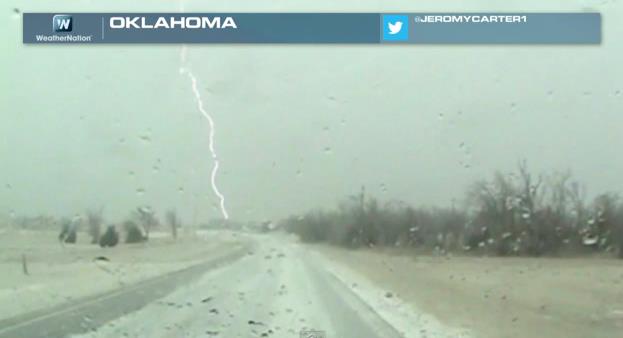
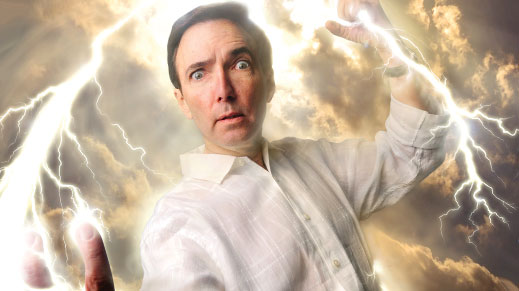
Serious Weather Whiplash. Cloud to ground lightning during heavy snow and sleet - in Oklahoma? The maps have been looking like early February, not early March, with cold and snow pushing as far south as Texas. From drought in the west to a parade of storms east of the Rockies, record warmth in Las Vegas to 73" snow in Chicago (43" above average, to date) the extremes have been even more extreme. That's the topic of today's edition of Climate Matters: "WeatherNationTV Chief Meteorologist Paul Douglas goes over the two very different winters that the United States saw this year. While the Eastern half of the US saw well above average snow and bone chilling cold, folks in Las Vegas enjoyed the warmest winter on record! Talk about weather whiplash!"

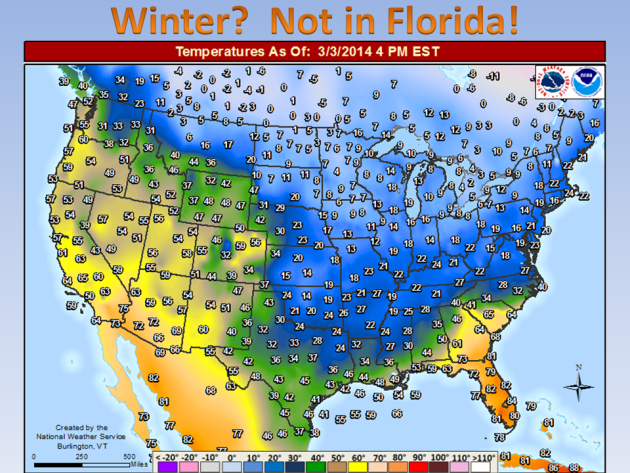
What March? Here's a good excuse to consider Florida - although I hate it when they get smug and start to gloat. Wait until summer-sauna and hurricane season, eh? Map above: NOAA.

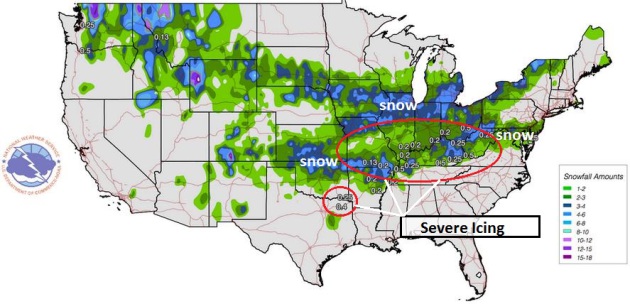
Preliminary Snow/Ice Totals. The map above is courtesy of NOAA, showing snow and ice totals from 7 AM March 1 to 7 AM March 3. Much of the Ohio and Middle Mississippi River Valley picked up .25 to .50" of glaze ice.

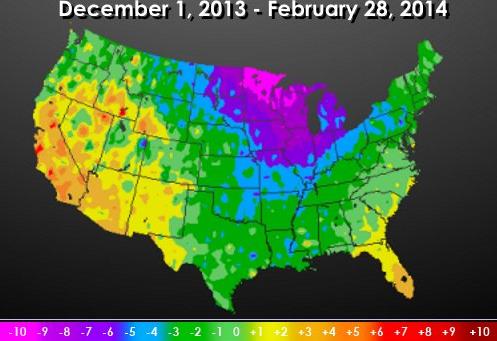
National Temperature Departures During Meteorological Winter. All those locations in green, blue and purple experienced colder than average temperatures from December thru February (no kidding). Only the far southeastern USA and much of the southwest was warmer than average. Map: University of Nebraska, HPRCC and Larry Cosgrove's WEATHERamerica newsletter.

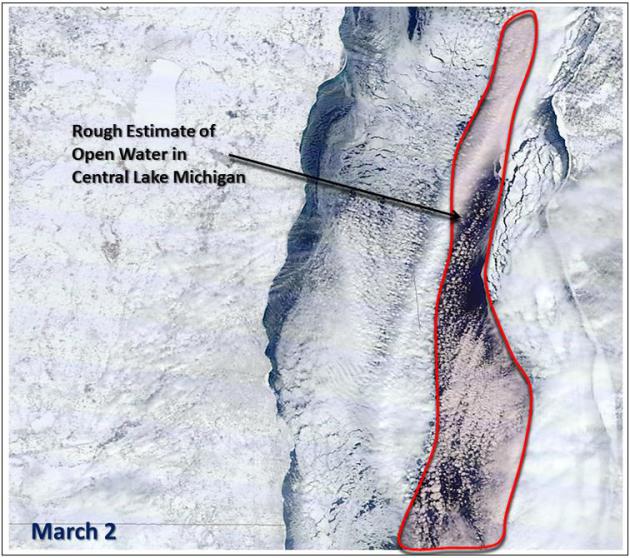
Lake Michigan Is 90% Ice-Covered. That compares with a maximum ice cover of 20% last winter. Map above and more details from the Milwaukee office of the National Weather Service.


Ask Paul. Weather-related questions, comments (and threats):

"How many hours has Mpls been above freezing since November 1, 2103?  Thank you."

Lyman Dale

I asked local weather and climate guru Pete Boulay at the Minnesota Climatology Working Group to tally up the numbers. Here is an excerpt of his reply:

"The more impressive totals are number of hours that we had above 32 degrees for meteorological winter.

December:  The Twin Cities International Airport had 64 hours of above freezing temperatures 33 or warmer

January: The Twin Cities International Airport had 34 hours of above freezing temperatures 33 or warmer in January and one hour of 40 degrees and that one hour was glorious.

February: The Twin Cities International Airport had was 32 hours for 33 degrees and above
."

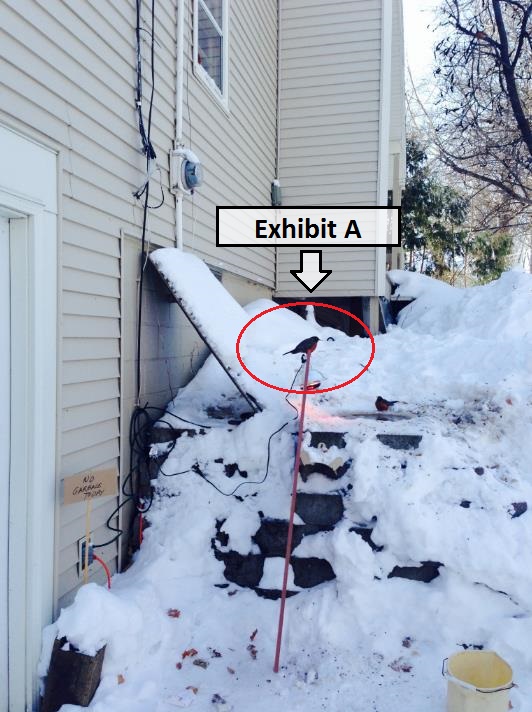
Reluctant Robin Retraction. In Monday's weather column I mentioned that "I can't promise robins or daffodils anytime soon". Howard Richards begs to differ:

"I had 8 of them vying for a spot around my heated birdbath in Mound on Sunday. I don’t think they ever left last fall!"

Best Regards, Howard Richards
Plymouth, Minnesota

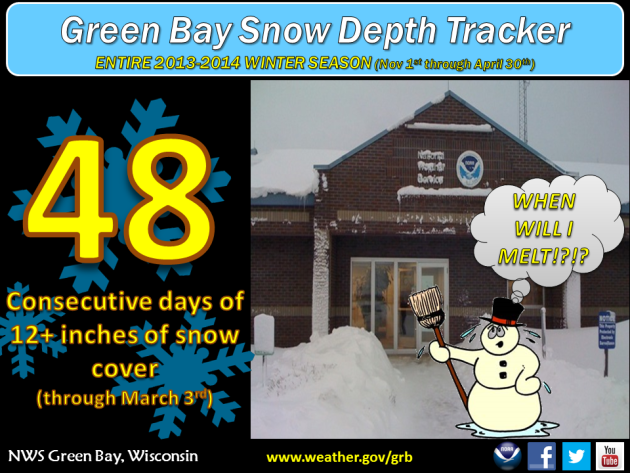
No Green In Green Bay. In fact, according to NOAA, it's the third longest streak with a foot of snow or more on the ground at KGRB.

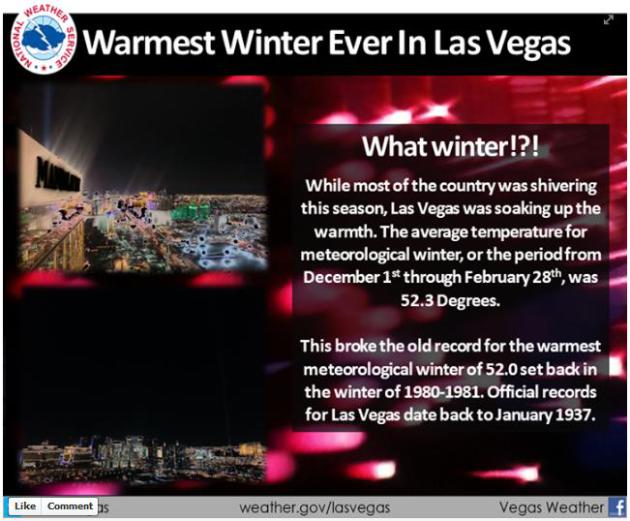
Warmest Meteorological Winter on Record in Las Vegas. Welcome to the Winter of All or Nothing, at least in terms of warmth. Details from NOAA.

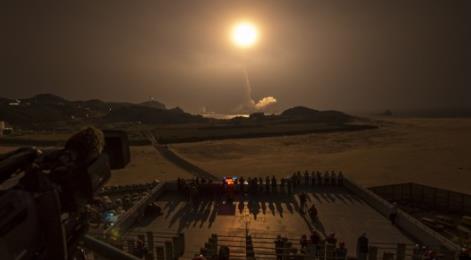
GPM Weather Observatory Successfully Launched. Gizmag has more details on a new weather and climate platform just launched into low orbit; here's an excerpt: "...A joint mission between NASA and the Japan Aerospace Exploration Agency (JAXA), the Global Precipitation Measurement (GPM) Core Observatory is a 4-ton spacecraft (and the largest spacecraft ever built at NASA's Goddard Space Flight Center) that will join a constellation of existing and future spacecraft to provide detailed information on the Earth's weather and climate cycles by mapping global precipitation every three hours..."

Photo credit above: "The GPM Core Observatory is launched aboard a Japanese H-IIA rocket from the Tanegashima Space Center last week." (Photo: NASA/Bill Ingalls).

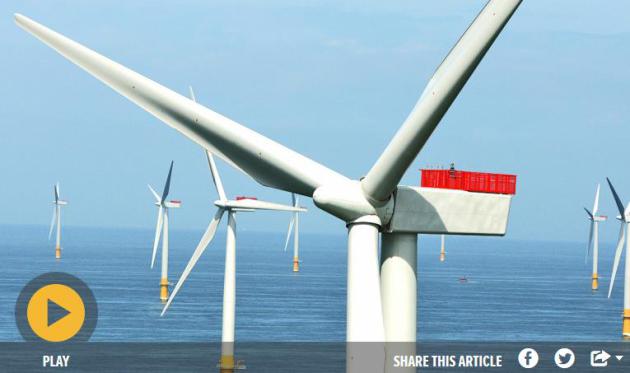
Tame Hurricanes With Offshore Wind Farms. You'd need a lot of turbines to blunt the raw power of a major hurricane, but this idea may not be as far-fetched as it sounds. Here's an excerpt of a Stanford University study from futurity.org: "Computer simulations show that offshore wind farms with thousands of turbines could have sapped the power of three real-life hurricanes, significantly decreasing their winds and accompanying storm surge, and possibly preventing billions of dollars in damages. For the past 24 years, Mark Z. Jacobson, professor of civil and environmental engineering at Stanford University, has been developing a complex computer model to study air pollution, energy, weather, and climate. A recent application of the model has been to simulate the development of hurricanes. Another has been to determine how much energy wind turbines can extract from global wind currents..."

Photo credit above: "Wind turbines could potentially disrupt a hurricane enough to reduce peak wind speeds by up to 92 mph and decrease storm surge by up to 79 percent." (Credit: Department of Energy and Climate Change/Flickr)

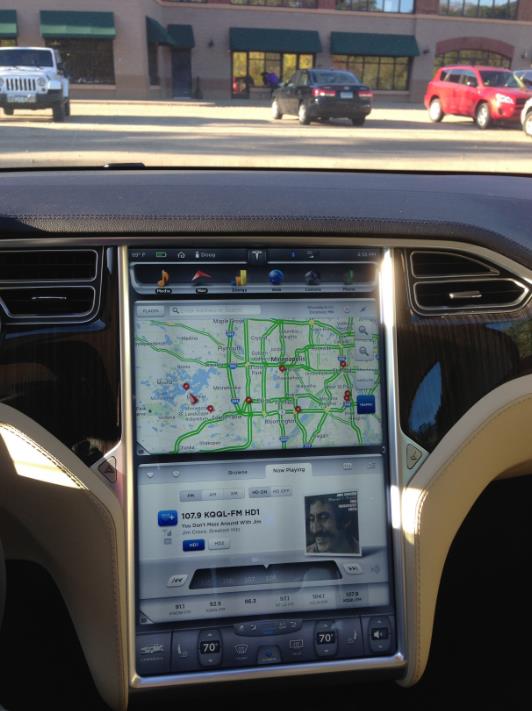
Why Apple Could Win Big With Tesla's Giant New Battery Factory. Wired has the article; here's an excerpt: "...This week, years after that first sighting, Tesla announced plans for what it calls the “Gigafactory,” a 10-million-square-foot plant for making car batteries. The company hopes that the sheer scale of the operation, combined with the inventiveness of its engineers, will bring battery prices down far enough to finally bring its electric cars into the mainstream. But it’s not just the prospect of a gasoline-free future that has sparked such excitement about the Gigafactory. The same basic lithium-ion tech that fuels Tesla’s cars also runs most of today’s other mobile gadgets, large and small. If Tesla really produces batteries at the scale it’s promising, cars could become just one part of what the company does. One day, Tesla could be a company that powers just about everything, from the phone in your pocket to the electrical grid itself..."

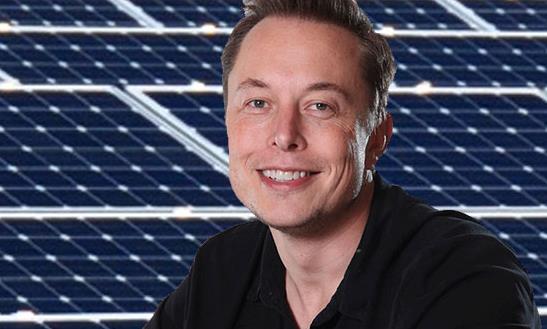
Energy Sector's Newest Power Player: Elon Musk. Here's an excerpt of a story at LinkedIn that caught my eye: "Elon Musk has established a well-deserved reputation for designing and building things that take off quickly — rockets, electric cars … and stock prices. But his biggest impact won’t necessarily be in speeding up how we get from here to there. It may be in transforming a much slower-moving industry: electric utilities..."

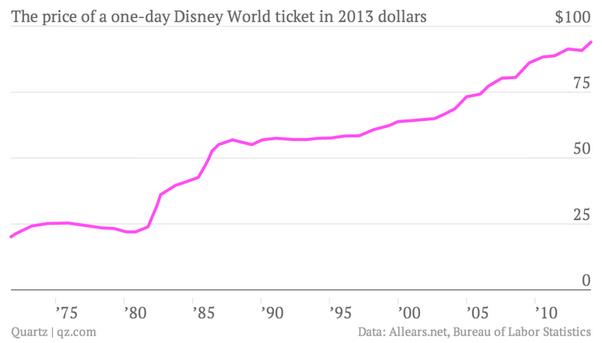
It Costs Five Times What It Did In 1970 To Spend A Day At Disney World. Save up your money if you're heading to Orlando to hang out with Goofy; here's a clip from a story at Quartz: "...Hanging out with Mickey Mouse is getting more expensive. Disney World hiked the price of a one-day ticket to the Magic Kingdom to $99 earlier this week. But it’s hardly the first time. The same thing happened last year. And the year before that. In fact, the price of a one-day ticket has been rising pretty steadily for decades, even after adjusting for inflation...


Climate Stories....

Don't Ignore Climate Change Realities. Here's an excerpt of an Op-Ed that appeared in The Kansas City Star: "...Using information from around the globe, the National Oceanic and Atmospheric Administration lays out compelling climate change evidence from the last century:

-Global surface temperatures are rising.
-The index ranking extreme weather events in the United States is at its highest level in 100 years. (Think polar vortex.)
-Sea levels are rising; oceans are getting warmer.
-Glacier volume is shrinking dramatically..."

Scientists Discover New "Giant Virus" From 30,000 Year-Old Permafrost. Don't sweat the snow flurries ok? Here's the intro to a story at Mashable: "If this sounds like it's coming straight from an episode of X-Files, that's because it is. Well, almost. Scientists studying microorganisms buried in Siberian permafrost, a layer of permanently frozen soil that rings the Arctic, found and revived a new type of giant virus that had been locked away for more than 30,000 years. The virus — pithovirus sibericum, a new type of giant DNA virus characterized by its large size and abundance of genes — is not hazardous to human or animal health..."

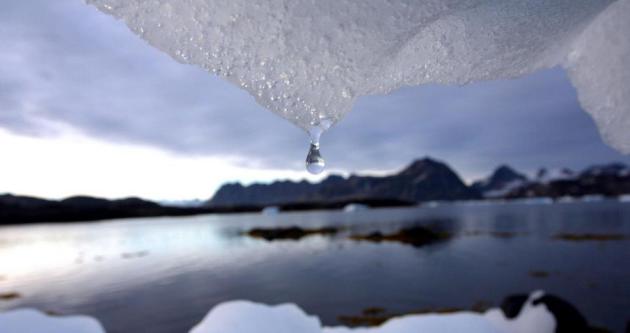
Photo credit above: "An iceberg melts in Kulusuk, Greenland near the arctic circle Tuesday Aug, 16, 2005." Image: John McConnico/Associated Press.

Sunday, March 2, 2014

A New Form of D.C. Gridlock: Heavy Snow Shuts Down Parts of East Coast Today


Bragging Rights

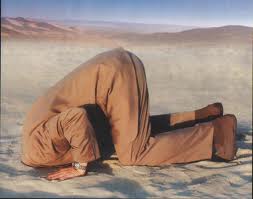
I suspect a conspiracy, a vast cover-up. This winter is turning into a snowbird machine. People who never considered moving to Scottsdale or Ft. Myers are starting to do the math.

Minnesota is home for me, but I find myself accepting odd speaking requests in warmer climes, anxious to learn more about the intricacies of tropical meteorology. Any excuse to escape.

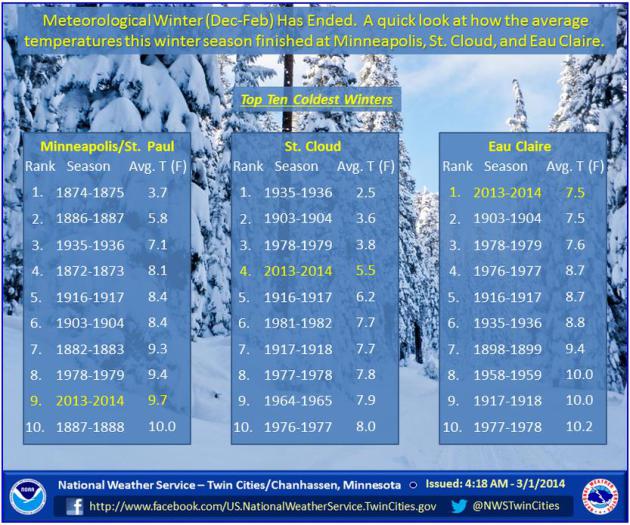
Primal scream time: today is the 50th subzero morning of winter. Average is closer to 27. Oddly enough no record lows in the Twin Cities metro this winter, but cold enough. NOAA reports the 9th coldest meteorological winter on record in Twin Cities but 4th coldest at St. Cloud (62 subzero lows) and the coldest on record at Eau Claire.

TPT Almanac boss Brendan Henehan reminded me that -15F Sunday morning marked the coldest March temperature since 1962.

Steve Reckers of New Hope reports the coldest February at New Hope since he started keeping records in the mid-50s.

We are so due for a thaw. I can't promise robins and daffodils anytime soon, but 30s are showing up on the 7-Day.

Then again there are advantages to being frozen in time. Fewer ice dams and spring flood warnings. Be careful what you wish for in 2014.

* File photo: WJON AM 1240 in St. Cloud.

50 Nights of Subzero Lows in the Twin Cities. Let me try and put this into perspective: if we pick up just two more nights below zero that will be the most since 1888. Details from the Twin Cities National Weather Service.

Top 10 Coldest Meteorological Winter. The Twin Cities metro came in at #9, but it was the 4th coldest December thru February period for St. Cloud, and the coldest ever observed at Eau Clairie. More details and graphs from NOAA.

Historic February? Meteorologist Dean DeHarpporte forwarded along a note from one of his friends, Steve Reckers, who was amazed by the February he tracked in his back yard. Here is an excerpt of that e-mail:

"I have just witnessed a truly remarkable Feb., the likes of which I am quite sure I will never witness again. It turned out to be the coldest Feb. in my record at 7.8 dating back to the mid 50s (see attached). The second coldest was 1989 at 8.6 and third coldest was 1979 at 8.7. The Dec.-Feb. winter was the second coldest at 8.5, 1978/79 was the coldest at 7.9 Today marks the 57th day of zero or below beating the record set in 78/79 at 56. Just counting below zero temps. I now have recorded 54."

- Steve Reckers, New Hope Weather Observer

Hope. After this mornings muted pain it's theoretically possible we may the rest of the week without enduring another subzero low, at least the ECMWF guidance is suggesting that. 30s are possible by the end of the week, again early next week. Graph: Weatherspark.

Spring Is Coming - The Atmosphere Just Doesn't Know It Yet. For the sake of mental health workers statewide I wanted to include the latest NOAA CFS (Climate Forecast System) model solution for MSP. Odds are it'll be off, but I suspect the trend is correct. Graphic: Ham Weather.

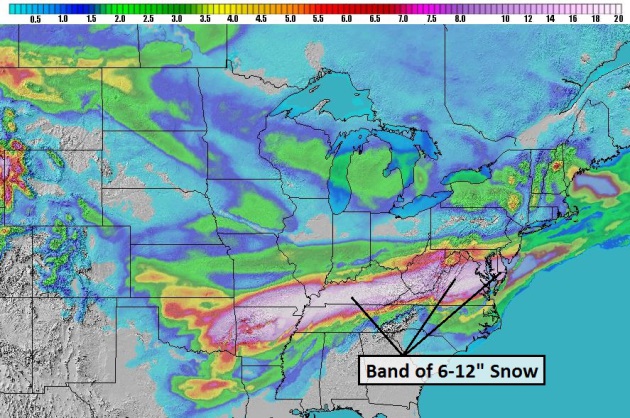
A New Form Of D.C. Gridlock. Politics will have nothing on the weather in Washington D.C. today. The atmosphere always bats last, as will be evident in our nation's capital, where as much as 8-12" snow may pile up today. In a city where the mere mention of "flurries" can incite panic, imagine what a cool foot of snow is capable of? Heavy snow and ice is spreading east across the Virginias and Maryland into Delaware today - travel to the East Coast will be impacted. NAM data courtesy of NOAA and Ham Weather.

States of Emergency
- Declared in Delaware
- Mississippi Governor declared one for northern MS
- Federal offices in Washington DC closed due to heavy snow and ice risk
- DC schools, along with those in Howard and Charles Counties in nearby Maryland, are also closed today.
- Fairfax County (VA) schools/offices closed today
- University of Oklahoma closing campus for today

* Thanks to Chris Bianchi at WeatherNation for the update.

Cold Perspective. Here's an excerpt of a note I received Saturday night from TPT Almanac Executive Producer Brendan Henehan, who did a great job summarizing just how unusual nighttime lows of -10F or colder in March really are. The mercury sank to -15F Sunday morning, equally cold this morning. Here is a portion of Brendan's e-mail:

"In the past 75 years --according to my tally-- there have been sixteen days in March in the Twin Cities when the temp was 10 below or colder.   We are expected to add two more to this historic number this weekend.  The National Weather Service forecast lows for (Saturday night) and Sunday night in the Twin Cities is 14 below.  If it gets to -12F either night it will be the coldest Twin Cities March temp since 1962.  And this weekend will almost surely constitute the coldest back-to-back March nights in the Twin Cities since 1948.  But don't worry... the record for the coldest Twin Cities March temp in the past 75 years is safe and secure.  On March 1, 1962 the mercury dipped to 32 below in Minneapolis and St. Paul.  Let's let that one stay a record."

Full List of -10 and Colder Twin Cities March Readings since 1939
3-2-1943        -11
3-10-1948      -17
3-11-1948      -27
3-2-1950        -13
3-9-1951        -10
3-7-1955        -11
3-4-1960        -10
3-5-1960        -14
3-7-1960        -16
3-1-1962        -32
3-6-1962        -10
3-7-1967        -10
3-2-1972        -11
3-4-1978        -11
3-26-1996      -10
3-9-2003        -10

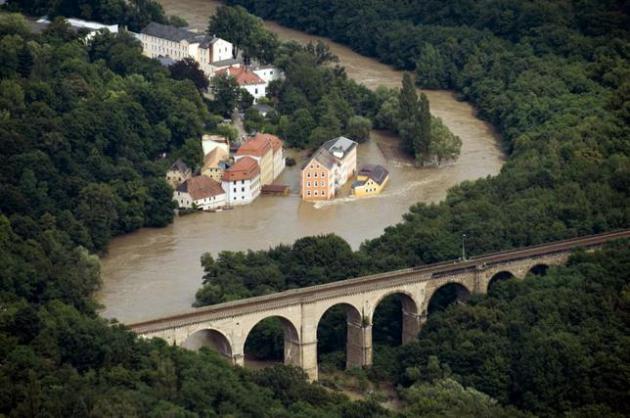
Europe's Flood Losses To Soar By 2050. Scientific American has the article; here's the introduction: "Extreme floods like those swamping parts of Britain in recent months could become more frequent in Europe by 2050, more than quadrupling financial losses, if climate change worsens and more people live in vulnerable areas, research showed on Sunday. The study said instances of very extreme floods, which now occur about once every 50 years, could shorten to about every 30 years, while cases of extreme damage now occurring once every 16 years could shorten to once every 10 years..."

File Photo above: "An aerial view of the Neisse river near Goerlitz, Eastern Germany, photographed on Sunday Aug. 8, 2010. The flooding in central Europe has struck an area near the borders of Poland, Germany and the Czech Republic." (AP Photo/ddp/ Jens Schlueter).

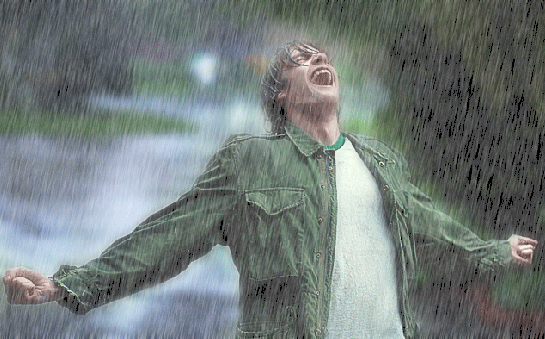
Los Angeles, Here's How To Drive In The Rain. Now before you scoff or laugh, keep in mind that it rained HARD late last week with widespread street flooding. But I thought it curious that The Los Angeles Times ran an article reminding locals how to drive in the rain; here's an excerpt: "...Here's an "am I doing everything I can to avoid a wreck" checklist.  Work your way down. It could help keep you, and all those drivers hurtling alongside you, safe:

Pan and scan
Keep your eyes scanning the roadway to avoid road debris and look out for disabled vehicles in reduced-visibility conditions.
Slow. Down.
Driving at reduced speeds helps you prepare for sudden stops due to debris and other hazards. Reduce your speed -- particularly as you drive through puddles..."

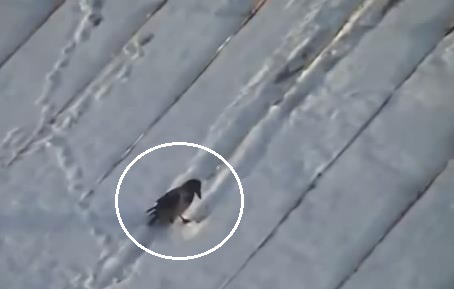
One Of The Funniest Things I've Ever Seen: "Crow-Boarding". Feeling blue about the 428th wind chill advisory of winter? Take the time to watch this YouTube clip from Russia. No, you can't make this stuff up.


Climate Stories...
Is The Arctic Really Drunk, or Does It Just Act Like This Sometimes? Is rapid warming of the Arctic and northern latitudes impacting the jet stream, causing weather to become "stuck"? More research is needed to help scientists connect the dots. I'm seeing this on the weather maps, but what's causing it? Chris Mooney from Mother Jones has the article; here's an excerpt: "...This weather now serves as the backdrop—and perhaps, as the inspiration—for an increasingly epic debate within the field of climate research. You see, one climate researcher, Jennifer Francis of Rutgers University, has advanced an influential theory suggesting that winters like this one may be growing more likely to occur. The hypothesis is that by rapidly melting the Arctic, global warming is slowing down the fast-moving river of air far above us known as the jet stream—in turn causing weather patterns to get stuck in place for longer, and leading to more extremes of the sort that we've all been experiencing. "There is a lot of pretty tantalizing evidence that our hypothesis seems to be bearing some fruit," Francis explained on the latest installment of the Inquiring Minds podcast. The current winter is a "perfect example" of the kind of jet stream pattern that her research predicts, Francis added (although she emphasized that no one atmospheric event can be directly blamed on climate change)..."

This Wicked Winter And Climate Change. Is climate volatility flavoring all weather now? Here's a portion of an interesting read at Discovery News: "...This is a speculative and genuinely controversial area of the science," said climate scientist Michael Mann of Penn State University. "There are some leading climate scientists who have provided evidence that climate change may be leading toward more persistent weather anomalies which can, for example, give the sort of extended periods of cold seen in the eastern and central U.S. this year, but at the expense in this case of a very warm western U.S. and unprecedented winter warmth in Alaska, and record warmth in many parts of Europe." Perhaps one of the most under-reported weather facts this winter is that almost every place except the central and eastern United States has been abnormally warm this winter." AP Photo: Orlin Wagner.

Evidence Check: Which Extreme Weather Events Are More Linked With Climate Change - Heat Waves or Hurricanes? Which weather events are more likely to be influenced (spiked) by a warmer, in many cases wetter atmosphere? Here's a clip from The Union of Concerned Scientists: "...The SREX report uses different ways of conveying scientific evidence, agreement and confidence regarding different weather phenomena, including how those phenomena have been changing over the past 50 years and attributing if human-caused climate change has played a nonexistent, minor, or major role in driving those changes. There were traditional likelihood terms defined by the IPCC such as “likely” (66 to 100 percent probability) or “very likely” (90 to 100 percent probability) to describe these relationships as well as expressions of scientists’ overall confidence in their findings, which ranged from low to medium to high..."

Hotter Extremes Belie Warming "Pause". Warm areas are getting warmer, which is what climate models were predicting 30 years ago. Here's a clip from a story at Climate News Network: "...It quickly became clear the so-called ‘hiatus’ in global average temperatures did not stop the rise in the number, intensity and area of extremely hot days,” said Lisa Alexander of Australia’s Centre of Excellence for Climate System Science. “Our research has found a steep upward tendency in the temperatures and number of extremely hot days over land and the area they impact, despite the complete absence of a strong El NiƱo.” And her colleague Markus Donat added: “There has been no pause in the increase of warmest daily extremes over the land and the most extreme of the extreme conditions are showing the largest change..."

How To Debate Climate Change Deniers (Without Scaring Them Off). Salon has the story - here's an excerpt: "...On the one hand, blaming big companies for climate change can come off as reactionary, strident, and disingenuous. After all, every individual has a carbon footprint and therefore contributes to climate change, even if she takes the bus and buys organic eggs. Who are we to blame companies for providing the consumer goods that we demand? I am part of the problem: I drive a car, fly to conferences, buy cheap clothes at Target. Who am I to point a finger at the oil, airline, and garment industries?..."

Saturday, March 1, 2014

What March? Major Snow & Ice Storm Spreads Across Ohio Valley into Virginias and Maryland by Monday


Silver Linings

Pray for a gradual thaw. There's 2-6 inches of liquid water locked up in those drifts. A MnDOT station near Monticello ground frost 73 inches deep. The potential for spring flooding will depend on many factors, especially the rate of warming, coupled with any rain in March, which would accelerate snow melt on frozen ground.

One silver lining: William Fernow asks "How much impact have our cold temperatures had on the emerald ash borer?" Lee Frelich at the U. of MN Center for Forest Ecology told me with metro readings around -20F the pests probably weren't wiped out, but our harsh winter may have set the bugs back a year or two. Details from Lee on my weather blog.

The sun is as high in the sky as it was in mid-October, which will make subzero fun less likely in March. I don't blame you for being skeptical, but we will warm up. Long-range models have been all but useless, hinting at repeated (phantom) thaws, but I suspect 30s late in the week are real. It may even feel like March out there.

A word of caution: as the atmosphere floating overhead begins to thaw the storm track will shift north, increasing the odds of a few tournament storms. Nothing brewing yet. Stay paranoid OK?

* photo above courtesy of emeraldashborer.info.

SWE: Snow Water Equivalent. According to NOAA estimates there is anywhere from 2-10" of liquid water trapped in Minnesota's snow pack right now, the greatest amounts over the Arrowhead, closer to 4-6" of water in and around the Twin Cities. This is one (of many) factors that hydrologists at NOAA will be examining when predicting the spring river flooding risk.

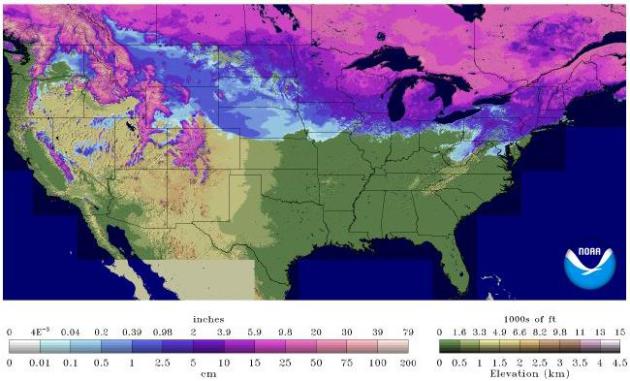
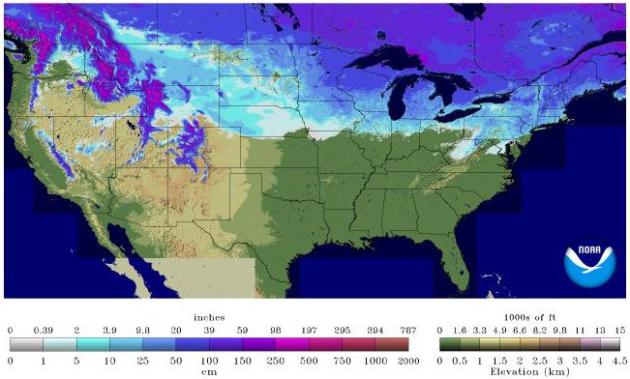
USA Snow Cover. The northern third of America is still covered in snow; heaviest amounts over the highest elevations of the Pacific Northwest and Rockies; 15-35" on the ground across the great state of Minnesota.

Cold Perspective. Here's an excerpt of a note I received Saturday night from TPT Almanac Executive Producer Brendan Henehan, who did a great job summarizing just how unusual nighttime lows of -10F or colder in March really are:

"In the past 75 years --according to my tally-- there have been sixteen days in March in the Twin Cities when the temp was 10 below or colder.   We are expected to add two more to this historic number this weekend.  The National Weather Service forecast lows for (Saturday night) and Sunday night in the Twin Cities is 14 below.  If it gets to -12F either night it will be the coldest Twin Cities March temp since 1962.  And this weekend will almost surely constitute the coldest back-to-back March nights in the Twin Cities since 1948.  But don't worry... the record for the coldest Twin Cities March temp in the past 75 years is safe and secure.  On March 1, 1962 the mercury dipped to 32 below in Minneapolis and St. Paul.  Let's let that one stay a record."

Full List of -10 and Colder Twin Cities March Readings since 1939

3-2-1943        -11
3-10-1948      -17
3-11-1948      -27
3-2-1950        -13
3-9-1951        -10
3-7-1955        -11
3-4-1960        -10
3-5-1960        -14
3-7-1960        -16
3-1-1962        -32
3-6-1962        -10
3-7-1967        -10
3-2-1972        -11
3-4-1978        -11
3-26-1996      -10
3-9-2003        -10

Long Range Models: Consistently Awful. The ECMWF (European) is usually pretty good, but none of the models are performing well in this (locked/stuck) pattern we've been experiencing since December. Any hint of a real thaw has been pushed back into early next week, but at least we'll see 20s later this week. Graphic: Weatherspark.

40 By Mid-March? Don't Take It To The Bank. I really want to believe the GFS solution above, suggesting highs topping 40F by mid-March. But everything keeps getting pushed back, a pattern I've been witnessing for several months now. I feel a growing sense of confidence that we will see 30s the second week of March. With a little divine intervention maybe we'll top 40F. Again, for the sake of people living along rivers, streams and in poor drainage areas let's hope our spring thaw is a gradual one.


Limping Into Spring. NOAA's CFS (Climate Forecast System) extended model - more of a trend - suggests one more run of subzero weather around March 12; maybe a couple nights near or just below 0F, before a sustained period of more seasonable weather from mid-March into early April. 60F by the second week of April? We can only hope and pray this outlook will verify. Graphic: NOAA and Ham Weather.

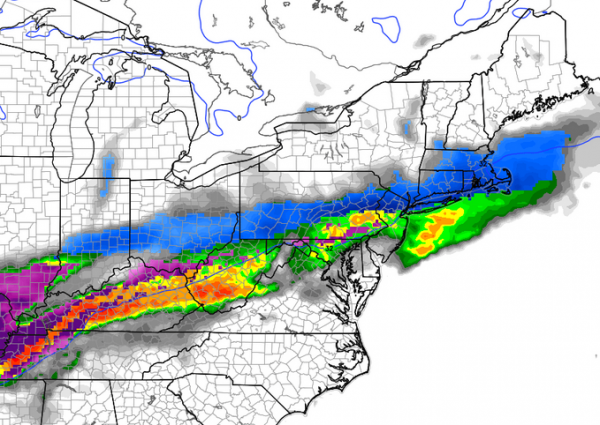
More Like Late January Than Early March. The core of the jet stream is still fairly far south for early March; today's storm spreading snow and ice across the Mid South into Tennessee and Kentucky, reaching Washington D.C. and Dover, Delaware Monday. NAM snowfall amounts: NOAA and Ham Weather.

Ice Potential. Baron Service's BAMS model shows a risk of significant ice (freezing rain and sleet) from near Little Rock to Memphis and Nashville today, enough to stop traffic and possibly spark power outages.

Measures Of This Cold Winter. Dr. Mark Seeley has a few eye-opening weather nuggets and statistics related to the duration and intensity of the cold across Minnesota in this week's edition of Minnesota WeatherTalk; here's an excerpt: "....For the meteorological winter (Dec-Feb), persistent cold and snow cover have been the themes across Minnesota. On a statewide basis it is the coldest winter since that of 1978-1979 and will likely end up among the top 5 coldest historically. Some measures of the cold winter season include:

* 65 days with below 0 F minimum temperature at Duluth, including a record string of 23 consecutive days from January 20 to February 11
* 70 days with below 0 F minimum temperatures at International Falls
* 50 days with 0 F or colder minimum temperatures in the Twin Cities, over twice the historical average and the most since the winter of 1977-1978.
.."

Alerts Broadcaster Briefing issued Saturday by meteorologist Andy Mair:

SNOW AND ICE STORM

- A rain/snow/ice mix is expected to begin falling this afternoon in southern and central Missouri. Expect rain at first, transitioning over to ice and snow by the evening. This storm will push eastward and by the end of the weekend will have impacted southern Illinois, Indiana, Ohio and Northern Kentucky.
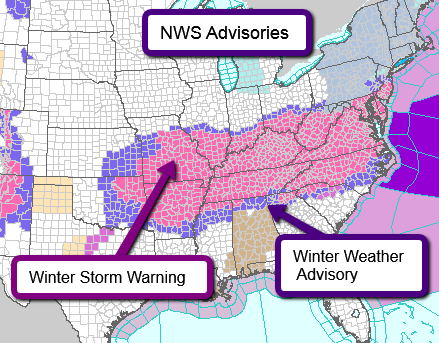
- Above you can see the advisories issued for the central part of the US. The National Weather Service has already issued a Winter Storm Warning for much of Missouri. Winter Storm Watches exist from Indiana to New Jersey. Expect the National Weather Service to begin upgrading these Winter Storm Watches to Winter Storm Warnings today as the models all come into agreement.

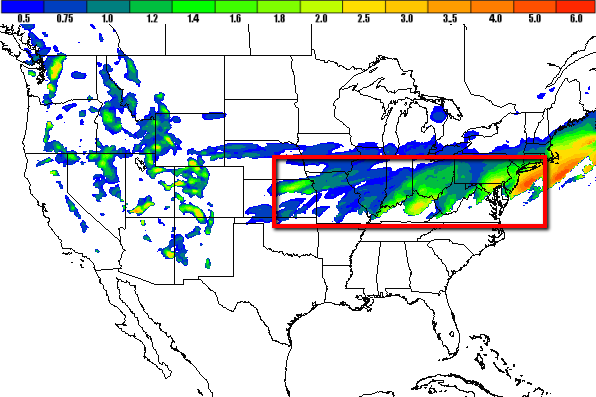
- Heavy winds will also accompany the fresh snow. This will make travel conditions even more difficult due to reduced visibility, including white out conditions, along with drifting snow. Please take extra precautions if traveling this weekend. Below is our in-house BPI forecast (Blizzard Potential Index). This shows the greatest potential for blizzard conditions to occur. The area below outlined in red is where we expect the wost conditions over the next few days as the storm progresses to the east.

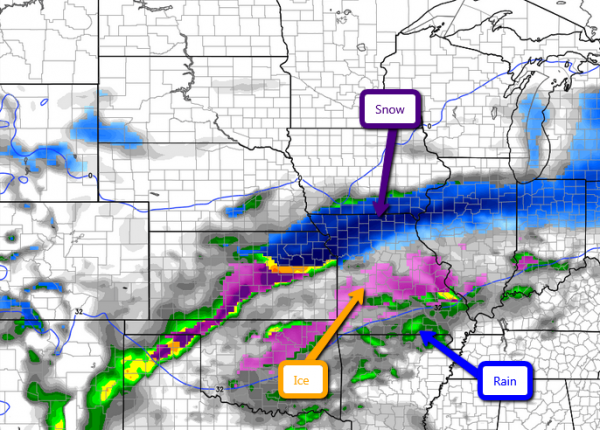
- Snow and rain will begin late this afternoon in Missouri and northern Illinois, Indiana and Ohio and carry on overnight and into Sunday. Here is a look at the simulated radar from Weatherbell this evening.

- By Sunday evening the snow/rain line will have pushed farther to the south bring a mixed bag of precip to Kentucky and West Virginia. You can see the very fine line between what is snow, ice and rain.

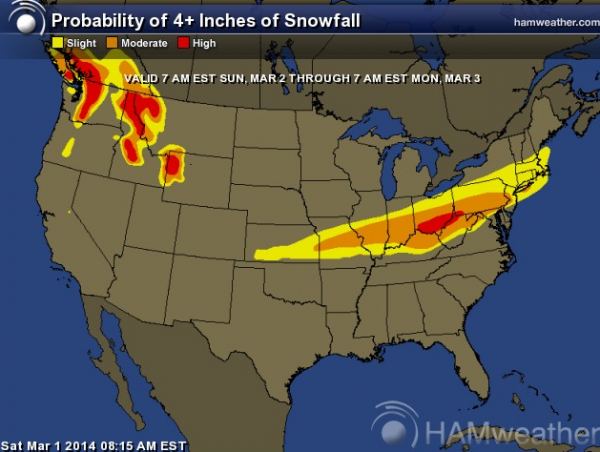
- Once the system has moved through most areas will have seen over 4+ inches of snow with some seeing as high as 8+ where the air stayed colder only allowing for snow to fall. Map: Weatherbell.

- Expect difficult driving conditions and air travel delays over the next 48 hours in the Central Plains. Driving will be hazardous as a rain/snow mix will create a layer of ice on roads accompanied by heavy winds to reduce visibility and create drifts. This will also cause extensive power outages as power lines will be dragged to the ground by the heavy ice accumulation and wind. Graphic: NOAA SPC and Ham Weather.

FLOODING IN CALIFORNIA
- More rain is expected for Southern California today and into the evening. Up to another inch of rain again today causing widespread flooding for most areas. Below is the forecasted rain accumulation today.
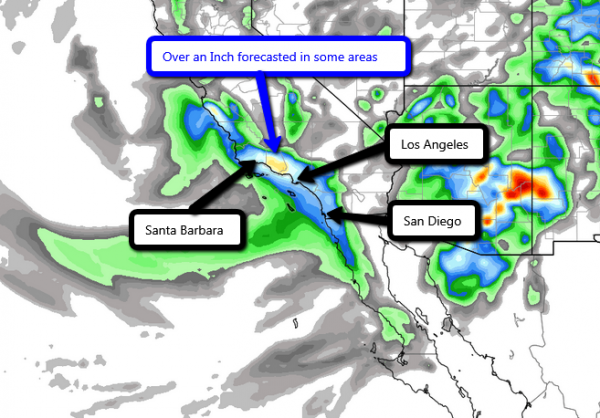
- Heavy rain yesterday already created serious flooding and mudslides. Some areas reported 5"+ of rainfall, which destroyed roads and flooded low-lying areas. After additional rain today, expect continued flooding concerns, but the good news is that dry skies are in sight. Rainfall should wrap up across this area by the end of this evening.

Some impressive rain fall totals so far from the NWS at 4am Saturday:
- Newhall 3.14"
- San Gabriel Dam 5.15"
- Crystal Lake 7.28"
- Camp Hi Hill 7.75
- Cogswell Dam 8.19
- White Ledge Peak 5.00"
- Black Mountain 4.76"

- Heavy rains have already caused mudslides and flooding across much of the area. Try to remain off roads and do not risk driving your vehicle through a flooded road. It only takes a few inches to knock you off your feet and 6" to move your vehicle.

SEVERE RISK TODAY
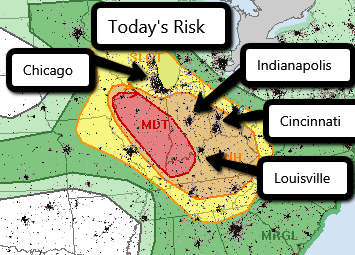
- The Storm Prediction Center has issued a slight risk for most of the Southeast Sunday. The main risks will be widespread straight line wind damage and hail. A few tornadoes cannot be ruled out. The same system that is bringing snow and ice to the Central Plains will continue to dive south bringing the cold air to the warm moist air in the gulf creating strong instability. That coupled with decent wind shear will create the opportunity for a line to form Sunday evening and overnight. Expect a long narrow band of high precip and damaging winds to form into a squall line with the chance of isolated tornadoes. Here is the risk that the SPC has issued for tomorrow:

SUMMARY:
- A lot going on out there today and tomorrow. Biggest concern for me today is the rain/ice/snow mix falling this evening from Missouri to West Virginia. Difficult travel conditions along with several power outages can be expected. It's best to get home and stay there this weekend. California has been experiencing heavy rain and isolated severe weather yesterday. Today expect another round of rain, although I don't expect totals today to be as high as yesterday. Stay off flooded roads and take proper precautions for flooding in your area. Tomorrow evening expect a line of thunderstorms to form and produce damaging winds and hail for most areas. This most likely WILL be an overnight event, so make sure your weather radios are on and you take proper precautions before going to sleep.  After these next few days, things should begin to quiet down as high pressure will take control over most of the central US. Stay safe!

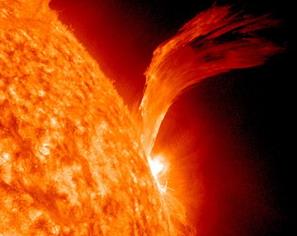
Will Future Sunburst Unplug The Earth? X-Class solar flares are measured on a G-scale from 1-5. A Category 4 or 5 geomagnetic storm has the potential, under just the right circumstances, to bring down the grid. How likely? Here's an excerpt of a story at pressherald.com: "...If the remnants of a similar solar flare struck the planet today? “Gee, I’d be without cable TV,” Melott deadpanned. Without email too, some fear. No heating or cooling. No electric grid. Satellite technology, it was nice knowing you. This is the scenario rolling out from a growing network of scientists, policymakers and survivalists. Not quite doomsday because life itself would continue, but a silent natural disaster that could unplug us from all we depend upon..."
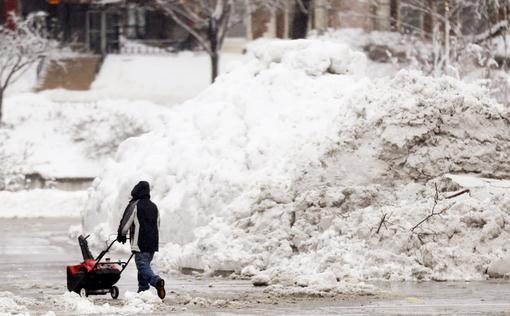
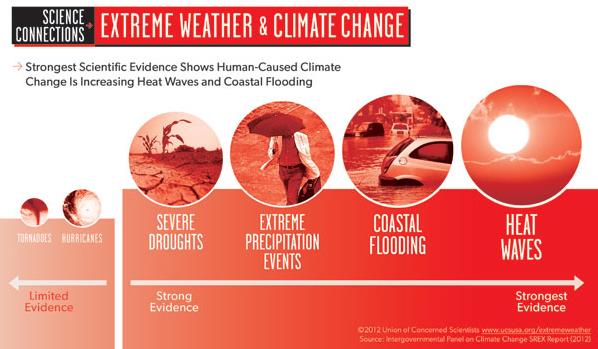
Photo credit above: "This image shows a solar flare just as sunspot 1105 was turning away from Earth on Sept. 8, 2010. The active region erupted, producing a solar flare and a fantastic prominence." The Associated Press.


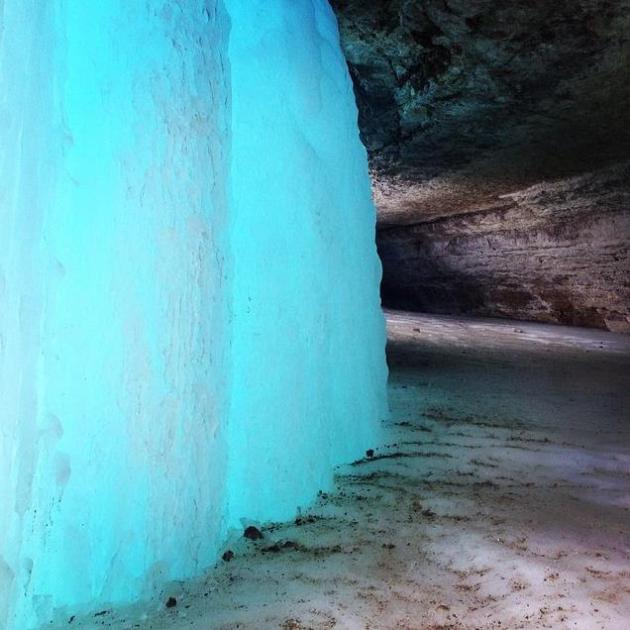
* photo above of an icy, eerie-looking Minnehaha Falls courtesy of Tracey Palmer.