Wednesday, November 27, 2013

A Relatively Quiet Thanksgiving - Snowier Pattern Late Next Week?


"Thanksgivukkah"

My late mother taught us to celebrate Thanksgiving every day of the year. She had a point. Our ancestors at Plymouth Rock were living meal to meal - trying to avoid smallpox and being murdered by Old Man Winter. It puts our modern-day challenges and setbacks into perspective.
Thanksgiving and Hanukkah fall on the same day for the first time since 1888. It won't happen again until 78,881. No kidding.

The hyper-local dining room forecast calls for several inches of turkey and blizzards of mashed potato drifts, washed down with a few showers of hot gravy.

Am I stuffing too much into this forecast? My bad.

It's chilly, but at least the sun is out, afternoon highs in the mid-20s. No problems for power-shopping Friday or getting home Sunday. ECMWF model guidance shows a potential for a significant, plowable snowfall from Wednesday night into Friday of next week, followed by a healthy swipe of arctic air in 8-12 days; even a few nights below zero in the metro area?

NOAA's CFS (Climate Forecast System) model predicts 5 inches of snow on the ground for Christmas. We'll see. Statistically 7 out of 10 Christmases at MSP are white.

OK, enough babble. Time for my pre-turkey nap.

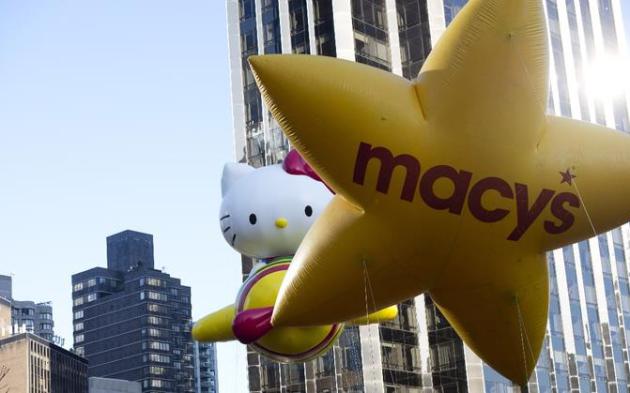
Macy's Might Have To Throw A Thanksgiving Day Parade Without Balloons. It's all about wind speeds and gusts in mid-town Manhattan; details in this clip from The Wire: "After a 1997 balloon crash on a windy parade day left one woman seriously injured, the city enacted a rule barring balloons from the parade if sustained winds reach 23 mph and gusts exceed 34 mph. Current forecasts predict sustained winds of 20 mph and gusts of 36 mph. Macy's spokesman Orlando Veras told the AP that parade officials won't make a decision on the balloons until tomorrow morning: "On Thanksgiving morning, Macy's works closely with the NYPD, who, based on real time weather data and the official regulations, determine if the balloons will fly and at what heights," he said..." (Photo credit above: AP).

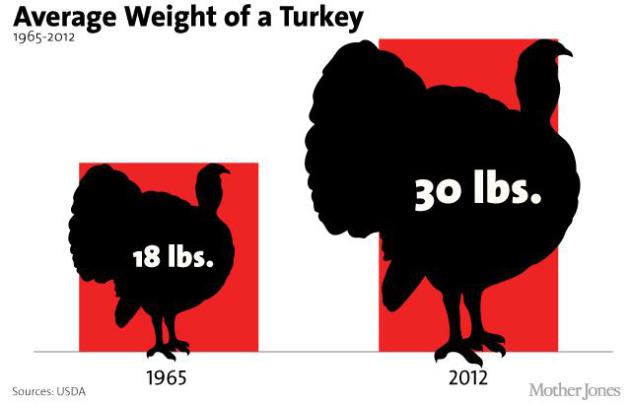
Your Thanksgiving Turkey In 6 Eye-Popping Charts. I did not know that! And frankly, I'm not sure I wanted to know that! The folks at Mother Jones break down turkey consumption and a few head-shaking nuggets.

"Thanksgivukkah". Today is an extraordinary day in many respects, as pointed out in this amusing YouTube video clip: "The last time Thanksgiving and Chanukah converged, it was 1888. It won't happen again until the year 78811 (and that's CE!). To celebrate, we wrote a song. Happy Thanksgivukkah, everyone!"

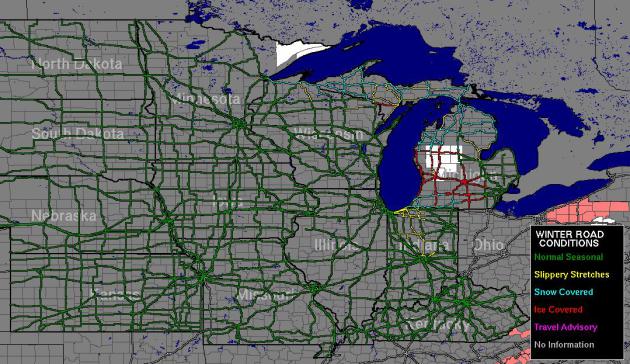
Midwest Travel Conditions. Roads are snow and ice covered across much of Michigan and northern Indiana, the result of lake effect snow squalls. Click here for the latest road conditions, courtesy of the University of Wisconsin.

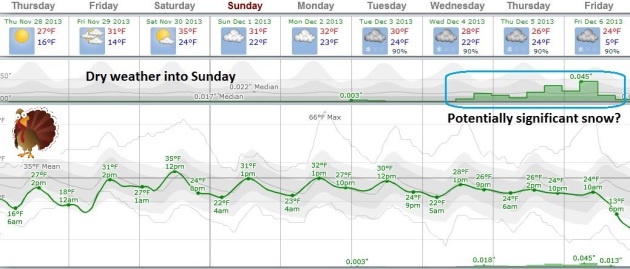
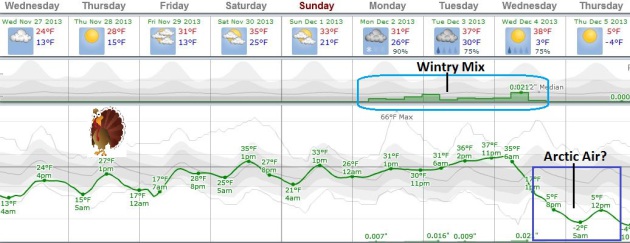
Quiet Into Sunday - Major Pattern Shift Late Next Week? It's too early to start ringing the snow bell (gong), but I'm seeing some signs on the maps that winter may finally bully its way into Minnesota and the rest of the USA late next week, preceded by the best chance of accumulating snow I've seen yet this winter season, from late Wednesday into Friday of next week - before temperature go over a cliff. The good news: no weather-related travel drama close to home into Monday. Graph: Weatherspark.

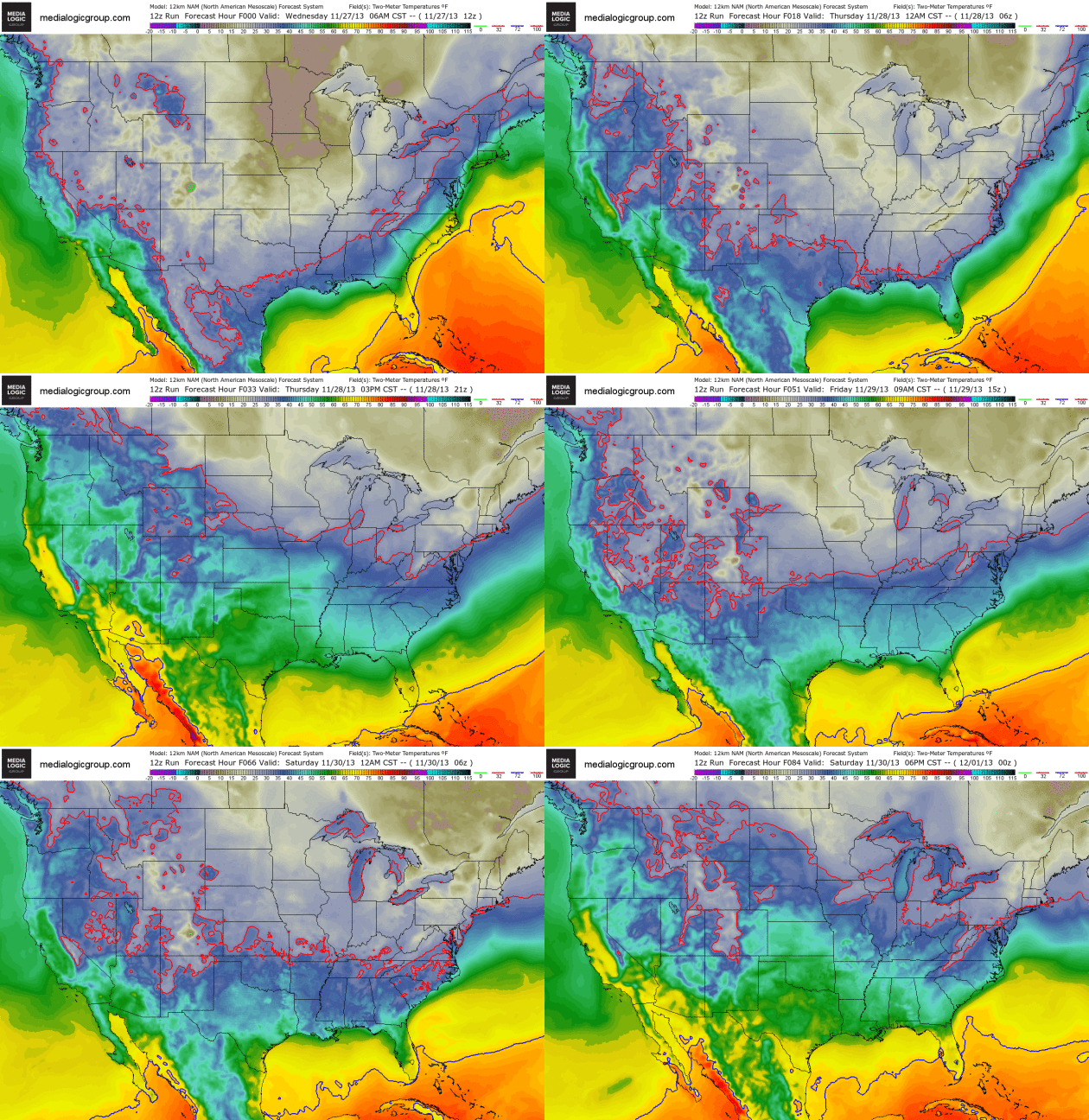
Thanksgiving Chill. Temperature will run a few degrees below average today from the Upper Mississippi Valley into the Great Lakes and New England, cold exhaust on the backside of the coastal storm that soaked much of the eastern seaboard. Watch the 32-degree isotherm (solid red line) push into the Florida Panhandle. Animation: NOAA and Ham Weather.

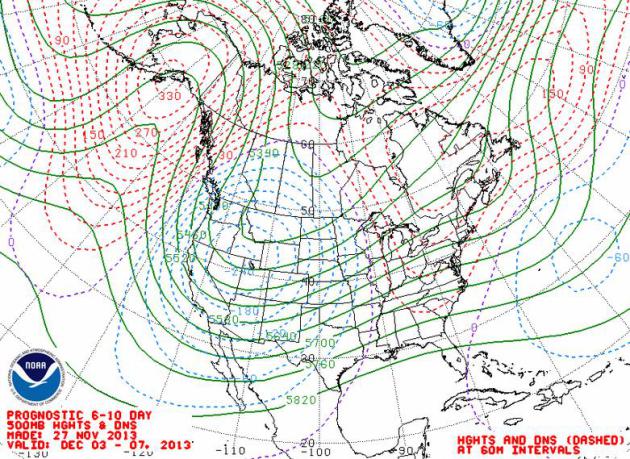
Think Snow. Anyone who follows the weather closely will take one look at the predicted 500 mb map above and see the (growing) potential for a significant snow event in early December from the Rockies into the Plains and Upper Midwest. Details are sketchy, but a surge of bitter air is forecast to carve out a deep long-wave trough over the Rockies, turning steering winds to the southwest, allowing Gulf moisture to surge north. These troughs of low pressure are storm incubators, and this could spell significant snow from Denver to Omaha and the Twin Cities the latter half of next week.

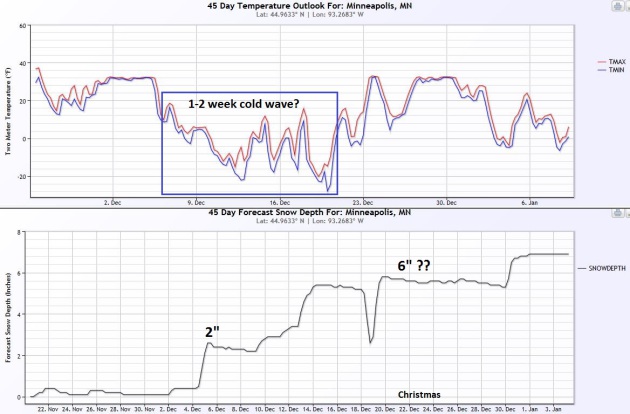
45-Day Wish-Cast. NOAA's CFS (Climate Forecast System) model is suggesting an extended period of temperatures well below average, from roughly December 6-18; a couple of weeks of single digits and teens for highs and nights below zero? We'll see, but this model has been fairly consistent with bitter air for the second week of December. By the way, we're scheduled to have nearly 6" of snow on the ground for Christmas in the Twin Cities. Give or take 6 inches. Source: NOAA CPC and Ham Weather.

Everything You Know About Getting Warm Is Wrong. Huffington Post has a timely article about methods for staying warm in the coming months; what works, and what just makes the situation even worse. Here's an excerpt: "...Drinking alcohol lowers your core body temperature, increases your risk for hypothermia and prevents your body from naturally shivering to keep warm. The reason why you feel warm while drinking alcohol is that your blood vessels dilate and send warm blood away from your core and towards your skin. This effect is only temporary and in the end significantly decreases your body's ability to fight the cold..."

In Spite Of Nagging Drought - 2013 Was Second Best Year For Farming Since 1973. Here's an excerpt of a good summary from CNBC: "...In crop projectiongs this month, the USDA increased its estimated total for corn to 1 percent over last year's estimate, and soybean production up 3 percent from the 2013 estimate. Corn will see total production at a record level of nearly 14 billion bushels. Those higher estimates came despite many areas of Iowa, Minnesota and the Upper Midwest dealing with late planting, along with some late-season drought conditions. Net farm income is also on the rise. It's forecast to be $120.6 billion in 2013, up 6 percent from 2012's estimate of $113.8 billion. After adjusting for inflation, 2013's net farm income is expected to be the second highest since 1973, according to the USDA..."

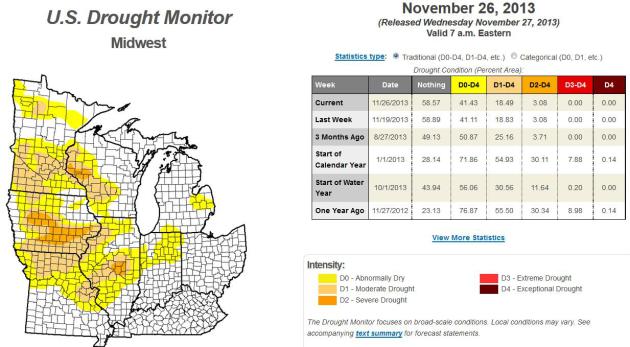
* the latest U.S. Drought Monitor update for the Upper Midwest, Great Lakes and Ohio Valley is here.

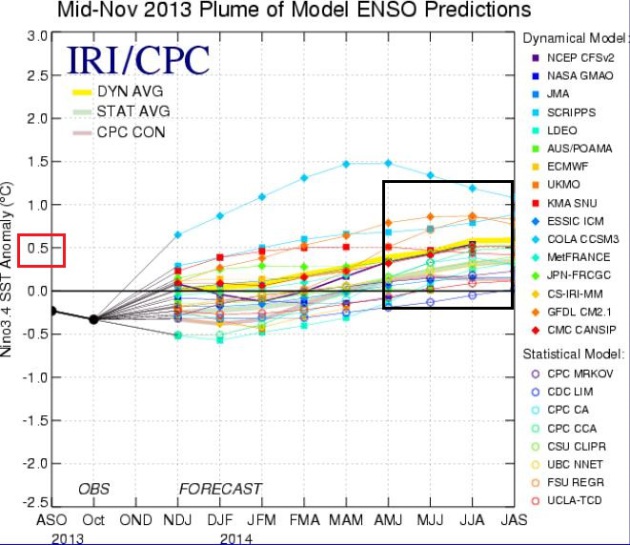
Growing Signs Of El Nino In 2014. The graphic above is from NOAA's latest ENSO update; after years of a perpetual La Nina cooling phase of the equatorial Pacific there are growing signs of a possible El Nino warming phase developing by early 2014; which may, in turn, favor milder than normal temperatures, and a southern storm track across the USA into the latter half of winter. It won't be declared an official El Nino event until and unless we go at least 3 consecutive months with sea surface temperatures .5C warmer than average.


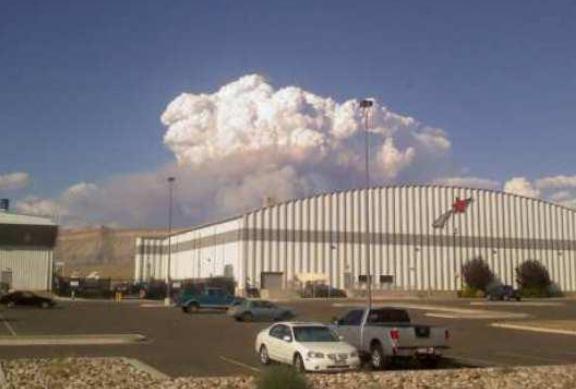
Battling Flames In Forests, With Prison As The Firehouse. The New York Times has the story of how many states are throwing more manpower on the front lines of major wildfires; here's an excerpt: "...As federal agencies have cut costs during the budget standoffs in Washington, further decreasing the size of a firefighting work force that has already been reduced by 40 percent since the 1980s, the burden of fighting wildfires has been shifted to states and local jurisdictions, even as they struggle under the weight of a sluggish economy. Prison crews, cheap and dependable, have emerged as a solution as wildfires burn bigger, hotter and longer each year and take up a growing portion of the United States Forest Service budget. (In 2012 alone, federal agencies spent $1.9 billion on wildfire suppression, just shy of the record, set in 2006.)..." (Photo above: Grand Junction office of the National Weather Service).

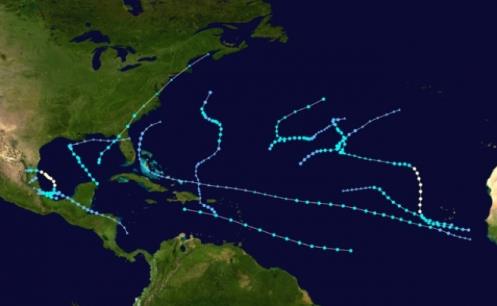
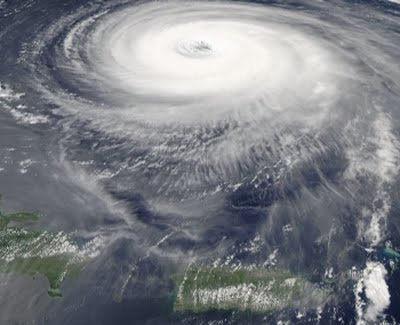
Least Active Atlantic Hurricane Season In 30 Years. Meteorologist Andrew Freedman has a good summary of a head-scratcher of a hurricane season at Climate Central; here's an excerpt: "Defying dire outlooks issued in the spring, the 2013 Atlantic hurricane season, which officially ends Nov. 30, was the least active since 1982, and the sixth-least-active season since 1950, the National Oceanic and Atmospheric Administration (NOAA) said on Monday. There were no landfalling hurricanes in the U.S. in 2013. In fact, it has been more than 8 years since the last major hurricane of Category 3 intensity or greater struck the U.S., a record stretch. The last major hurricane strike occurred in 2005, when Hurricane Wilma hit Florida. When the start of the 2014 Atlantic hurricane season rolls around on June 1, 2014, it will have been 3,142 days since that storm made landfall, a record timespan..."

Graphic credit above: "Map of 2013 tropical storm and hurricane tracks." Credit: Wikimedia Commons.

The Pioneers Of Seasonal Hurricane Forecasting Might Stop Doing It. They insist it has nothing to do with this year's poor track record, as reported by SFGate.com; here's a clip: "...Many seasonal forecasters predicted that overall activity — measured in terms of the number of storms, their intensity and their duration, would be as much as twice as high as average levels. Instead activity was only about 30 percent of typical levels, or one of the five quietest years in the last half century of Atlantic hurricane seasons. Now comes word that the dean of seasonal forecasting, William Gray and his co-author Phil Klotzbach, of Colorado State University, may be ending their forecasts. It has nothing to do with their poor forecast this year, they say..." (Image credit: NASA).

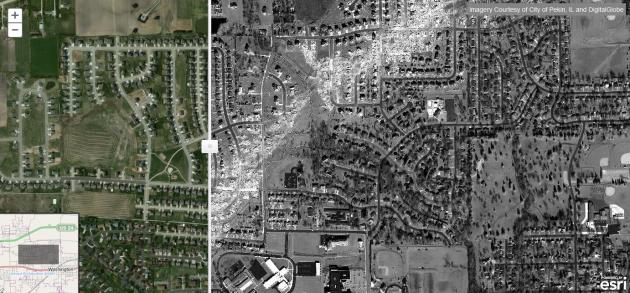
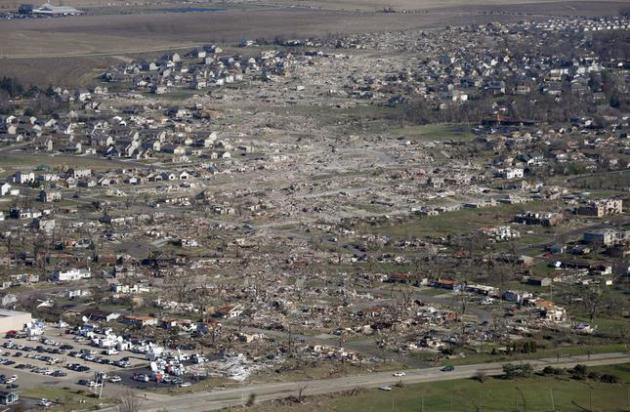
Before And After The Tornadoes In Illinois. ESRI has an interactive URL that shows the severity of damage in Washington Illinois, after an EF-4 tornado bull-dozed its way across the center of town on November 17.

The Silent Triumph: Weather Warnings Saved Hundreds Of Lives In Midwest Tornado Outbreak. 106 tornado reports on November 17, some as far north as Michigan - unprecedented in their violence and how late in the season they formed this far north. Here's a clip from Capital Weather Gang, a quote from meteorologist Mike Smith that resonated: "...
The lower death toll from this week’s storms was not inevitable; it is the result of a half-century of scientific discovery and technological development: Doppler radar, weather satellites, lightning detection networks and smartphone apps. It is a result of volunteer storm chasers instantly reporting the most violent tornado (the Washington, Ill., storm) when it first touched down near Pekin.
No other nation enjoys the quality and breadth of meteorological services available in the United States. It is an area in which federal dollars are put to valuable use and leveraged through the efforts of private-sector weather companies such as AccuWeather, and by meteorologists and emergency managers.
File photo above: AP Photo/Charles Rex Arbogast.

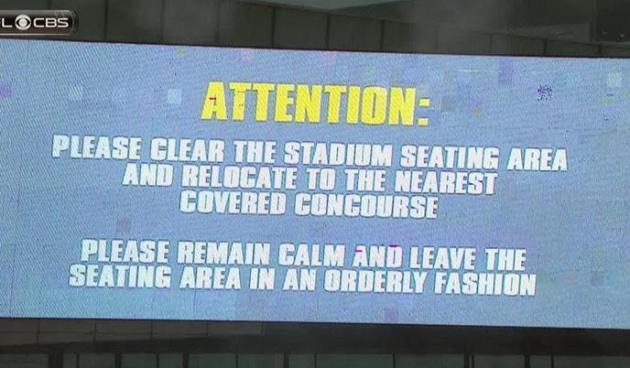
Special Report: Storming The Field. Fans sitting in a stadium are sitting ducks when it comes to weather, especially extreme weather. New technologies, apps and alerts can help, but it pays to be continually weather-aware. Don't depend on anyone else for your safety, or the safety of your family. Here's an excerpt of a story at WTVM.com in Columbus, Georgia: "...It could be dangerous, but where are you supposed to go?" asked former Auburn kicker Al Del Greco. Tornadoes can happen anywhere, even at football stadiums. The good news is that tornado safety has changed since 1983. Just this season, the South Carolina/North Carolina game was delayed and the stadium was evacuated after a severe storm with lightning moved in during the second half. Colleges and universities now have rules in place, and it starts with the suspension of play. "If we left the game playing, nobody's going to leave. They're not going to take it serious. They're going to sit there and keep watching as long as it's playing," explains Chance Corbett, the Auburn director of public safety..."

Stock Returns Affected By Weather, Says Study. Say what? Valuewalk.com has a story that made me do a triple-take; here's an excerpt: "The Quant Research Team at www.empiritrage.com has drawn attention to a recent study by William Goetzmann, Dasol Kim, Alok Kumar and Qin Wang which shows that weather-based indicators of mood impact perceptions of mispricing and trading decisions of institutional investors. According to Empiritrage analyst William N. Goetzmann, “It is interesting because it points out that weather may affect highly educated investors, and that it would be interesting to see how the temperature (as opposed to cloudiness) affects stock returns...”

Researchers Track Outdoor Air Temperatures By Measuring The Battery Temperatures Of Smartphones. Here's an innovative way to track hyper-local changes in air temperature, as described in this clip from Inside Science: "...On the other hand, Georgescu's ASU colleague David Hondula, who was not involved in this study, wants to use smartphones to track the heat exposure of individuals. "If your phone is tracking your weather conditions, you might have a personalized alert that you have experienced excessive heat as you've moved through your daily life," said Hondula. When informed of their heat exposure, people can take steps to protect their health, and thus reduce heat-related mortality. In Hondula's words, "There's certainly the potential for many important questions to be answered, if everyone's walking around with a potential environmental monitor in their pocket."

The Daniel Fast: A Diet From God? Step away from the turkey - just fruit and vegetables going forward, ok? Here's a clip from an interesting story at The Atlantic: "...Daniel said he and his friends would eat a diet of only vegetables (“pulse”). After 10 days, they grew healthier and stronger than the Babylonians, and his diet became a small demonstration of his opposition to the King’s power. This passage is occasionally used to encourage Christians to resist the corrupting influences of the outside world. But several years ago, some Protestant churches began to take the “diet” aspect of Daniel’s story literally. Motivated by both faith and fitness, today many protestant Christians around the country are, like Daniel, occasionally limiting themselves to fruits and vegetables for 21-day increments..."

Image credit above: "flickr/A Gude/Waiting for the Word/Frapestaartje."

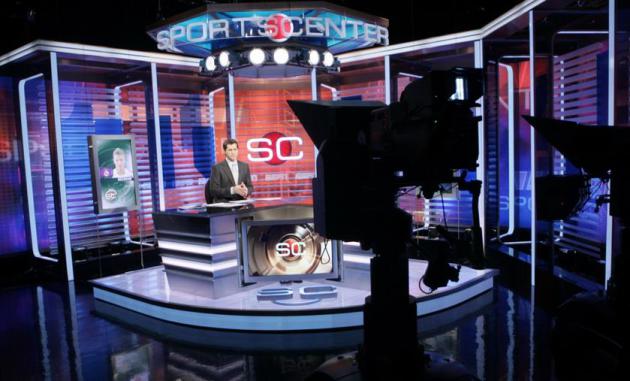
"Action": From Sports Star To TV Star. The New Yorker has a fascinating article about how ESPN grooms it's on-air talent, making that hard turn from sports star to TV "personality"; here's the excerpt: "...ESPN, the Megalodon of sports broadcasting, has no shortage of retired millionaires sending job applications: both the N.F.L. and the N.B.A. host annual seminars for players interested in broadcasting, and a current Pittsburgh Steeler recently asked if he could work as an unpaid intern. But finding linebackers who understand the difference between B-roll and a boom mike can be difficult. “They go from a job where you’re trained to say as little as possible to a job where you need to say as much as possible,” Gerry Matalon, a senior producer who helps run ESPN’s on-air talent development, said recently. In 2008, to remedy the problem, ESPN created a talent department staffed with several performance coaches like Nash..."


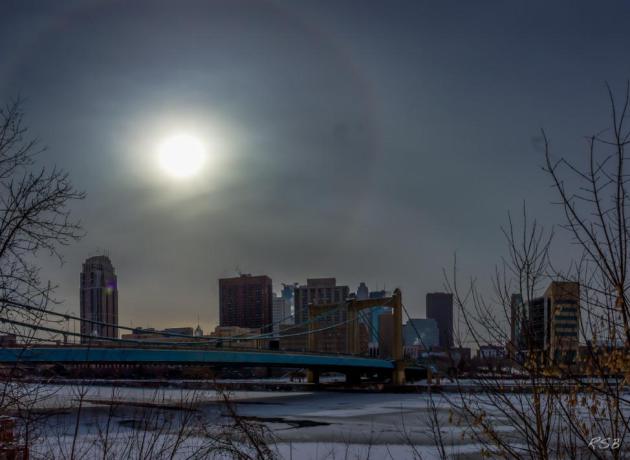
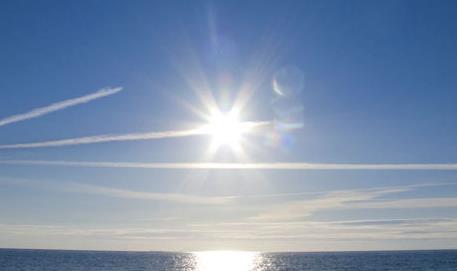
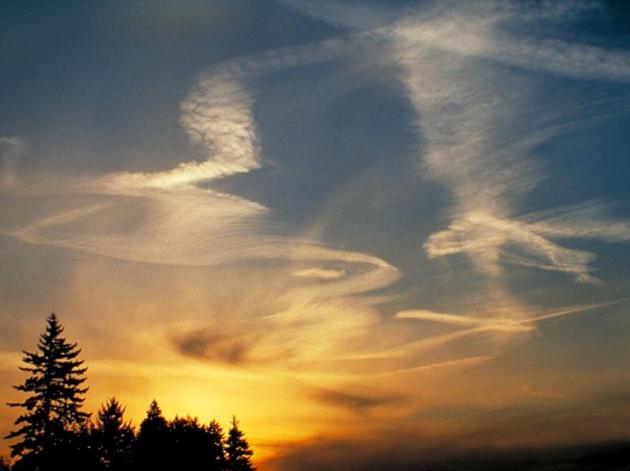
* 22 degree halo photo courtesy of Steve Burns.

Climate Stories...

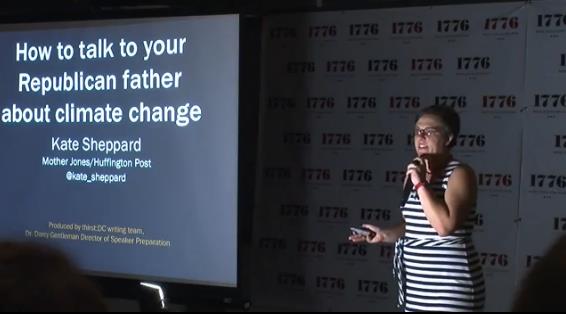
Can You Talk Turkey With Your Climate-Change-Denying Relatives This Thanksgiving? After reading this (and checking out the video) I wasn't sure whether to laugh or weep; here's an excerpt from Huffington Post: "...Thanksgiving is coming and you know what that means, folks: dinner with your climate-change-denying relatives. You know who I'm talking about. The uncle who thinks sunspots are the reason the planet's getting warmer. The cousin who thinks dinosaur farts are to blame. Grandma, who also thinks President Barack Obama is a lizard from space. Maybe you try to avoid these conversations at your Thanksgiving dinner. But there usually comes a point in the evening when, having exhausted all conversation about how lovely the new trivet is and yes, the traffic yesterday was just the worst, other topics come up. Sometimes you start talking about the weather … and then all of a sudden you're arguing about whether Al Gore's breath is really the reason it's been so hot lately..."

Chris Hadfield: We Should Treat Earth As Kindly As We Treat Spacecraft. Here's an excerpt of a thoughtful, timely piece from NASA astronaut Chris Hadfield, in Wired Science: "...While I was on the space station, I used Twitter to ask hundreds of thousands of people what they would like me to take a picture of. Resoundingly, the answer was “home.” Everyone, from all around the world, wanted to see their hometowns. I found that thought-provoking. After millennia of wandering and settling, we are still most curious about how we fit in and how our community looks in the context of the rest of the world. A curiosity of self-­awareness, now answerable by technology. This is where the answers to our problems will start..."

Image credit above: "Astronaut Chris Hadfield was commander of Expedition 35 on the International Space Station, from December 2012 to May 2013." Tavis Coburn.

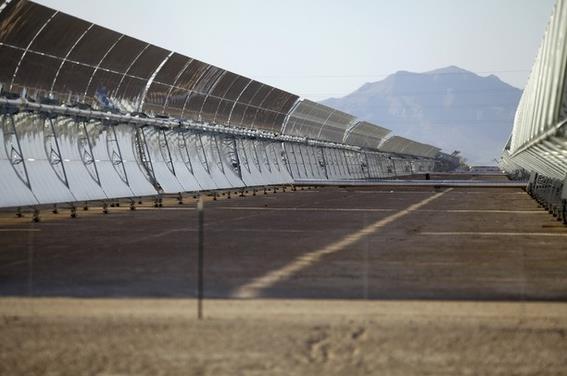
Solar Energy Was America's Sole New Power Source In October. My dream (among others) is to be able to power my Tesla Model S, for free, with affordable solar power and battery storage in my garage. That day may be fast approaching. Here's a clip from The Atlantic: "In October, power plants generating 530 megawatts of electricity came online in the United States. And every single electron put on the grid came from the sun, according to a report released today. It’s possible to make too much of the fact that solar energy was the sole source of new electricity capacity in US that month. After all, the completion dates of power plants can be random. That’s particularly true for complex, multibillion-dollar, fossil fuel power stations that can take years to build and are subject to oversight by state regulators..."

Photo credit above: "A solar thermal power plant." (Reuters).

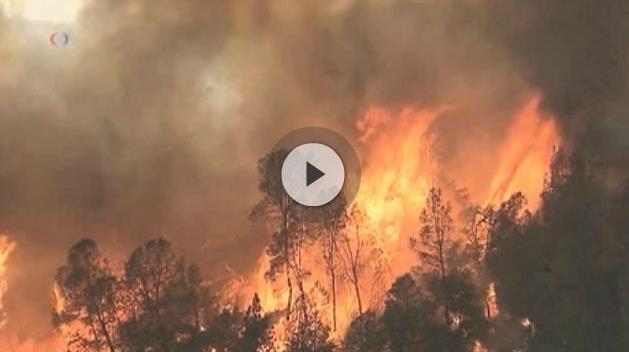
High Intensity "Megafires" A New Global Danger. Here's an excerpt (and video clip) from VOA, Voice of America: ".."

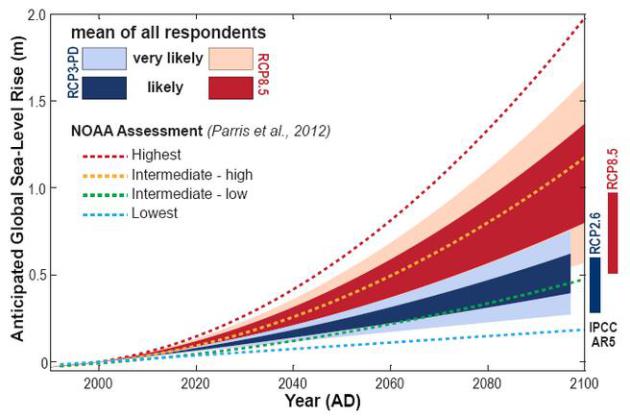
How High Will Sea Levels Rise? Let's Ask The Experts. Here's a snippet from a comprehensive article at The Washington Post: "...So here's one way to get a better sense for the broader debate: A new study in Quaternary Science Reviews simply asked 90 experts on sea-level rise for their projections, based on their work. This isn't brand-new scientific research, but it does give a very useful overview of the current state of research. The results? The experts, on average, think global sea levels will rise somewhere between 0.7 and 1.2 meters by the end of the century if global warming continues unchecked (that's between 2.2 and 4 feet)..."

Acidifying Oceans Alarm Hundreds Of Scientists. Here's a clip from a story at Environment News Service: "...Climate change is causing the world’s oceans to acidify at rates not seen for the last 55 million years, and the only way to moderate this danger is to reduce human emissions of carbon dioxide, conclude 540 scientists from 37 countries in a new report. Their conclusion is the outcome of the Third Symposium on the Ocean in a High CO2 World that took place in Monterey, California in September 2012. The findings of these experts were presented in a report to the Conference on Climate Change that took place in Warsaw from November 11 to 22..." (Photo credit: Alamy).

Research Suggests Future Global Warming Has Been Underestimated. UPI has the article - here's a clip: "Global warming could go on for centuries even with a complete stop of CO2 emissions and then stabilize at an even higher temperature, a Swiss scientist says. Researcher Thomas Frolicher says computer models contradict the assumption by many scientists that global warming would come to an end if, some day, humans succeed in ending the release of greenhouse gas emissions into the atmosphere. Frolicher and U.S. colleagues report they've used a model that represents physical and biogeochemical processes -- such as the exchange of greenhouse gases and heat with the oceans -- at a far more detailed level than many previous models..."

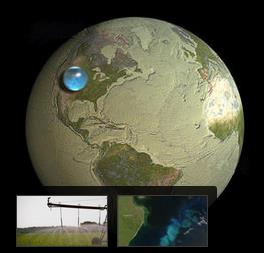
What 11 Billion People Mean For Water Scarcity. Yahoo News has the story - here's the introduction: "The water woes plaguing the Southwest foreshadow a worldwide problem to come. Already, 2.7 billion people globally face at least some water scarcity, according to a 2012 study detailed in the journal PLOS ONE. Fights over water rights are causing political conflicts and instability in such places as the Nile valley and the Indian subcontinent. As population sizes rise, those conflicts will get more intense, according to a report by the National Intelligence Council, which advises the director of national intelligence for the United States about national security issues. And the latest population models predict that 11 billion people will live on Earth by 2100, according to a United Nations report released last summer..."

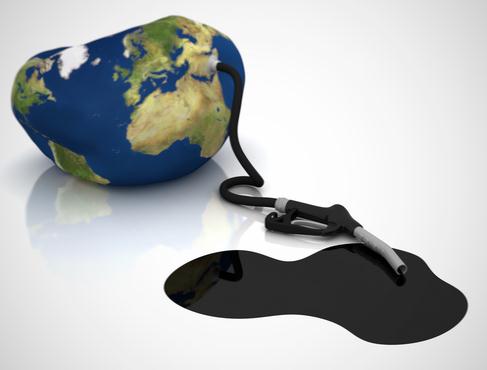
On Campuses, A Fossil Fuels Divestment Movement. The Washington Post has the story - here's the introduction: "A divestment movement is marching across U.S. college campuses, borrowing tactics from the 1980s anti-apartheid campaign and using them against oil, gas and coal companies to fight climate change. Students are teaming with investment advisers to convince universities, pension funds and institutional investors that they can take a stand against fossil-fuel companies without hurting their returns. “We have a government that has been taken over by the fossil-fuel industry, so we’re going to pressure the fossil-fuel industry itself,” said Chloe Maxmin, a junior leading Divest Harvard..." (Image: Clean Technica).

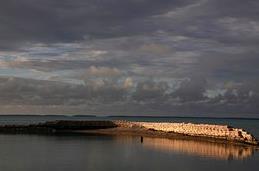
Global Warming Threatens Pacific Economies, Report Says. Here's an excerpt from Real Time Economics at The Wall Street Journal: "...Rising temperatures might sound nice for people planning a beach vacation. But for Pacific Island nations, global warming poses a big threat to their ability to capture tourist dollars, according to the Asian Development Bank. In a report Tuesday, the Manila-based lender says sun-baked tropical nations from Samoa to the Cook Islands that rely on tourism income could become less attractive destinations as global temperatures rise..."

Photo credit above: Reuters. "A wall built to protect people from rising tides in the Pacific island nation of Kiribati."

U.S. Methane Study Says Emissions 50% Higher Than EPA Estimates. Here's an excerpt from a story by the AP and Huffington Post: "The United States is spewing 50 percent more methane — a potent heat-trapping gas — than the federal government estimates, a new comprehensive scientific study says. Much of it is coming from just three states: Texas, Oklahoma and Kansas. That means methane may be a bigger global warming issue than thought, scientists say. Methane is 21 times more potent at trapping heat than carbon dioxide, the most abundant global warming gas, although it doesn't stay in the air as long. Much of that extra methane, also called natural gas, seems to be coming from livestock, including manure, belches, and flatulence, as well as leaks from refining and drilling for oil and gas, the study says. It was published Monday in the Proceedings of the National Academy of Science..."
Tuesday, November 26, 2013

Latest Details on Nor'Easter Impacting Thanksgiving Travel (unconventional ways to stay warm in the coming months)


Half a November

It's a little odd shivering through the chill without any snow on the ground. Perpetually-frustrated snow lovers are starting to feel cheated again.

A paltry inch of wet snow has dribbled on the Twin Cities this month. We should have picked up over 7 inches by now. Adding insult to injury much of north Texas and the hills of Georgia have picked up more snow than MSP this month.

Another upside-down weather map.

If you listen carefully you can almost hear the gnashing of teeth and shrieks of frustration from travelers out east. A coastal storm soaks D.C., New York & Boston with 2-3 inches of rain; heavy snow cakes the Appalachians on the busiest travel day of the year. Proving that Old Man Winter has a wicked sense of humor.

A scrawny clipper brushes the Arrowhead with 1 inch of snow today; otherwise plan on dry skies (and roads) into the weekend with slowly moderating temperatures. Mid 30s return the first half of next week with a little snow or mixed precipitation.

I still don't see The Big One.

Temperature may fall off a cliff in 8 days: single digits & low teens with subzero lows after December 4? But major storms detour well south and east of Minnesota into mid-December.

Easy Traveling Into Sunday. ECMWF guidance shows a slow warming trend into the weekend. Low to mid 30s is not atmospheric bargain, but compared to Tuesday's sting it should feel pretty good out there by Saturday and Sunday. The approach of a much colder front may set off wet snow, or a wintry mix Monday and Tuesday. Temperatures may plummet by the middle of next week, early guidance showing a "high" of 5 a week from tomorrow. Graph: Weatherspark.

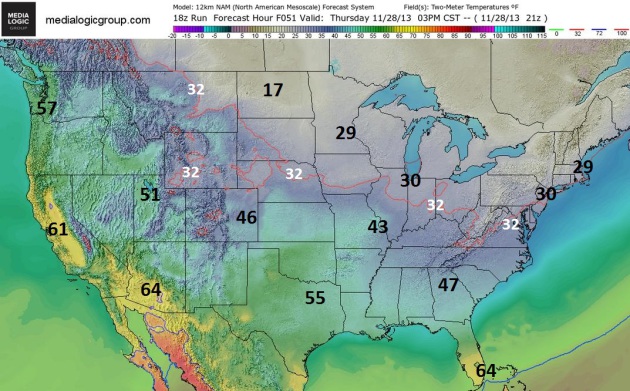
Thanksgiving Highs. With a low sun angle and short duration of daylight maximum temperatures take place early in the afternoon. The map above shows 3 PM temperatures on Thursday, courtesy of NOAA's 12km NAM and Ham Weather.

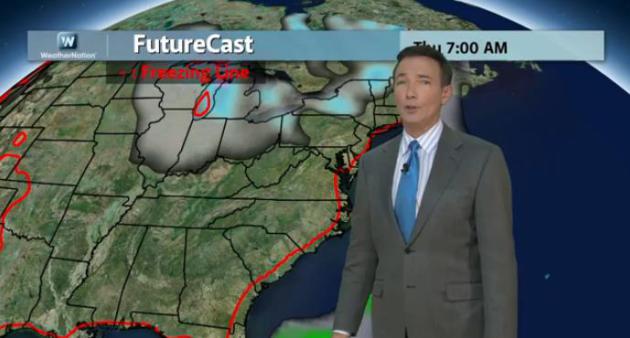
Thanksgiving Weather Details. We lucked out here in the Upper Midwest, but folks out east are not taking quiet weather for granted, not today. The most traveled day of the year is a rainy, windy, icy, snowy mess. A surge of cold air on the backside of this powerful coastal storm will push the freezing line to the Gulf Coast and Florida Panhandle - highs in the 50s over south Florida Thanksgiving Day. Brrr. Hey, we grill at that temperature here in Minnesota, but everything is relative. More travel weather details, and late November tornado climatology in today's edition of Climate Matters.

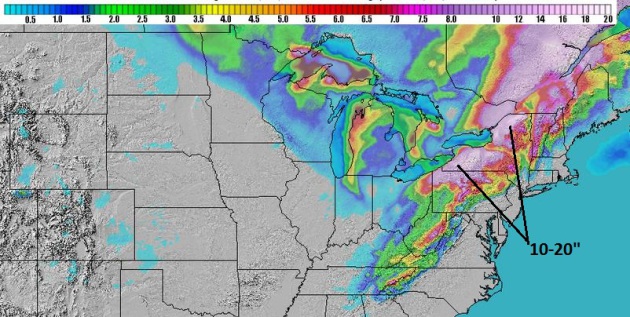
Snowfall Totals. The heaviest snow bands are forecast to set up from northwestern Pennsylvania into upstate New York and northern New England. Lake Effect snows will drop some 5-10"+ amounts over the U.P. of Michigan and northern Indiana. NAM 84-hour snowfall courtesy of NOAA and Ham Weather.

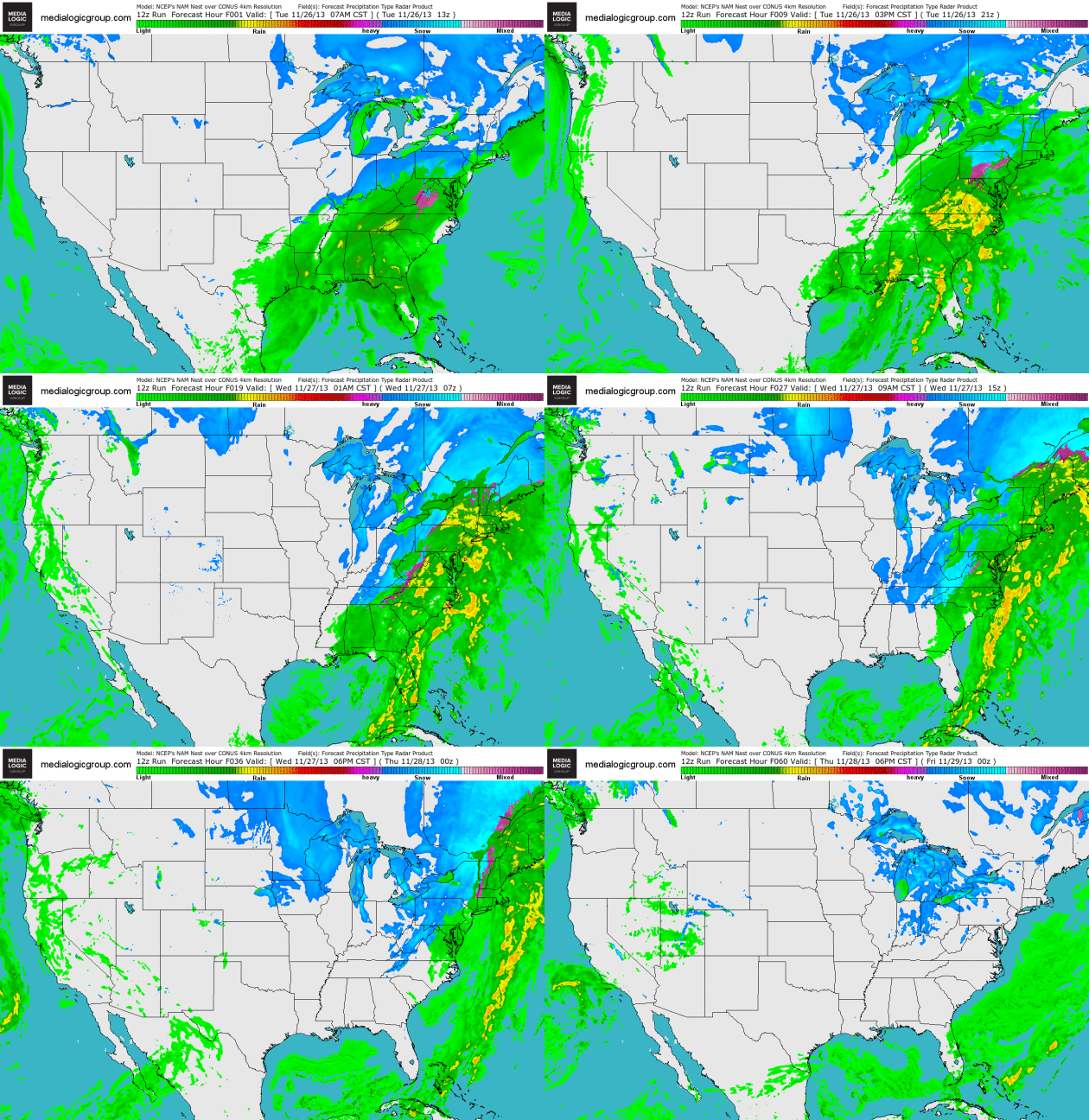
Exit Stage Right. Today will test your patience if you're traveling anywhere from the Great Lakes and New England to the Mid Atlantic states; heavy rain pushing up the east coast, changing to heavy snow over the Appalachians. The good news: this storm will be well out to sea by Thanksgiving Day. 4km NAM Future Radar courtesy of NOAA and Ham Weather.

Everything You Know About Getting Warm Is Wrong. Huffington Post has a timely article about methods for staying warm in the coming months; what works, and what just makes the situation even worse. Here's an excerpt: "...Drinking alcohol lowers your core body temperature, increases your risk for hypothermia and prevents your body from naturally shivering to keep warm. The reason why you feel warm while drinking alcohol is that your blood vessels dilate and send warm blood away from your core and towards your skin. This effect is only temporary and in the end significantly decreases your body's ability to fight the cold..."

Growing Signs Of El Nino In 2014. The graphic above is from NOAA's latest ENSO update; after years of a perpetual La Nina cooling phase of the equatorial Pacific there are growing signs of a possible El Nino warming phase developing by early 2014; which may, in turn, favor milder than normal temperatures, and a southern storm track across the USA into the latter half of winter. It won't be declared an official El Nino event until and unless we go at least 3 consecutive months with sea surface temperatures .5C warmer than average.

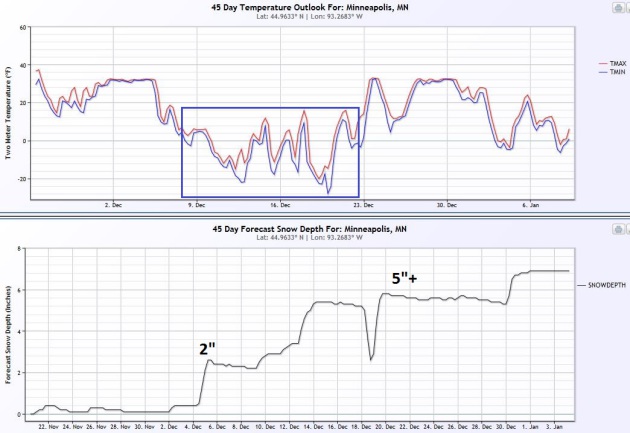
45-Day Wish-Cast. My confidence level is low (a -1 on a scale from 1 to 10), but I find these long range CFS (Climate Forecast System) forecasts from NOAA CPC interesting. I'm trying to determine if there is ANY skill here. The latest forecast calls for an arctic snap between December 8-20, with a slight warming trend in time for Christmas. The model shows 2" of snow on the ground by December 5, about 5"+ on the ground in time for Christmas Eve. Place your bets.

Alerts Broadcaster Briefing: Excerpt of a summary issued Tuesday, November 26, 2013.

* The most ill-timed storm of 2013 is pushing heavy rain and snow up east coast; heavy rain still likely for eastern seaboard - plowable snows for the Appalachians, Blue Ridge Mountains and Shenandoah Valley. Heaviest snows expected over western Pennsylvania and upstate New York.
* 2-4" rains along and east of I-95 later today, tonight and Wednesday morning will trigger sporadic urban flooding.
* Travel by land and air will continue to be disrupted; the worst of the storm along the I-95 corridor from Tuesday evening into Wednesday morning.
* Storm pushes into the Atlantic by Thanksgiving Day - no problems on Thursday.
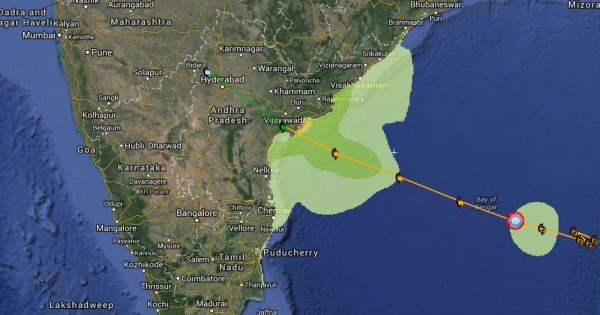
* Typhoon Lehar forecast to strike the eastern coastline of India (Andhra Pradesh region) as a strong tropical storm or weak hurricane Thursday.

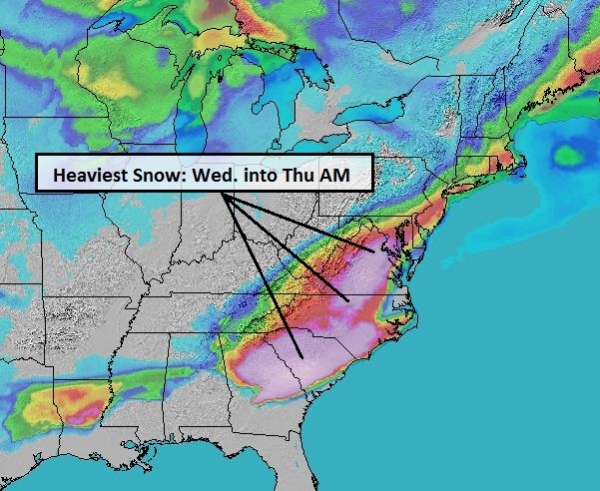
Snowfall Potential. Snowfall amounts will be tied to elevation; higher terrain of the Appalachians will nudge precipitation from rain over to snow, with enough to shovel, plow and snarl traffic from near Asheville, North Carolina into eastern Kentucky, eastern Ohio and much of central and western Pennsylvania and New York state - enough snow to cause problems generally west of I-81. NAM model: Ham Weather.

Another Solution. The RPM model isn't nearly as impressive in terms of snowfall totals, but I'm a little skeptical about this solution. It shows the axis of heaviest snow from near Youngstown, Erie and Buffalo to Rochester and Syracuse, which is realistic. Little or no snow is expected east of I-95. Map: WSI.

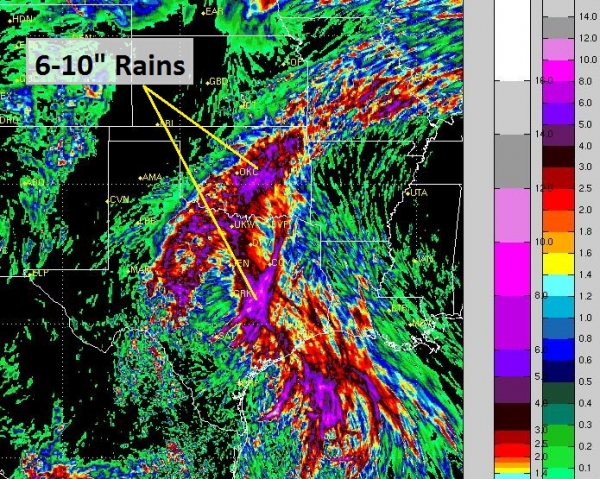
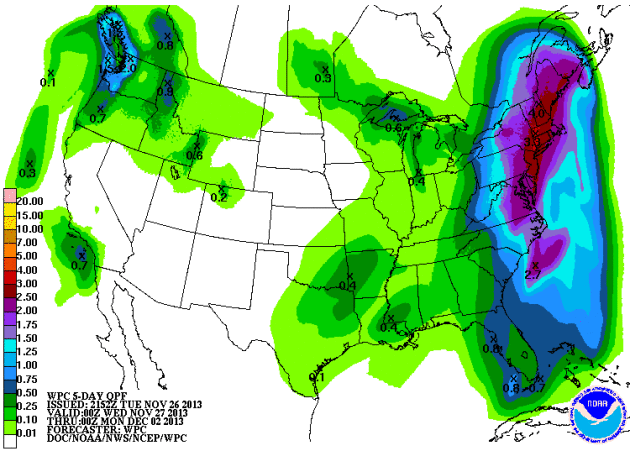
A Burst of Torrential Rain. Most eastern cities will experience a 6-10 hour period of moderate to heavy rain - as much as 2-4" from near Charlotte to Washington D.C., New York, Hartford and Boston, triggering urban and small stream flooding (and excruciatingly slow commutes and travel times) later today into Wednesday morning. Map: NOAA.

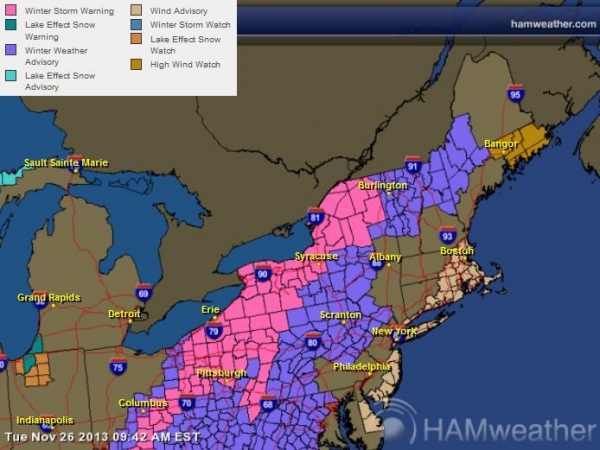
More Warnings. The heaviest swath of snow comes from south and east of Columbus to Pittsburgh, Erie, Buffalo, Rochester and Syracuse, where Winter Storm Warnings are in effect. Winds along the Atlantic coastline will gust into the 25-40 mph range tonight and early Wednesday. The latest warnings from NOAA and Ham Weather are here.

Typhoon Lehar. Just when you thought typhoon season might be finally drawing to a close, along comes "Lehar". A moderate typhoon with sustained winds of 95, gusts over 110 mph, Lehar may strengthen slightly before weakening as it approaches Vijayawada, India by Thursday as a strong tropical storm or Category 1 hurricane/typhoon.

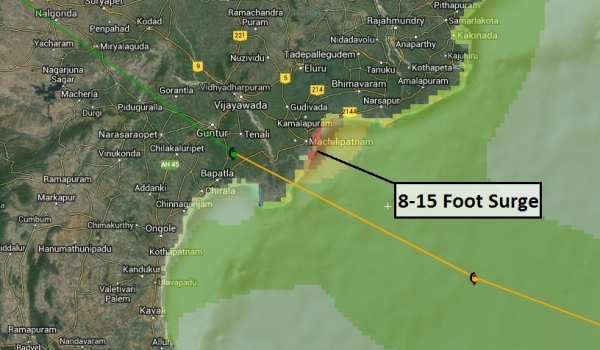
Significant Storm Surge Potential. Our models show a risk of a 5-15 foot storm surge east of Vijayawada, near Machilipatnum as the center of the storm pushes ashore Thursday, which seems high for a (predicted) Category 1 typhoon at landfall. We'll keep an eye on storm surge predictions, which proved to be the biggest killer from Typhoon Haiyan (death toll in the Philippines is now over 5,000). One lesson from Haiyan: locals react to the word "tsunami" - they can grasp the potential for destruction. The term "storm surge" was not well understood or appreciated in the Philippines, leading to confusion and a higher death toll as people remained in their homes, close to sea level.

Summary: A major storm is now pushing out of the Gulf of Mexico, tracking right up the East Coast Wednesday. This will be a (heavy) rain event for most of the east coast, with heavy, wet snow over the Appalachians, some accumulating snow as far west as Lexington, Kentucky and Columbus, Ohio. The arc of heaviest snow tracks from western Pennsylvania into upstate New York, with some 10-18" amounts possible near Syracuse and Rochester. For the major east coast city centers this will be a heavy rain event, and travel plans/commutes will be disrupted over the next 36 hours. Lousy timing, but I'm reminded of this uncanny fact: storms (given a choice) prefer to come right before major holidays.

Paul Douglas - Senior Meteorologist - Alerts Broadcaster

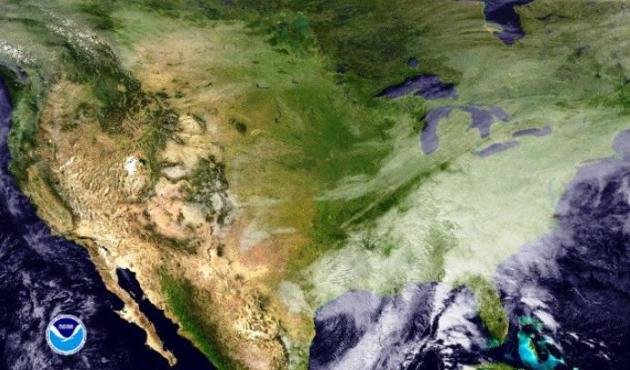
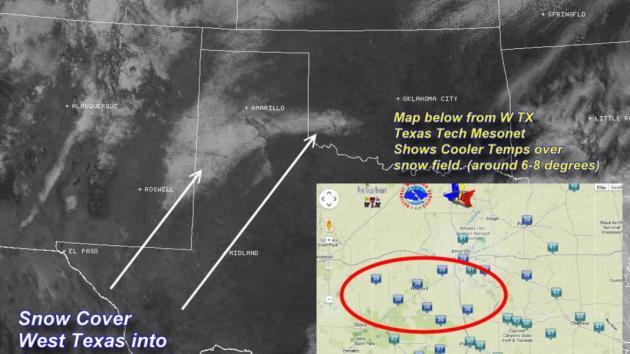
Ski Texas. Tuesday's visible satellite image clearly showed freshly fallen snow over the Texas Panhandle, extending into southwestern Oklahoma. Image courtesy of the Lubbock office of the National Weather Service.


Least Active Atlantic Hurricane Season In 30 Years. Meteorologist Andrew Freedman has a good summary of a head-scratcher of a hurricane season at Climate Central; here's an excerpt: "Defying dire outlooks issued in the spring, the 2013 Atlantic hurricane season, which officially ends Nov. 30, was the least active since 1982, and the sixth-least-active season since 1950, the National Oceanic and Atmospheric Administration (NOAA) said on Monday. There were no landfalling hurricanes in the U.S. in 2013. In fact, it has been more than 8 years since the last major hurricane of Category 3 intensity or greater struck the U.S., a record stretch. The last major hurricane strike occurred in 2005, when Hurricane Wilma hit Florida. When the start of the 2014 Atlantic hurricane season rolls around on June 1, 2014, it will have been 3,142 days since that storm made landfall, a record timespan..."

Graphic credit above: "Map of 2013 tropical storm and hurricane tracks." Credit: Wikimedia Commons.

The Pioneers Of Seasonal Hurricane Forecasting Might Stop Doing It. They insist it has nothing to do with this year's poor track record, as reported by SFGate.com; here's a clip: "...Many seasonal forecasters predicted that overall activity — measured in terms of the number of storms, their intensity and their duration, would be as much as twice as high as average levels. Instead activity was only about 30 percent of typical levels, or one of the five quietest years in the last half century of Atlantic hurricane seasons. Now comes word that the dean of seasonal forecasting, William Gray and his co-author Phil Klotzbach, of Colorado State University, may be ending their forecasts. It has nothing to do with their poor forecast this year, they say..." (Image credit: NASA).

Before And After The Tornadoes In Illinois. ESRI has an interactive URL that shows the severity of damage in Washington Illinois, after an EF-4 tornado bull-dozed its way across the center of town on November 17.

The Silent Triumph: Weather Warnings Saved Hundreds Of Lives In Midwest Tornado Outbreak. 106 tornado reports on November 17, some as far north as Michigan - unprecedented in their violence and how late in the season they formed this far north. Here's a clip from Capital Weather Gang, a quote from meteorologist Mike Smith that resonated: "...
The lower death toll from this week’s storms was not inevitable; it is the result of a half-century of scientific discovery and technological development: Doppler radar, weather satellites, lightning detection networks and smartphone apps. It is a result of volunteer storm chasers instantly reporting the most violent tornado (the Washington, Ill., storm) when it first touched down near Pekin.
No other nation enjoys the quality and breadth of meteorological services available in the United States. It is an area in which federal dollars are put to valuable use and leveraged through the efforts of private-sector weather companies such as AccuWeather, and by meteorologists and emergency managers.
File photo above: AP Photo/Charles Rex Arbogast.

Special Report: Storming The Field. Fans sitting in a stadium are sitting ducks when it comes to weather, especially extreme weather. New technologies, apps and alerts can help, but it pays to be continually weather-aware. Don't depend on anyone else for your safety, or the safety of your family. Here's an excerpt of a story at WTVM.com in Columbus, Georgia: "...It could be dangerous, but where are you supposed to go?" asked former Auburn kicker Al Del Greco. Tornadoes can happen anywhere, even at football stadiums. The good news is that tornado safety has changed since 1983. Just this season, the South Carolina/North Carolina game was delayed and the stadium was evacuated after a severe storm with lightning moved in during the second half. Colleges and universities now have rules in place, and it starts with the suspension of play. "If we left the game playing, nobody's going to leave. They're not going to take it serious. They're going to sit there and keep watching as long as it's playing," explains Chance Corbett, the Auburn director of public safety..."

Stock Returns Affected By Weather, Says Study. Say what? Valuewalk.com has a story that made me do a triple-take; here's an excerpt: "The Quant Research Team at www.empiritrage.com has drawn attention to a recent study by William Goetzmann, Dasol Kim, Alok Kumar and Qin Wang which shows that weather-based indicators of mood impact perceptions of mispricing and trading decisions of institutional investors. According to Empiritrage analyst William N. Goetzmann, “It is interesting because it points out that weather may affect highly educated investors, and that it would be interesting to see how the temperature (as opposed to cloudiness) affects stock returns...”

Researchers Track Outdoor Air Temperatures By Measuring The Battery Temperatures Of Smartphones. Here's an innovative way to track hyper-local changes in air temperature, as described in this clip from Inside Science: "...On the other hand, Georgescu's ASU colleague David Hondula, who was not involved in this study, wants to use smartphones to track the heat exposure of individuals. "If your phone is tracking your weather conditions, you might have a personalized alert that you have experienced excessive heat as you've moved through your daily life," said Hondula. When informed of their heat exposure, people can take steps to protect their health, and thus reduce heat-related mortality. In Hondula's words, "There's certainly the potential for many important questions to be answered, if everyone's walking around with a potential environmental monitor in their pocket."

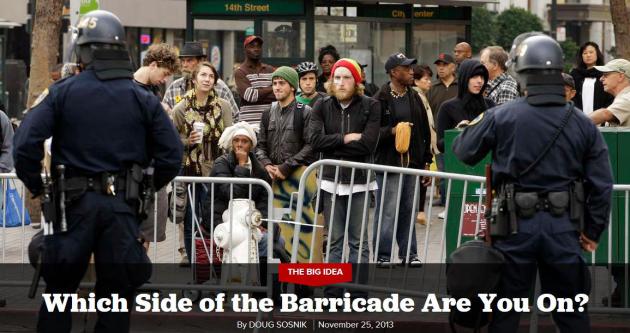
Which Side Of The Barricade Are You On? Is the American Dream still achievable, or is the game rigged, gamed, only to favor a small percentage of the elite? Here's an excerpt of an interesting read at Politico: "...At the core of Americans’ anger and alienation is the belief that the American Dream is no longer attainable. Previous generations held fast to the promise that anyone who worked hard and played by the rules could get ahead, regardless of their circumstances. But increasingly, Americans have concluded that the rules aren’t fair and that the system has been rigged to concentrate power and wealth in the hands of a privileged few at the expense of the many. And now the government is simply not working for anyone. Americans’ long-brewing discontent shows clear signs of reaching a boiling point. And when it happens, the country will judge its politicians through a new filter—one that asks, “Which side of the barricade are you on?..."

Only 25% Of Yahoo's Employees Use Yahoo Mail? Yes, there's a little disconnect here, as described by Kara Swisher at All Things Digital: "As most know, I love a good internal memo from inside Yahoo and here’s a doozy related to a rather controversial topic of late: How badly the new version of Yahoo Mail has been received by consumers. As has been widely reported, a relentless and vocal group of Yahoo Mail users have been complaining vociferously after the Silicon Valley Internet giant drastically revamped its popular Mail service in October. The ire includes a lot of distress over the removal of its tabs function and the addition of a multi-tasking feature in its place..."

Climate Stories...

Research Suggests Future Global Warming Has Been Underestimated. UPI has the article - here's a clip: "Global warming could go on for centuries even with a complete stop of CO2 emissions and then stabilize at an even higher temperature, a Swiss scientist says. Researcher Thomas Frolicher says computer models contradict the assumption by many scientists that global warming would come to an end if, some day, humans succeed in ending the release of greenhouse gas emissions into the atmosphere. Frolicher and U.S. colleagues report they've used a model that represents physical and biogeochemical processes -- such as the exchange of greenhouse gases and heat with the oceans -- at a far more detailed level than many previous models..."

What 11 Billion People Mean For Water Scarcity. Yahoo News has the story - here's the introduction: "The water woes plaguing the Southwest foreshadow a worldwide problem to come. Already, 2.7 billion people globally face at least some water scarcity, according to a 2012 study detailed in the journal PLOS ONE. Fights over water rights are causing political conflicts and instability in such places as the Nile valley and the Indian subcontinent. As population sizes rise, those conflicts will get more intense, according to a report by the National Intelligence Council, which advises the director of national intelligence for the United States about national security issues. And the latest population models predict that 11 billion people will live on Earth by 2100, according to a United Nations report released last summer..."

On Campuses, A Fossil Fuels Divestment Movement. The Washington Post has the story - here's the introduction: "A divestment movement is marching across U.S. college campuses, borrowing tactics from the 1980s anti-apartheid campaign and using them against oil, gas and coal companies to fight climate change. Students are teaming with investment advisers to convince universities, pension funds and institutional investors that they can take a stand against fossil-fuel companies without hurting their returns. “We have a government that has been taken over by the fossil-fuel industry, so we’re going to pressure the fossil-fuel industry itself,” said Chloe Maxmin, a junior leading Divest Harvard..." (Image: Clean Technica).

Global Warming Threatens Pacific Economies, Report Says. Here's an excerpt from Real Time Economics at The Wall Street Journal: "...Rising temperatures might sound nice for people planning a beach vacation. But for Pacific Island nations, global warming poses a big threat to their ability to capture tourist dollars, according to the Asian Development Bank. In a report Tuesday, the Manila-based lender says sun-baked tropical nations from Samoa to the Cook Islands that rely on tourism income could become less attractive destinations as global temperatures rise..."

Photo credit above: Reuter. "A wall built to protect people from rising tides in the Pacific island nation of Kiribati."
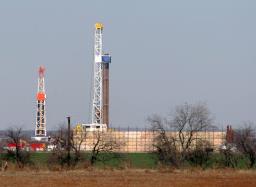
U.S. Methane Study Says Emissions 50% Higher Than EPA Estimates. Here's an excerpt from a story by the AP and Huffington Post: "The United States is spewing 50 percent more methane — a potent heat-trapping gas — than the federal government estimates, a new comprehensive scientific study says. Much of it is coming from just three states: Texas, Oklahoma and Kansas. That means methane may be a bigger global warming issue than thought, scientists say. Methane is 21 times more potent at trapping heat than carbon dioxide, the most abundant global warming gas, although it doesn't stay in the air as long. Much of that extra methane, also called natural gas, seems to be coming from livestock, including manure, belches, and flatulence, as well as leaks from refining and drilling for oil and gas, the study says. It was published Monday in the Proceedings of the National Academy of Science..."