Saturday, February 23, 2013

February 24: Another 12-16" Central Plains (stormy pattern south/east next 2 weeks)


A "Tough Winter"?

Winters have been trending milder, to the point where a (nearly average) winter feels like punishment from a vindictive Old Man Winter.

"Paul, are you going to write about this tough winter we're having?" a friend asked last week. Huh?
Which got me thinking. Has it been that bad?

MSP has picked up 35.5 inches of snow. During an average winter we should be up to 40 inches by now. 9 subzero nights; average for an entire winter is 22.5. Based on NWS Heating Degree Days we've saved roughly 5 percent heating our homes & businesses since last fall. A tough winter? No, not really.

A reality check, compared to last year's Memphis-like winter. In spite of climate change we'll still experience cold fronts and occasional snows. If it ever gets to the point where it never snows (at all) we'll be past the point of no return.

Quiet weather prevails this week, with a minor league thaw and a major rain/wind storm tracking well east of Minnesota. Low to mid 30s give way to 20s by late week, but no more polar (subzero) air is in sight.

March 2013 won't bring 70s & 80s, like last year.

But the Spring Parade of Homes kicks off next weekend. Birds are chirping again!

It won't be long now.

New Snow By Tuesday Night. The NAM model prints out another snowy drubbing for Kansas, as much as 15-18", maybe another foot for Kansas City. Omaha may pick up 4-6", with 3-4" for Chicago, maybe 2-3" for the Detroit area. Boston picks up 1-2" later today, much heavier amounts northinto Maine.

 
Storm-Free Next 7-10 Days. The latest ECMWF (European) model keeps any significant storms well south of Minnesota, highs at or above freezing into Thursday, then cooler weather by late week.


Spring 2013 Climate Outlook. Here's an excerpt of an interesting post (and some great visuals) from the Grand Forks office of the National Weather Service: "A change in the weather pattern brings an increased spring snow-melt flood risk and the hope to alleviate drought conditions for the growing season. Since October 2013 temperatures across the Red River Valley have generally averaged close to normal. The warmest temperatuers have been across the central portions of the basin with the coldest across the Upper Devils Lake Basin and along the International Broder region of north central Minnesota. Departures generally range from 1 degree below to 1 degree above the median..."

Despite Lingering Drought, USDA Predicts A Flood Of Grain. NPR has the story - here's a snippet: "Economists at the U.S. Department of Agriculture, gazing into their crystal ball, see American farmers planting and harvesting huge amounts of corn, soybeans, and wheat this year. They're predicting a record harvest of corn: 14 billion bushels, up nearly 40 percent over last year's drought-crippled level. With supply up, prices will fall. The USDA thinks that the price of the average bushel of corn could fall by a third. And soybean production and price are expected to follow a similar track..."

Photo credit above: "John Honeywell uses a grain drill to plant winter wheat near Orlando, Okla., on Sept. 12, 2012. "Sue Ogrocki/AP Photo

Thin Snowpack In West Signals Summer of Drought. Here's an excerpt from The New York Times (subscription may be necessary to read full text): "After enduring last summer’s destructive drought, farmers, ranchers and officials across the parched Western states had hoped that plentiful winter snows would replenish the ground and refill their rivers, breaking the grip of one of the worst dry spells in American history. No such luck. Lakes are half full and mountain snows are thin, omens of another summer of drought and wildfire. Complicating matters, many of the worst-hit states have even less water on hand than a year ago, raising the specter of shortages and rationing that could inflict another year of losses on struggling farms..." (USA snow cover map above courtesy of NOAA).

February 23, 2012 Snow Cover. I was struck by the difference from last year at this time, when only 23% of the USA had any snow on the ground (vs. 56% now). The lack of snowcover was one factor in record March warmth and thousands of record highs. We'll see a warming trend next month, but I doubt we'll see anything equivalent to 2012, when flowers were blooming in Minnesota by late March. Just a hunch.

Earth's Average Temperature For January Ties As 9th Warmest On Record: NOAA. Details from Huffington Post: "The globally-averaged temperature for January 2013 tied with 1995 as the ninth-warmest January since record keeping began in 1880, according to a news release today from the National Oceanic and Atmospheric Administration. The combined average January temperature over global land and ocean surfaces was 54.57 degrees Fahrenheit, or 12.54 degrees Celsius. This January marked the 37th consecutive January and also the 335th consecutive month with a global temperature above the 20th Century average, NOAA reported..."

Louisiana May See The Fastest Rising Seas In The World. Here's an excerpt from Grist: "As Hurricane Katrina approached, many Americans for the first time learned about New Orleans’ precarious, below-sea-level orientation. The city is described as “bowl-like,” rimmed by levees and natural structures that might not hold back surging storm water — and might make drying out nearly impossible. It turned out that the analogy was imperfect. New Orleans is more like a TV dinner tray, and only the Ninth Ward ended up flooded....From The Lens: Stunning new data not yet publicly released shows Louisiana losing its battle with rising seas much more quickly than even the most pessimistic studies have predicted to date. …Southeast Louisiana — with an average elevation just three feet above sea level — has long been considered one of the landscapes most threatened by global warming. That’s because the delta it’s built on — starved of river sediment and sliced by canals — is sinking at the same time that oceans are rising. The combination of those two forces is called relative sea-level rise, and its impact can be dramatic...."

32 Reasons Why Minnesota Has The Greatest State Fair In The Country. Hey, it's not just me waving the flag; this comes from buzzfeed.com. I just happen to agree (that's chicken fried bacon above - comes with a cardiologist).


* photo above courtesy of Tim Wright.


Climate Stories...

"Climate Change Lowering Great Lakes Water Level". Here's a snippet of a story at Mlive.com that caught my eye: "...One thing I hear is, ‘This is all caused by drought,’” Gauthier told a room of about 40 people. “Don’t let people tell you this is caused by drought. We are in climate change. “There’s no politics here.” He said the lake’s current condition represented “a whole different paradigm.” “The last time the water was this low for this long was the Dust Bowl,” Gauthier said of the 1930s-era ecological event. He talked about the consequences of the low lake levels. Those include freighters which carry lighter loads, the reduction in hydraulic water power at sites such as Niagara Falls, impacts on the fishing industry, decreased recreational boating and collapsing seawalls..."

Study: Gas Taxes Are Six Times As Effective As Stricter Fuel-Economy Standards. Here's an excerpt of an article at The Washington Post: "What’s the best way to curtail gasoline consumption? Economists tend to agree on the answer here: Higher gas taxes at the pump are more effective than stricter fuel-economy standards for cars and trucks. Much more effective, in fact. A new paper from researchers at MIT’s Global Change program finds that higher gas taxes are “at least six to fourteen times” more cost-effective than stricter fuel-economy standards at reducing gasoline consumption. Why is that? One of the study’s co-authors, Valerie Karplus, offers a basic breakdown here: Fuel-economy standards work slowly, as manufacturers start selling more efficient vehicles, and people retire their older cars and trucks. That turnover takes time. By contrast, a higher gas tax kicks in immediately, giving people incentives to drive less, carpool more, and buy more fuel-efficient vehicles as soon as possible..."

Friday, February 22, 2013

February 23: Looking Ahead to 2013


A Reluctant Spring?

Last March was a gift, but most years Minnesotans earn their spring. This will be one of those years. We'll see 32 F next week, but it won't get warm enough, fast enough, to trigger a sudden snowy meltdown. We'll have snow on the ground into early March, chilling the air from below, limiting how mild it can get.

I've gone on record with my (reckless) 2013 outlook: gradual easing of the drought over Minnesota, but more severe storms and tornadoes. This summer should be warmer and stickier than normal, but not the steamy record-setter 2012 was.

Southern Minnesota has seen 3 separate 1 in 1,000 year floods since 2004. I expect more jaw-dropping "Black Swan" USA weather events in 2013 due to more heat and energy in the system; hopefully not another Sandy.

But expect the unexpected.

No dramatic warm fronts are brewing anytime soon, any snow next Tuesday will be light and slushy - most roads wet - a vague hint of spring to come. With Gulf moisture on the increase, and no rapid temperature spikes, I suspect we'll pick up at least another 10 inches of snow, on top of the 35" that's already fallen.

A 45 inch winter? That's happened only a third of the winters since 2000; only once since 2005. Nice to see it can still snow!

Friday Snowfall. According to National Weather Service reports most of the metro did pick anywhere from 2-5", generally more on the south/east side of the Twin Cities. Around 5" was reported at Lakeville and Apple Valley, 4.5" at White Bear Lake. Many close-in suburbs saw less than 3" or so, still enough to shovel, plow and turn some streets into skating rinks.

WInter Snowfall Records. Keep in mind official snow (and rain) records were kept at the Chanhassen NWS between 2000 and 2004, but looking back at the least 13 years we've only had 4 winters with more than 45" of snow. The new 30 year rolling average (1981-2010) is 54.4". At the rate we're going I wouldn't be at all surprised for us to see at least 45" for much of the metro area this winter. 125 years of Twin Cities snowfall records here, courtesy of the Minnesota Climatology Working Group.

March: Slightly Milder and Wetter. The CPC (NOAA's Climate Prediction Center) outlook for March is above, showing an eventual thaw, a wetter than average moisture bulls-eye over the Upper Midwest and Great Lakes.

Spring Preview. CPC is predicting a warmer than normal spring for much of the United States; wetter from MSP to Detroit and Chicago, but drier for the Deep South, Florida and most of the western USA.

Summer Guess-Cast. Continuing a recent trend, CPC shows another baking summer for most of the USA, although I still suspect it won't be quite as hot as last summer. I just can't imagine 2 years like that, back to back. A dry bias is likely over the Southern Plains and Pacific Northwest. Place your bets.


More Snow = Slightly Elevated Flood Risk for Red River Valley? Here's an excerpt from Mark Seeley in his weekly Weathertalk Newsletter: "NOAA's National Hydrologic Remote Sensing Center reports that over western portions of Minnesota the snow pack water content varies from 2 to 5 inches as of February 20, 2013. These water contents are relatively high as the moisture content of January and February snows has been more than normal. The higher water contents in the southern end of the Red River Valley are of concern for spring flood forecasting. You can follow the week to week assessments of snow cover and snow water content using their web site at http://www.nohrsc.nws.gov/"

..."The CPC also sees good chances for some continued alleviation of drought across our state through the end of May. The hydrologic features (lake levels and stream flows) will benefit from above normal precipitation whether it comes as rain or snow. The soil will not benefit much until it thaws out later in the spring. Right now soil frost depths still range from 20-40 inches deep in many areas and will take some time to thaw out..."


Chilly Into First Week of March. The NAEFS experimental long range temperature forecast (first week of March) shows a warming trend across much of Canada, but cooler than average temperatures from the Midwest to Florida. No early spring this year.

Check On That "Gently Used" Car. I would be very careful about buying a used car these days - especially one that originated on the east coast. Here's an excerpt from The Daily News: "Nearly four months after Hurricane Sandy, the total number of cars damaged in the storm has now past the 250,000 mark, according to preliminary numbers released by the National Insurance Crime Bureau. The NICB’s numbers are based on Sandy-related claims made to its member insurance companies. NICB member companies make up 88 percent of auto insurance available in the United States..."
 

Photo: funnychill.com.


Climate Stories...

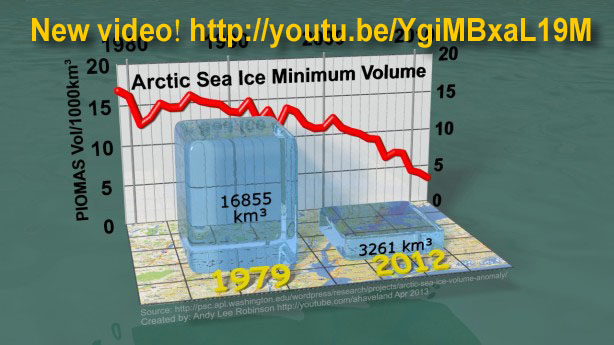
Arctic Sea Ice Volume Now One Fifth Its 1979 Level. For 30 years professional (in many cases paid) climate deniers have squawked about "alarmists and hype". When it comes to ice volume in the Arctic the changes are happening faster than even the most aggressive climate models predicted. Here's an excerpt from Jeff Master's Wunderblog: "...With two years of data to Cryosat-2 data to analyze, the results of the PIOMAS model have now been confirmed by a study published on-line in February 2013 in Geophysical Research Letters. In a University of Washington news release, co-author Axel Schweiger said, "people had argued that 75 to 80 percent ice volume loss was too aggressive. What this new paper shows is that our ice loss estimates may have been too conservative, and that the recent decline is possibly more rapid." The U.K.'s Natural Environmental Research Council reported that the team of scientists found that from 2003 to 2012, the volume of Arctic sea ice declined 36% in the autumn and 9% in the winter. The measure of sea ice volume is a good indicator of how the Arctic's most stable, "multi-year" ice is fairing. As the multi-year ice declines, sea ice extent, the total area covered by sea ice, in an "Arctic death spiral".

Graphic credit above: "Arctic sea ice volume in thousands of cubic kilometers during the September minimum in 1979 compared to 2012, as estimated by the University of Washington PIOMAS model. Arctic seas ice volume has declined by more than a factor of five. Image credit; Andy Lee Robinson."


Poll: Climate Change A Top Concern For Latinos. This caught my eye, and in Fox News Latino, no less. Maybe someone at Fox News Latino will communicate this headline to the Fox Mothership. Wait, aren't Republicans trying to court Latinos? But many continue to deny that climate change is even a problem. My head hurts. Here's an excerpt: "...The poll showed 74 percent of Latinos -- 1,218 were polled -- believe climate change is a very serious problem. This number is almost 10 percent higher than the national average among all American adults. “What was surprising was that once again Latinos have higher support for taking action against global warming,” said Quintero..."

Kerry Comes Out Swinging On Climate Change. Here's an excerpt of a story at The Hill: "...Kerry again signaled that he hopes to use his role as top diplomat to promote green energy technologies, arguing they can provide a major boost to U.S. industries in the “next great revolution in our marketplace.” He also cited the prospect of new markets for “America’s second-to-none innovators and entrepreneurs.” “We need to commit ourselves to doing the smart thing and the right thing and to truly take on this challenge, because if we don’t rise to meet it, then rising temperatures and rising sea levels will surely lead to rising costs down the road. Ask any insurance company,” he said..."

Solutions For Climate Change Aren't Either/Or. Here's the conclusion of an Op-Ed at billmoyers.com: "...President Obama’s decision on Keystone XL is at the top of our list because it’s the most immediate decision he can make to fight climate disruption. The reason why Americans want to stop tar sands is because they recognize something that short-sighted critics seem to have overlooked: The president cannot be serious about fighting climate disruption and approve the Keystone XL tar sands pipeline. This pipeline would open the floodgates for one of the filthiest fuel sources in the world. It would pump some of the filthiest, most carbon-intensive fuels through our country and onto the world market. President Obama can’t have it both ways."

Photo credit above: "Thousands of protestors gather at the National Mall in Washington calling on President Barack Obama to reject the Keystone XL oil pipeline from Canada, as well as act to limit carbon pollution from power plants and '€move beyond'€ coal and natural gas, Sunday, Feb. 17, 2013." (AP Photo/Manuel Balce Ceneta).

Unlocking The Conspiracy Mindset. You just can't make this stuff up. Here's a snippet of a story from Justin Gillis at The New York Times: "...The strongest finding in the survey was that ideological belief in an unregulated free market tended to be a predictor of someone’s willingness to reject the findings of mainstream climate research. No great surprise there. It was the secondary findings that set off a brouhaha. Dr. Lewandowsky’s survey results suggested that people who rejected climate science were more likely than other respondents to reject other scientific or official findings and buy into assorted fringe theories: that NASA faked the moon landing, that the Central Intelligence Agency killed Martin Luther King Jr., that the AIDS virus was unleashed by the government, and so forth..."

USDA On Climate Change: Adaptation For Agriculture, Forests. Here's a segment of a story at The Energy Collective: "Crop production may shift along with changing temperature and precipitation patterns, but that doesn’t lessen the likely disruption to lives, livelihoods and communities in agricultural, forest and other areas where local economies across the country depend on natural resources, or to residents of urban areas ultimately dependent on the water, food, fiber and materials ecosystems provide. For example, the annual cost of weed control in the U.S. total more than $11 billion, according to the report. That’s expected to increase with rising temperatures and carbon dioxide concentrations, which will add to rising food costs. Similarly, rising temperatures and changing precipitation patterns will also have impacts on livestock production. “Heat stress for any specific type of livestock can damage performance, production, and fertility, limiting the production of meat, milk, or eggs..."

Thursday, February 21, 2013

February 22: Plowable Friday for Midwest (significant Chicago flight delays likely)


Storm Inflation

When I got to KARE-11 (then WTCN) a "big winter storm" meant 6-12 inches. My first winter, '83-84, a record 98.6" fell. I remember having a "what have I gotten myself into?" moment. Since then our winter snows have become more erratic; milder temperatures (especially at night) leading to more melting. No guarantees of snow cover all winter long. More midwinter rain/ice. In short, it's now hit or miss.

In this fickle winter environment an inch or two has become reason to lead the news; today's 2-4 inches becomes a "storm".

We had a word for days like this back in the early 80s.
"Flurries".

Another big contributing factor: traffic, which has nearly doubled in 30 years. It takes less snow/ice to cripple your commute. This morning's powdery snow, falling at 20-23 F, may compress into a smear of slush, which will quickly refreeze into glaze ice.

It could be worse: 8" for Chicago, maybe 16" at Kansas City. We're just getting a taste.
After a quiet weekend we thaw out a little next week; Tuesday's storm probably tracks east of Minnesota. No more subzero lows are in sight into early March.

This evening on TPT "Almanac" I talk about 2013: easing drought, but more severe storms.
On Edge. As the map above makes clear, the brunt of the moisture and energy with today's storm is sliding just south/east of MSP; we'll still pick up 2-4", mabe 5" for Northfield and Red Wing, 6" for Rochester and Eau Claire, with 8-10" for Des Moines. Expect delays at Chicago Midway and O'Hare with some 6-7" snowfall amounts.
Second Biggest Snowstorm On Record At Wichita. From Capital Climate: "The latest National Weather Service storm total report from Wichita, Kansas indicates that the 14.2" so far is the second biggest snowstorm since records began in 1888. According to the latest hourly report, snow has now ended. Elsewhere in Kansas, unofficial reports were as high as 18"..."

Photo credit above: "Jason Rushford and Anna Balthazor make a snow creature in Wichita, Kan., Thursday, Feb. 21, 2013. Kansas was the epicenter of a winter storm, with parts of the state buried under 14 inches of powdery snow, but winter storm warnings stretched from eastern Colorado through Illinois." (AP Photo/The Wichita Eagle, Mike Hutmacher).
Kansas City "Rush Hour". Details: "Northbound I-29 near I-635 in Kansas City Missouri was littered with stuck vehicles after the Kansas City area was pounded with rapidly accumulating snow, Thursday, February 21, 2013." (Keith Myers/ Kansas City Star/MCT).

Chilly Into First Week of March. The NAEFS experimental long range temperature forecast (first week of March) shows a warming trend across much of Canada, but cooler than average temperatures from the Midwest to Florida. No early spring this year.
Check On That "Gently Used" Car. I would be very careful about buying a used car these days - especially one that originated on the east coast. Here's an excerpt from The Daily News: "Nearly four months after Hurricane Sandy, the total number of cars damaged in the storm has now past the 250,000 mark, according to preliminary numbers released by the National Insurance Crime Bureau. The NICB’s numbers are based on Sandy-related claims made to its member insurance companies. NICB member companies make up 88 percent of auto insurance available in the United States..."


4 Stages of Life. Not sure who to credit, but this one hit a nerve. I'm up to Stage 3, btw.

This Is A Test. Thanks to failblog.org for this not-so-gentle reminder to never let your guard down. Ever.


Climate Stories...

Arctic Sea Ice Volume Now One Fifth Its 1979 Level. For 30 years professional (in many cases paid) climate deniers have squawked about "alarmists and hype". When it comes to ice volume in the Arctic the changes are happening faster than even the most aggressive climate models predicted. Here's an excerpt from Jeff Master's Wunderblog: "...With two years of data to Cryosat-2 data to analyze, the results of the PIOMAS model have now been confirmed by a study published on-line in February 2013 in Geophysical Research Letters. In a University of Washington news release, co-author Axel Schweiger said, "people had argued that 75 to 80 percent ice volume loss was too aggressive. What this new paper shows is that our ice loss estimates may have been too conservative, and that the recent decline is possibly more rapid." The U.K.'s Natural Environmental Research Council reported that the team of scientists found that from 2003 to 2012, the volume of Arctic sea ice declined 36% in the autumn and 9% in the winter. The measure of sea ice volume is a good indicator of how the Arctic's most stable, "multi-year" ice is fairing. As the multi-year ice declines, sea ice extent, the total area covered by sea ice, in an "Arctic death spiral".

Graphic credit above: "Arctic sea ice volume in thousands of cubic kilometers during the September minimum in 1979 compared to 2012, as estimated by the University of Washington PIOMAS model. Arctic seas ice volume has declined by more than a factor of five. Image credit; Andy Lee Robinson."


Poll: Climate Change A Top Concern For Latinos. This caught my eye, and in Fox News Latino, no less. Maybe someone at Fox News Latino will communicate this headline to the Fox Mothership. Wait, aren't Republicans trying to court Latinos? But many continue to deny that climate change is even a problem. My head hurts. Here's an excerpt: "...The poll showed 74 percent of Latinos -- 1,218 were polled -- believe climate change is a very serious problem. This number is almost 10 percent higher than the national average among all American adults. “What was surprising was that once again Latinos have higher support for taking action against global warming,” said Quintero..."

Kerry Comes Out Swinging On Climate Change. Here's an excerpt of a story at The Hill: "...Kerry again signaled that he hopes to use his role as top diplomat to promote green energy technologies, arguing they can provide a major boost to U.S. industries in the “next great revolution in our marketplace.” He also cited the prospect of new markets for “America’s second-to-none innovators and entrepreneurs.” “We need to commit ourselves to doing the smart thing and the right thing and to truly take on this challenge, because if we don’t rise to meet it, then rising temperatures and rising sea levels will surely lead to rising costs down the road. Ask any insurance company,” he said..."

Solutions For Climate Change Aren't Either/Or. Here's the conclusion of an Op-Ed at billmoyers.com: "...President Obama’s decision on Keystone XL is at the top of our list because it’s the most immediate decision he can make to fight climate disruption. The reason why Americans want to stop tar sands is because they recognize something that short-sighted critics seem to have overlooked: The president cannot be serious about fighting climate disruption and approve the Keystone XL tar sands pipeline. This pipeline would open the floodgates for one of the filthiest fuel sources in the world. It would pump some of the filthiest, most carbon-intensive fuels through our country and onto the world market. President Obama can’t have it both ways."

Photo credit above: "Thousands of protestors gather at the National Mall in Washington calling on President Barack Obama to reject the Keystone XL oil pipeline from Canada, as well as act to limit carbon pollution from power plants and '€move beyond'€ coal and natural gas, Sunday, Feb. 17, 2013." (AP Photo/Manuel Balce Ceneta).

Unlocking The Conspiracy Mindset. You just can't make this stuff up. Here's a snippet of a story from Justin Gillis at The New York Times: "...The strongest finding in the survey was that ideological belief in an unregulated free market tended to be a predictor of someone’s willingness to reject the findings of mainstream climate research. No great surprise there. It was the secondary findings that set off a brouhaha. Dr. Lewandowsky’s survey results suggested that people who rejected climate science were more likely than other respondents to reject other scientific or official findings and buy into assorted fringe theories: that NASA faked the moon landing, that the Central Intelligence Agency killed Martin Luther King Jr., that the AIDS virus was unleashed by the government, and so forth..."

USDA On Climate Change: Adaptation For Agriculture, Forests. Here's a segment of a story at The Energy Collective: "Crop production may shift along with changing temperature and precipitation patterns, but that doesn’t lessen the likely disruption to lives, livelihoods and communities in agricultural, forest and other areas where local economies across the country depend on natural resources, or to residents of urban areas ultimately dependent on the water, food, fiber and materials ecosystems provide. For example, the annual cost of weed control in the U.S. total more than $11 billion, according to the report. That’s expected to increase with rising temperatures and carbon dioxide concentrations, which will add to rising food costs. Similarly, rising temperatures and changing precipitation patterns will also have impacts on livestock production. “Heat stress for any specific type of livestock can damage performance, production, and fertility, limiting the production of meat, milk, or eggs..."

Wednesday, February 20, 2013

February 21: 12-18" Central Plains (few inches Twin Cities to Chicago)


Potentially Plowable

"Paul, where should I turn: local TV meteorologists, computer models, or plowing companies, who seem to have some of the best information?" All of the above.

Take all the snowfall predictions and divide by 2. That will be closer to reality.

Beware of models; they're only as good as the physics involved, and the quality of weather data feeding these simulations. The art is knowing which model to believe, and when. I've discovered (the hard way) that it's better to be conservative with snowfall predictions. Because Mother Nature always finds a new and creative way to trip you up.

Travel won't be a problem today; a surge of snow pushes in from the south late tonight. Rush hour tomorrow may be anything but with some 2-5 inch amounts possible (over 6" parts of southern MN).
As I've mentioned in the past - the air temperature during a storm is as important as "how many inches?" I expect 20-25 F tomorrow, a colder snow. Wheel tracking glazing, from traffic compacting snow, may result in glaze ice, especially Friday AM.

The storm next Tuesday doesn't look quite as impressive; a couple inches of slushier snow?

This may be one of the best weekends of winter to get out and PLAY in that snow!

Dueling Models. Here is the GFS solution, courtesy of Ham Weather, showing the heaviest amounts (3-5") over southeastern Minnesota. Some 4-8" snowfall amounts are likely over Iowa, with 15-20" amounts centered on southern Nebraska and Kansas.

NAM: Slightly More Aggressive With Snow Totals. Both ECMWF and NNAM are predicting just over .30" liquid. If the air temperature was 30-32 that would equate into about 3" of slushy snow. With temperatures tomorrow forecast to be in the low to mid 20s, there will be more air between the flakes, a slightly drier, more powdery snowfall, so we could still see 5" from this system, even though most of the moisture and energy will pass south of MSP.

A Tale Of Two Snowfalls. The predicted rain/snow ratio Friday is forecast to be 1:15 to 1:17, meaning 15" of snow for every inch of liquid precipitation. The latest NAM prints out about .37", which equates to 4-5", give or take. The best chance of 4-5" will probably come over the south metro. Another (wetter, slushier) snowfall is possible Tuesday of next week.

Track: A Bit Too Far South/East. A perfect storm track for significant snow at MSP runs from DSM (Des Moines) to La Crosse to EAU (Eau Claire). The predicted track with tomorrow's storm will be about 150 miles to far south east for the heaviest snow bands to set up right over the metro, but I still believe we'll be brushed by a few inches, probably enough to shovel/plow.

Next Week's Storm: Few Inches (Probably Not A Major Storm). Thhe latest ECMWF (European) model pushes the track of the next storm a little too far south/east of MSP (again) for heavy snow. We may pick up a few inches of sloppy, slushy snow, temperatures closer to freezing may keep freeways mostly wet. Too early to tell.

More Blizzards, Yet Less Snow Overall? I know it sounds like a disconnect, but it's the same trend we're seeing during the summer month: storms spaced farther apart, more time in-between rain events, but when it does decide to rain it comes down in buckets, torrents - tropical deluges. According to the Minnesota Climate Office southern Minnesota has experienced 3 separate 1-in-1,000 flash floods just since 2004. I could see one, but three? These trends are now spilling over into winter months, the result of a warmer atmosphere above to hold more water vapor. Basic physics. Here are more climate science details in today's 2.30 WeatherNation Update.

$188 Billion Price Tag From U.S. Severe Weather From 2011 To 2012. Climate Progress and beforeitsnews.com have the story; here's an excerpt: "The United States was subjected to many severe climate-related extreme weather over the past two years. In 2011 there were 14 extreme weather events — floods, drought, storms, and wildfires — that each caused at least $1 billion in damage. There were another 11 such disasters in 2012. Most of these extreme weather events reflect part of the unpaid bill from climate change — a tab that will only grow over time...."
  • 67 percent of U.S. counties and 43 states were affected by “billion-dollar damage” extreme weather events in 2011 and 2012.
  • 1,107 fatalities resulted from these 25 extreme weather events in 2011 and 2012.
  • Up to $188 billion in damage was caused by these severe weather events in 2011 and 2012.
  • $50,346.58 was the average household income in counties declared a disaster due to these weather events—3 percent below the U.S. median household income of $51,914. [2]
  • 356 all-time high temperature records were broken in 2012.
  • 34,008 daily high temperature records were set or tied throughout 2012, compared to just 6,664 daily record lows—a ratio of 5-to-1.
  • 19 states had their warmest year ever in 2012.

Budget Cuts Threaten Weather Forecasts, NOAA Warns. Here's a clip of a story from Climate Central and Huffington Post that made me do a double-take: "Automatic budget cuts set to take effect March 1 could add to the woes of the federal government’s troubled weather satellite programs, jeopardizing future forecasts, a top official said Friday. “It’s not going to be pretty,” outgoing National Oceanic and Atmospheric Administration chief Jane Lubchenco said of the package of across-the-board spending cuts known as “sequestration.” “The sequester has the potential to wreak havoc with so many different things, and satellites loom large within that,” she told reporters at the annual meeting of the American Association for the Advancement of Science. “There’s just so much uncertainty. Nobody knows how long it might last, and it’s very difficult to plan for that...”

Photo credit above: "The VIIRS sensor on the NOAA/NASA Suomi NPP satellite passed over the central eye of Hurricane Sandy on Oct. 25, 2012. Without the satellite data, NOAA’s weather forecasts would become less reliable." Credit: JPSS/NOAA/NASA

Weather Satellites Could Miss The Next Hurricane Sandy. There may be a serious gap in coverage with the POES (polar orbiting) weather satellites; data which is fed into computer models, data which made a tangible difference forecasting major winter storms (and Sandy) during recent years. Here's a portion of a Yahoo Finance article that caught my eye: "...Since the 1970′s, America had two sets of polar-orbiting weather satellites, one operated by the government’s weather researchers, and the other by military. In 1994, it was decided that combining them into one operation would save a lot of money. After 16 years of unsuccessful attempts to do that, the government threw up its hands and decided to split the task, giving the weather agency the late afternoon orbit and the military the early morning, with the mid-day orbit shared with the European space agency. But even these separate plans have been plagued by delays, and the GAO warns that the gap in afternoon coverage by the weather researchers could last from 17 to 53 months. The defense department, meanwhile has decided to launch previously mothballed satellites. which may not have the technology to perform the kinds of observation needed for weather forecasting..."

More Images From The New England Storm. Here's an excerpt of a fascinating story at NASA's Earth Observatory: "Marshall Shepherd, current president of the American Meteorological Society and director of the atmospheric science program at the University of Georgia, tweeted out this annotated version of a Terra MODIS satellite image of the storm aftermath. It seems that the monumental snowfall highlighted some land features of New England, including its longest river, one of the largest manmade reservoirs in the United States (Quabbin), and the scar of a vicious tornado..."

Impact-Based Severe Storm Warnings. NOAA is testing new wording (to get consumers to take action, to actually get up off their couches) in Kansas and Missouri. Here's an excerpt of a story (and video) from WICS-TV: "From now on, severe weather events will include “impact-based” warnings. The idea has been tested in Missouri and Kansas already. The focus is to include statements that indicate how much damage will come with a storm, to give the public a better idea of a storm’s severity. The NWS works with local television and radio stations, as well as emergency management agencies, to disseminate storm information to the public through broadcasts and sirens. Generally, the Logan County Emergency Management Agency uses three factors to determine when they activate their outdoor sirens..."

In America Weather Forecasters Get A Yugo While Climate Modelers Gets A Ferrari. Here's a portion of a post from Eric Berger at The San Francisco Chronicle: "Cliff Mass, a professor of atmospheric sciences at the University of Washington, recently posted some eye-opening graphics about computers used by national forecasters. The post came after a forecast model run by the European forecast center (ECMWF) kicked the tail of the U.S. model (Global Forecast System) in regard to both Hurricane Sandy and the recent blizzard that struck the northeastern United States. In both cases the European model showed a clear severe storm threat to the northeastern United States five days out where the American model did not. “Disappointing,” Mass concludes. If you’re interested, I also recently interviewed one of the top European modelers about some of reasons why they’ve become so successful..."

Researchers Prove Air Pollution Causes Heart Attacks. Forbes has the eye-opening article; here's the intro: "Air pollution causes heart attacks and death. Especially when the pollutants include ozone and particulate matter. And more often in the summer time, when ozone levels are higher. These are the conclusions of researchers at Rice University who studied the 11,677 cases of cardiac arrest logged by emergency services personnel in Houston, Tx. between 2004 and 2011. They found that during periods of peak pollution, the heart attack risk to Houston residents increases as much as 4.6%..." (AP Photo/Mark Lennihan).

* America's 20 Dirtiest Cities? 7 of them are in California. Forbes has the details here.

Inquirer Editorial: Must Storms Have Their Own Names? I'm going to start naming sunny days, just for something to do. Here's an excerpt of an Op-Ed from Philly.com: "The creeping acceptance of a mercenary scheme to name winter storms is not among the most important things in the news, or even the weather. But like an ill wind, it carries an unmistakable whiff of chaos and dissipation. The system for naming hurricanes and tropical storms was developed over decades to facilitate communications about weather patterns that can endanger large swaths of the planet. Storms must reach sustained winds of at least 40 m.p.h. before they earn a name from one of several rotating lists established by an international committee of the U.N. World Meteorological Organization in Geneva. Officials even have a deliberate procedure to retire the names of the most damaging storms once a year..."

"The Master in the Art of Living makes little distinction between his work and his play, his labor and his leisure, his mind and his body, his education, his love, and his religion. He simply pursues his vision of excellence in everything he does, leaving others to determine whether he is at work or at play."


- Zen Wisdom


Climate Stories...

Bill McKibben visted The University of Minnesota last night, talking about climate change's impact on Minnesota, and what will happen if the Keystone XL Pipeline is approved (he was arrested protesting the pipeline last week in Washington D.C.). His all volunteer organization, 350.org, is global in scope, thousands of people concerned about the implications of a warmer, stormier world. He's skiing the Birkie this weekend (in his free time - which he has precious little of these days).

Climate Change Series: Global Warming A Threat To National Security. I know Admiral David Titley of the Navy; he's a friend and a former classmate. He was also a climate skeptic, before seeing the effects of a changing climate in his role at the Navy. Here is an excerpt of an interview at wbur.org: "It’s all about the water. Okay, it’s partly about food and energy, too. But from a national security perspective, climate change is all about the water: where it is or isn’t, how much or how little there is, how quickly it changes from one state (e.g., solid ice to liquid water) to another. Because of the effects of climate change in the Arctic, for the first time in 500 years we’re opening a new ocean to navigation. The last guy who did that was Christopher Columbus. Until 2005, the Arctic Polar ice cap consisted mostly of multi-year ice — ice that had formed two or more years before the date of measurement and was generally 2 to 4 meters (6.6 to 13 feet) thick and much harder to break through than first-year ice. Since 2007, most Arctic ice is now less than a year old and less than one meter thick. Climate scientists now expect that by 2030 much of the Arctic Ocean will be free of ice several months a year, opening it for commercial navigation just as the Baltic Sea is now...."

Photo credit above: "In this Aug. 20, 2009 photo, released by the USGS, the Coast Guard Cutter Healy breaks ice ahead of the Canadian Coast Guard Ship, in the Arctic Ocean. The ship is taking part in a multi-year, multi-agency Arctic survey that will help define the Arctic continental shelf." (Patrick Kelley/AP)

Weather Warning: Study Examines Climate Change As National Security Issue. What does the CIA know that we don't know? Plentty, including the implications of shifting climates and the potential for changes in drought frequency and access to clean water to be a tipping point for minor things like...revolutions, uprisings and civil wars. Here's an excerpt of a very interesting story from The Harvard Gazette: "...One of the recommendations in our report is the need for a serious investment in measurement and observation. It’s really important to keep doing that, otherwise we’re going to be flying blind.” “The bottom line is that our national security depends on our ability to sustain and augment our scientific and technical capacity to monitor unfolding events and forewarn of important changes,” Baker said. “The imminent increase in extreme events will affect water availability, energy use, food distribution, and critical infrastructure — all elements of both domestic and international security.”

We Need Climate CHANGE. CNBC has some interesting numbers in this Op-Ed; here's an excerpt: "...Moreover, the National Academy of Sciences reported in 2010 that 97 percent of 1,372 climate researchers agree that these fundamental changes in our climate are human-caused. By contrast, Republican Senator Rubio's skepticism may be based on a very different set of numbers, such as 146 million. That's the number of dollars spent in recent years by the Virginia-based Donors Trust and Donors Capital Fund to cast doubt on the causes of climate change. This money is more than double the contributions made to similar denial groups by the more widely publicized Koch brothers and seven times the funding provided by ExxonMobil during a similar period. It total, these funds can buy a lot of doubt about the overwhelming scientific consensus and the weather patterns that are changing before our eyes..."

Even Deadly Meteors And Asteroids May Not Unite The Human Race. David Horsey has a cartoon (and message) that resonates in the L.A. Times; here's an excerpt: "...Similarly, many of the same people refuse to accept the settled scientific facts that indicate the changing global climate is bringing more destructive storms, drought and rising seas. They cannot honestly refute the science, so they willfully ignore it. They have a vested interest in the status quo and so choose short-term political and economic gain over the long-term welfare of the human race. It is oh-so-much easier to blame the president, blame a conspiracy of international scientists or talk about God’s wrath than it is to tell the oil and coal companies and the polluting industries that provide large donations at election time that they cannot do business as they have in the past...."

Cartoon credit above: "Russian meteor would not convince science skeptics of anything." (David Horsey / Los Angeles Times / February 18, 2013)

Forecasting Climate With A Chance Of Backlash. My friend, Jim Gandy, is a seasoned TV meteorologist in Columbia, South Carolina, a (very) red state. He's been including regular segments on climate change in his television weathercasts, tying it into the changes South Carolinians are already witnessing all around them. Jim's efforts are featured in this NPR story, where I'm briefly quoted. Here's an excerpt: "When it comes to climate change, Americans place great trust in their local TV weathercaster, which has led climate experts to see huge potential for public education. The only problem? Polls show most weather presenters don't know much about climate science, and many who do are fearful of talking about something so polarizing. In fact, if you have heard a weathercaster speak on climate change, it's likely been to deny it. John Coleman in San Diego and Anthony Watts of Watts Up With That? are among a group of vocal die-hards, cranking out blog posts and videos countering climate science. But even many meteorologists who don't think it's all a hoax still profoundly distrust climate models. "They get reminded each and every day anytime their models don't prove to be correct," says Ed Maibach, who directs the Center for Climate Change Communication at George Mason University, and has carried out several surveys of TV weathercasters. "For them, the whole notion of projecting what the climate will be 30, 50, a hundred years from now, they've got a fairly high degree of skepticism"....

Is It Time For A National Climate Summit? The short answer is yes. Here's an excerpt of a story at The Summit County Citizens Voice: "Citing damage from intense storms like Sandy, more intense and frequent wildfires and prolonged droughts, a coalition of national groups, including the American Meteorological Society and the American Fisheries Society, are calling for a national, science-based climate summit. In a Feb. 8 letter to President Bararck Obama, the groups said the summit “would be designed to identify policies and actions that can be taken by each Federal agency and by state and local governments to address the causes and effects of climate change.” Other groups signing on to the letter include: Society for Conservation Biology, Society for Ecological Restoration, The Wildlife Society and the Ecological Society of America..."

China To Introduce Carbon Tax: Official. Now I've seen everything. Here's a clip from the China's official news agency, Xinhua: "BEIJING, Feb. 19 (Xinhua) -- China will proactively introduce a set of new taxation policies designed to preserve the environment, including a tax on carbon dioxide emissions, according to a senior official with the Ministry of Finance (MOF). The government will collect the environmental protection tax instead of pollutant discharge fees, as well as levy a tax on carbon dioxide emissions, Jia Chen, head of the ministry's tax policy division, wrote in an article published on the MOF's website. It will be the local taxation authority, rather than the environmental protection department, that will collect the taxes..."

Volcanic CO2 Caused Ancient Episodes Of Global Warming. Keep in mind that (today), volcanoes spew greenhouse about the same amount of greenhouse gases, including CO2, as the state of Florida. It wasn't always this way - tens and hundreds of millions of years ago volcanoes were erupting (simultaneously) around the world, pumping enormous amounts of carbon into the atmosphere, leading to dramatic warming. Climate Central has the details; here's a clip: "The main effect of volcanoes in the modern world is to cool the planet by throwing particles of sulfur dioxide high into the stratosphere, where they temporarily block the Sun. In the distant past, however, paleo-climatologists have long believed that volcanic activity was a major cause of global warming. Massive eruptions - far more powerful than anything going on today - can pump large amoounts of heat-trapping carbon dioxide into the air. The problem with that theory is that those events don't last long enough to explain periods of warmer climate that have lasted tens of millions of years..."

Photo credit above: "The new idea is that it's a more sustainted series of eruptions from volcanoes in strategic locations along the edge of continents that cause  these long periods of warmth." Credit: flickr/NASA's Marshall Space Flight Center.